Patterson-Gimlin Bigfoot film is a hoax?

  • Thread starter Thread starter johne1618
  • Start date Start date
I think this can be compared to the way really old UFO photos are treated by believers. The Trent photos are a great example. Believers often treat old photos as "better evidence", claiming that the technology needed to fake them didn't exist back when they were taken. They're right that Photoshop didn't exist and that analog photography had certain limitations when it came to methods of faking photos. But they chose to forget that, at the end of the day, none of this really matters. Faking the Trent photos wouldn't have required Photoshop or any advanced digital technology. All that was needed was a model and some fishing line. And the same goes for the PG film. A gorilla suit and some experimentation with posture and gait are really all that would have been needed, since both the proportions and the way the figure walks are consistent with a human in a costume. But it's the same old argument: "It's an old photo/video, therefore it must be real."
These days AI has replaced photoshop in this type of flawed argument.
 
And if there isn't a large population wouldn't inbreeding become a massive problem?
Also, showing up in all the places they get reported would require a fairly large population"

delme bigfoot.jpg

Source: Saved from the Internet some time ago, if it becomes important I can go track it down.

But the point it, although I often think "Bigfoot, elusive man-ape of the Pacific Northwest," reports come in from pretty much everywhere in the US that there are people. That's a pretty darn big range there, even if ol' BF is pretty uncommon in any area across his range, you'd still need a lot of them just to cover the number of places they're supposedly seen.

And the more of them there are, the more chances for one to get shot by a hunter, or hit by a car, or caught in a trap, or otherwise be definitively shown to exist.

Of course, it could be argued that some of those areas don't have any Bigfeet, just people making erroneous and/or hoax reports. But the more that is true, the more firmly it establishes that there need not be ANY of them in the real world for them to be reported!
 
At the national (US) level, there seems to be a correlation between where Bigfoot is seen and where UFOs are reported:


M4.png


Surely this is significant evidence of some strange Bigfoot-UFO connection!
Waydaminnit:

m3.png


(2nd, 3rd maps from https://nuforc.org/newmap/ and https://www.worldmap1.com/united-states-population-density-map#google_vignette)
Roughly similar maps can be found showing the distribution of other things across the US, including schools, bars, registered drone operators.

To a degree we might expect there to be more Bigfoot reports in areas with higher populations because there are more potential witnesses,
but a strong correlation only makes sense if Bigfoot is relatively evenly distributed across the continental US or is drawn towards human habitation (including major metropolitan areas) in most parts of the nation.

I would guess (haven't checked) that maps of the distribution of sightings of "established" (irrefutably existing) wild animals in the US, say bison (buffalo), wolves, alligators, would not show such a clear correlation with human population density.
 
Are there also a similar maps, from regions outside of the US? I guess (certainly) not.
I have not found any. There might be one based on Canadian sightings as reported to a Canadian clearing house?

Worth noting the the usual UFO sightings map one finds on the Internet shows a strong bias towards places where there are a lot if people per unit of area and English is spoken. This hints that such maps including multiple countries and based on reports of sightings may reveal more about the linguistic range of the map compiler than about how widespread reports are. Example: a UFO map compiled by an English speaker who did not know the terms used for UFO in Spanish and other languages (eg: OVNI) will miss a lot of reports from Central or South America, among other places...
 
If it existed, hunters would find tracks, droppings, fur, and dead animals.
No technology needed—the animal does not exist.
I think so too. Remains would have been found in American caves, over time; even if bones from individuals who had succumbed to predators. Homo floresiensis remains were found in caves
 
  • Like
Reactions: RTM
If it existed, hunters would find tracks, droppings, fur, and dead animals.
No technology needed—the animal does not exist.
Yeah, but I guess it comes down to two different perspectives on the whole Bigfoot thing. On one side, we have the people who believe Bigfoot is a real animal, some kind of primate or primitive human actually living in the forest. And on the other side, we have the people who believe it's some kind of interdimensional entity, perhaps a space alien or, why not, a demon of the forest.

It's easy to dismiss the first hypothesis based on the logic you've presented. Obviously, a breeding population would leave some sort of evidence behind. And I guess that's why the second type of claim has emerged among believers in the paranormal. All arguments about the lack of traces left behind by this large-footed primate in the forest can immediately be dismissed, since an interdimensional being "wouldn't leave such traces behind."

But as always, it's (often) impossible to prove a negative. Making up a space-traveling primate à la Chewbacca and then asking people to debunk its existence is kinda ridiculous, just like asking someone to debunk unicorns or leprechauns.
 
Yeah, but I guess it comes down to two different perspectives on the whole Bigfoot thing. On one side, we have the people who believe Bigfoot is a real animal, some kind of primate or primitive human actually living in the forest. And on the other side, we have the people who believe it's some kind of interdimensional entity, perhaps a space alien or, why not, a demon of the forest.

It's easy to dismiss the first hypothesis based on the logic you've presented. Obviously, a breeding population would leave some sort of evidence behind. And I guess that's why the second type of claim has emerged among believers in the paranormal. All arguments about the lack of traces left behind by this large-footed primate in the forest can immediately be dismissed, since an interdimensional being "wouldn't leave such traces behind."

Well, inventing ad-hoc excuses is the usual way to prop up untenable theories, and when the excuses border the unfalsifiable (inter-dimensional beings, demons...) they're even better! What the proponents of this approach forget is that for any added hypothesis one must factor in the probability of that hypothesis being true... which (to be very, very charitable) I'd put in one in one trillion for physical interdimensional beings and one in one trillion trillions for supernatural ones. Thus this kind of theories is even easier to dismiss than the good ol' Ape of the Wood.
 
some kind of interdimensional entity

At some point between Kaluza Klein and M Theory- this seems to have become the prevailing explanation for..... pretty much anything people want to waive hands at.

Some of the Alt Propulsion theories invoke higher dimensions but at least have demonstrated scientific reasoning for doing so - ET and Bigfoot are just out there invoking none 3+1 realities because.
 
Thus this kind of theories is even easier to dismiss than the good ol' Ape of the Wood.
True. Or at least they're not even worth spending time debunking. It's not about evidence; it's all about faith. According to Hitchens's razor, we can simply dismiss such claims without spending time explaining why. No one has ever presented any evidence that holds up to scrutiny and gives us a reason to believe an interdimensional super-ape is lurking in the woods. Therefore, we have no reason to believe such a creature exists, let alone spend time debunking such silly claims. When it comes to the flesh-and-blood Bigfoot, on the other hand, I think it's more relevant to debunk the whole story using arguments like the ones presented by @Mendel.
 
I had never really taken a close look at the 1967 PG film before. Sure, I'd seen it numerous times, but I'd never bothered to properly analyze what I was looking at. (Frankly, I've never been that interested in Bigfoot.) As a result, my interpretation of the footage had largely been shaped by what others claimed to see in it. However, after watching Capturing Bigfoot, I decided to take a closer look at it myself. And one thing quickly became apparent: much of what has been said about the footage, by believers and skeptics alike, seems to be based on assumptions and good old-fashioned pareidolia. Even the new high-resolution scan of the original film reveals surprisingly little detail. All the talk about muscles moving beneath the thick fur, not to mention the endless speculation about moving toes and thumbs, can probably simply be dismissed without much further consideration. No real need of any high tech suite there.

But then there are certain claims frequently made by believers that skeptics often take seriously enough to try to disprove. One of the most common is that the creature's arms are "unusually long", with proportions that supposedly don't match those of a human. But when I watch the film, I simply don't see any unusually long arms. So where does this claim actually come from?! Skeptics have often suggested that the arms could have been artificially extended using sticks concealed inside the sleeves, or perhaps gloves with elongated fingers. Personally, though, I'm not convinced there's anything unusual about the arm length that needs explaining in the first place. What I see when looking at that blurry, furry silhouette are proportions that seem perfectly consistent with those of a human in a padded suit.
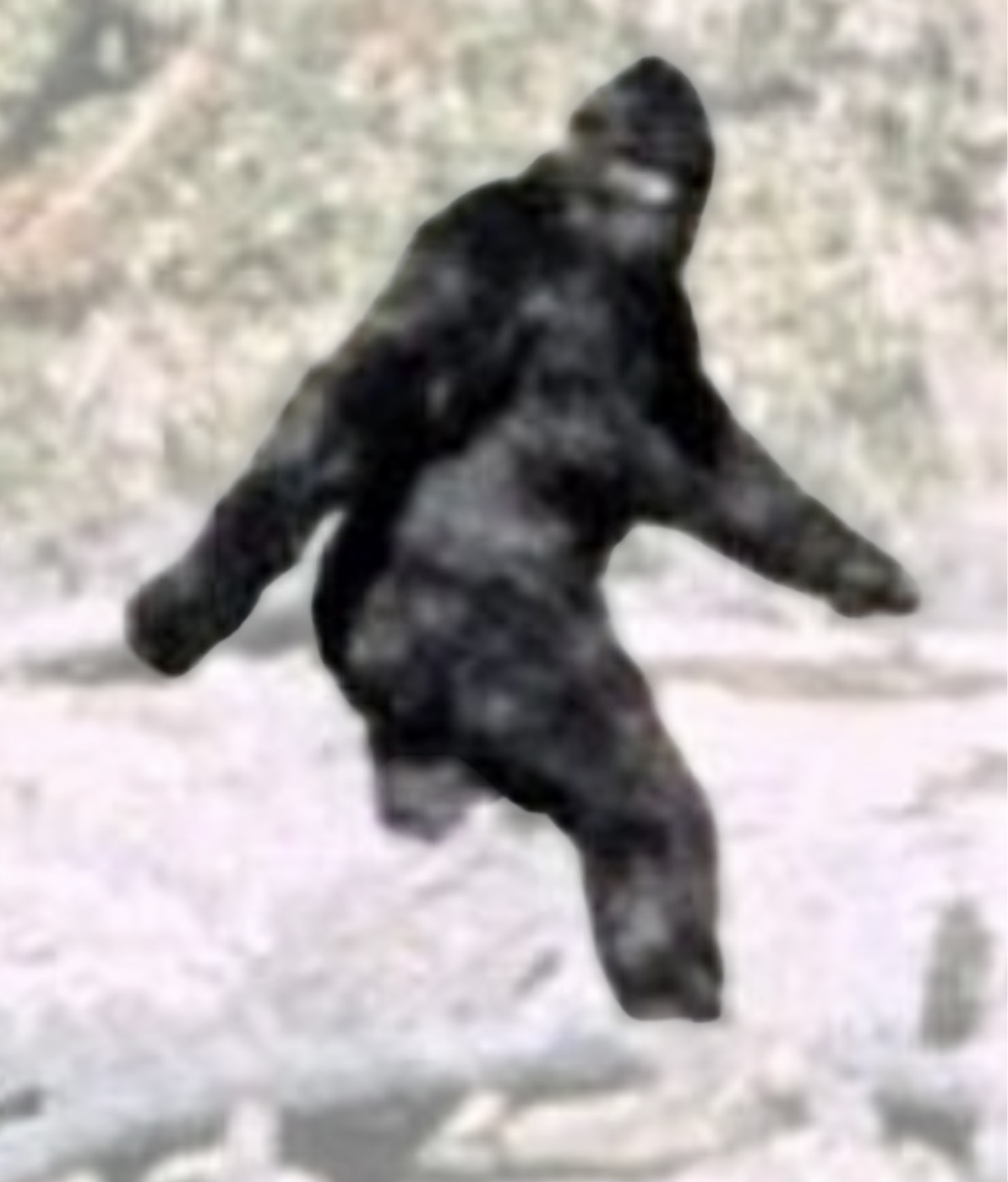
IMG_5996.jpeg


In the still image above, I've lightened the background to make the creature's proportions easier to distinguish. The arms appear to reach almost to the knees, with the legs slightly bent. That's pretty much exactly where my own hands end up when I stand in a similar pose. Of course, it's entirely possible that the costume had some sort of oversized ape hands, slightly larger than those of a human. Looking at photographs of gorilla suits from the mid-20th century, relatively large hands seem to have been a common feature. The image below, for example, is from the 1951 film Bride of the Gorilla.

IMG_5998.jpeg


And then there's the famous walk. It's sometimes claimed that the creature in the PG film walks in a way that would be impossible for a human to replicate. But once again, I find myself questioning whether there's anything here that actually needs debunking, because I simply don't see what others claim to see. In the clip below, we can watch the section of the film where the "creature" is closest to the camera, with both legs clearly visible and unobstructed.


And to me, it looks remarkably similar to an ordinary man strolling through the woods. The knees aren't even bent all that much. In fact, I'm not entirely convinced that the posture suggests an actor deliberately trying to imitate some sort of crouching, ape-like walk. The slightly bent legs could just as easily be explained by the costume being rather heavy and cumbersome, making it difficult to navigate the uneven terrain, especially with limited visibility through a mask.

Which brings me to my main point. I don't think attempts to debunk the Patterson–Gimlin film should focus on explaining away pareidolia and unsupported claims. If someone insists that the creature's arms are too long to belong to a human, the appropriate response shouldn't necessarily be to explain how a costume could have been constructed with artificially elongated arms. Instead, the claim itself should be challenged. Where is the evidence that the arms are unusually long in the first place?

The same goes for the supposedly impossible walk. Before trying to demonstrate how a human could reproduce it, shouldn't we first establish that there's actually something unusual about it? The burden of proof should rest with those claiming that the creature has non-human proportions or moves in a way no human possibly could. Such extraordinary claims require actual evidence, not simply interpretations of a blurry silhouette.

Patterson was certainly a clever man, and I suspect he understood just how poor the image quality needed to be to prevent viewers from identifying details that might give away the costume. Consequently, it's virtually impossible to conclusively debunk the film through an analysis of the footage alone. But the reverse is equally important: I have yet to see a single detail in the film that is genuinely inconsistent with a man wearing an ape suit. And if there's nothing in the footage that actually requires an extraordinary explanation, perhaps there's not much worth debunking in the first place. Trying to explain away supposedly elongated limbs and an allegedly impossible walk only plays into the hands of believers.

I have one question, though: what do you make of the newly discovered clip presented in Capturing Bigfoot? I'm thinking mainly of when it might have been shot. The film itself was produced in 1966, but that doesn't necessarily mean it was shot that year. At first glance, the vegetation seems to indicate that it was filmed in the fall, with lots of yellow and red leaves:
IMG_6030.jpeg

However, the problem is that the entire film seems to have a reddish color cast. Just look at the rider's face, or the blurry mess at the beginning of the film, when the camera is shaking:
IMG_6033.jpeg

If the film was shot in the fall, I would say the fall of 1966 is the best guess, with the fall of 1967 also being a possibility. The former is a bit problematic, since we have no indication that Patterson had access to a camera back then, let alone that he was filming staged Bigfoot footage. The latter, on the other hand, is also somewhat questionable, since it would suggest that the newly discovered footage was shot almost simultaneously with the famous Bluff Creek clip.

Which leaves us with a third option: that the footage was part of the mockumentary-style movie Patterson was trying to shoot in the Ahtanum Creek area in the summer of 1967. Personally, this seems like the most plausible explanation to me, if it weren't for the autumn-looking landscape. But what do you think? Could the red and yellow colors in the surrounding vegetation possibly be explained by dried-out vegetation combined with a reddish color cast in the film?

This was a long post, but it's basically all of my thoughts on the whole PG debacle.

 

Attachments

  • IMG_6028.png
    IMG_6028.png
    550.6 KB · Views: 1
And one thing quickly became apparent: much of what has been said about the footage, by believers and skeptics alike, seems to be based on assumptions and good old-fashioned pareidolia.
Indeed, When discussing the film online with BFBs (Big Foot Believers) I've often tried to "soften" my presentation by admitting that things that I see when looking at the film (most notably the saggy-britches effect in the sitting down area!) may not really be there, but may just be my brain interpreting the very poor quality video that we all have to look at in a fashion consistent with what I think I am seeing, a man in a suit.

I say this because, first of all, it is true, that may be why I see a saggy britches costume and they don't, and it is fair for me to admit that. But I also hope that, if they can grasp that I might be seeing things that are as much in my mind as in the video, they might be more open to the idea that THEY may also be doing this when they see rippling muscles and impossibly long arms.

It is also worth pointing out what the video shows of the face:
delme.jpg

It drives home just how poor the imagery is. Mask or actual 'squatch, either way, how many nostrils does it have? Probably two, but you can't see that in the imagery. Does it have ears? Can't see if it does or not. And too bad about that terrible injury that put out an eye... oh, you can't see it? OK, neither can I, we can't see the eyes at all, in fact.

Similarly looking at the hands, it probably has fingers, but you can't see them.

All of which is moot now, the evidence that it was hoaxed has become pretty conclusive. But a lot of claims were made about subtle details in footage that was, after all, providing very poor resolution.
 
Back
Top