
You are using an out of date browser. It may not display this or other websites correctly.
You should upgrade or use an alternative browser.
You should upgrade or use an alternative browser.
While I can't guarantee The Bigfoot Society is the authoritative scientific body for Bigfoot, it does have 317k followers and 6k members. They released a statement:
External Quote:OFFICIAL BIGFOOT SOCIETY STATEMENT
After watching Capturing Bigfoot and considering the evidence presented, my official position is that the 1967 Patterson–Gimlin film from Bluff Creek was a hoax.
I believe that one million percent, and I'll gladly say it publicly.
Holy mackerel. What a time to be involved in the Bigfoot community.
I also believe that Bob Hieronimus and Greg Long deserve apologies from those who have unfairly ridiculed, attacked, or mistreated them over the years.
I understand why people are emotional right now. Some have spent decades studying, defending, and building friendships around this film. That's a tremendous amount of personal investment, and I respect the emotions involved.
I encourage everyone to watch the documentary, examine the evidence, and come to their own conclusions.
As for Bigfoot Society, I'm ready to move forward.
The number one mission of Bigfoot Society has always been giving witnesses a safe environment to share their experiences and get something off their chest that they may have been carrying for decades.
I've interviewed over 1,000 witnesses. Many have never shared their experiences publicly. Some have spent 30, 40, or even 50 years wondering what they saw, afraid of ridicule, or simply wishing they had someone willing to listen.
Those people deserve to be heard.
They deserve respect, compassion, and a place where they can tell their stories without fear of being mocked or judged.
That is why I do this.
I believe there are people having extraordinary experiences in the wilderness that deserve serious attention. I want to continue documenting those accounts, investigating the areas where these encounters occur, and working toward answers, discovery, and ultimately conservation.
My belief in the importance of those witnesses remains as strong as ever.
I know there will be disagreements about this documentary and the future of the Patterson–Gimlin film. That's okay. Everyone has the right to examine the evidence and reach their own conclusions.
As for me, I'm ready for the next chapter.
There are witnesses waiting to share their stories. There are experiences that need to be preserved. There are places that deserve investigation.
That's where my time and energy belong.
The mission of Bigfoot Society continues.
It's time to MOVE FORWARD.
— Bigfoot Society

John J.
Senior Member.
External Quote:
Bigfoot Society
15 hours ago
OFFICIAL BIGFOOT SOCIETY STATEMENT
After watching Capturing Bigfoot and considering the evidence presented, my official position is that the 1967 Patterson–Gimlin film from Bluff Creek was a hoax.
Whoever the Bigfoot Society is/ are, and whatever their ongoing views about Bigfoot, I'm quite impressed they've made this statement.
It might have been hard for them, and they probably know it will make some supporters unhappy.
Drawing conclusions that are different to what might be wanted or expected in light of new evidence can be tough, but it's an important step in understanding the facts about a subject.

MonkeeSage
Senior Member.
My main takeaways (going from memory).Spill the tea! (That's how the young folks say "please provide the details" lol)
The personal/anecdotal stuff:
- Clint Patterson (Roger's son) had come to believe the original PGF was a hoax based on circumstantial evidence (apart from the new film, e.g., his father making something out of fur coats in a locked shed, and later burning what appeared to be a costume) and he wanted to come clean about it.
- Clint had become estranged and disowned by his mother Patricia because she was still receiving royalties and didn't want him to reveal the hoax.
- Clint reconciles with his mother and she agrees to finally reveal the hoax.
- Bob Heironimus continues to maintain he is the person in a costume in the PGF, but says it wasn't him in the newly released film.
- Bob Gimlin never received any money from PGF though he was supposed to receive 1/3 (instead, Roger and his brother in law Al DeAtley split all the money between themselves and it caused a falling out with Bob, through he reconciled with Roger before Roger died), but he has found celebrity and a sense of belonging and acceptance in the Bigfoot community and has been doing conference appearances for the last decade.
- Patricia says it was Al DeAtley in the costume in the newly released film and he was the one who marketed and distributed the PGF.
- Clint and Bob Heironimus view the new film and see it as vindication. Bob Gimlin is shown it and he asks who the guy on the horse is and then is quiet.
- Clint, Patricia, and Bob (Heironimus) approach Bob Gimlin at a Bigfoot conference and say they are coming clean about it all being a hoax and ask him to join them, he says okay and seems to agree. However at this point he is quite old and many not have fully grasped the situation. A text overlay after the scene says he and his wife still maintain the PGF is real.
The newly released film:
- Shows someone on a horse at the start, which looks like Bob Gimlin and his horse, then pans through trees to see a "Bigfoot" that looks very similar to Patty in the PGF, walking away from the camera and looking back over the right shoulder.
- Provenance and provenience are not firmly established. Film came from the brother of a friend Roger met while printing his earlier Bigfoot books and was allegedly locked in his safe since it was developed.
- A film expert examined the film and found a date code of 1966. He noted that doesn't mean it was exposed that year, but the lack of fogging and sharp contrast make him believe it was exposed soon after manufacture.
- Jeff Meldrum (famed BF researcher and collector of plaster footprint casts) viewed the new film and was visibly shaken. In the end he says even if the PGF was a hoax it doesn't mean BF is not out there.
- Bill Munns (former practical FX artist and famed PGF defender) examined the film and also says the film stock is authentic and was definitely shot on the same type of camera Roger used (I don't think he says it in the documentary but from what I have seen people saying he believes it was a later attempt to recreate the PGF by people other than Patterson and Gimlin).
- Larry Lund (BF researcher and former associate of Rene DaHinden) viewed the new film and now thinks PGF was a hoax.
My thoughts:
I would like to see the provenance and provenience of the new film more thoroughly addressed/established. Some correspondence between Roger and the brothers who ended up with the new film for example (not necessarily about the particular film, but at least establishing that he was in contact with them). On the claims from the people involved, it's essentially the word of Patricia Patterson and Bob Heironimus against Bob Gimlin. Gimlin appears to have a reason to maintain PGF is real, while it's harder to see what motive Patricia might have to disparage Roger's name and legacy and lose income by admitting it was a fake.
I think people who already lean towards hoax will see this as more supporting evidence. Just the established fact that there is a film from the time period that shows a similarly detailed costume already negates the old claim that a costume like that could not be created at the time, and I think that is a strong point regardless of anything else. People who really want to believe will probably not be convinced.
Last edited:
The newly discovered clip is often referred to as a "rehearsal", but to me, it looks more like a scene from the mockumentary-style Bigfoot movie Patterson was working on. The movie that never came to be. I don't remember the exact details, but wasn't he working on it around May or June 1967? If so, this clip could have been shot around that time. The stereotypical cowboy character (Gimlin?) comes across as a bad actor in a spaghetti western.
And yeah, this really should be the final nail in the coffin for the whole story. I have no doubt that believers will keep arguing that there are issues with the clip's provenance, that we don't know exactly when it was filmed, and that the ape doesn't look quite identical to the one in the October 1967 video. But none of that really matters. At the end of the day, the new clip proves that it was indeed possible to stage a reasonably convincing-looking video of a furry creature strolling off into the distance. But I'm sure some people will keep imagining muscle movements and facial features in that blurry silhouette. Well, let's give the creature the scientific name Magnipes hieronymus.
And yeah, this really should be the final nail in the coffin for the whole story. I have no doubt that believers will keep arguing that there are issues with the clip's provenance, that we don't know exactly when it was filmed, and that the ape doesn't look quite identical to the one in the October 1967 video. But none of that really matters. At the end of the day, the new clip proves that it was indeed possible to stage a reasonably convincing-looking video of a furry creature strolling off into the distance. But I'm sure some people will keep imagining muscle movements and facial features in that blurry silhouette. Well, let's give the creature the scientific name Magnipes hieronymus.
Oh that's actually a much wider scope than I expected. I thought it was just the new footage. That's some good tea! I'm going to watch it for sureMy main takeaways (going from memory).
MonkeeSage
Senior Member.
I don't recall them discussing Philip Morris or the origin of the costume at all. I was kind of surprised. But it's already almost two hours long and was mostly focused on personal interviews for the first 2/3 and the new film for the last 1/3, so maybe it didn't fit the flow or they didn't have time to get into it.I won't have a chance to watch it for a bit -- but I'd love to know does it confirm the suit's origin from Morris Costumes in Charlotte, NC, at all? They're down the street from where I live.

JMartJr
Senior Member.
Or of course it is possible that Morris was wrong.I don't recall them discussing Philip Morris or the origin of the costume at all. I was kind of surprised. But it's already almost two hours long and was mostly focused on personal interviews for the first 2/3 and the new film for the last 1/3, so maybe it didn't fit the flow or they didn't have time to get into it.
(I've long wondered if they had more than one suit to shoot "test footage," one of which MIGHT have been from Morris, or not, but in any case it would make sense to shoot test footage to see which looked best -- and then there they sat with the bet looking piece of film, and a great opportunity for a PR stunt. That is of course pure speculation, but it might explain why Morris would say he supplied the suit, but to my eye the suit he shared photographs of is not look much like the PG Bigfoot suit. Maybe he DID supply them with one, as did others, and Morris's is not the one in the best bit of film?)

Rex Banner
New Member
I have always had a more fundamental issue with the film regarding the "creature's" behaviour. Namely, it doesn't act like an animal. An animal encountering humans in the wild would do one of three things: flee, stand its ground with an aggressive display or attack. What it would not do is casually saunter away with an occasional insouciant look over its shoulder.
And, furthermore, a human wouldn't do that either. Think about it: you encounter strangers on your property. Do you A) Confront them? B) Warily observe them? Or C) Casually saunter away? I'm guessing it's not C.
The "creature" doesn't behave like a wild animal or a human. It behaves like an actor who's been told to move in a particular way.
That seems like a reasonable idea, but frankly, the suit used in the hoax didn't really need to be all that sophisticated. I'm sure it could've been made from some of the fur coats Clint apparently saw in his father's shed. Distance, blur, and camera movement would have done the trick, hiding all the flaws. Still, I think the suit they used was probably more elaborate than necessary, since Patterson had originally intended to create a Bigfoot costume convincing enough for (close-up?) scenes in his movie. Making a suit that could withstand that kind of scrutiny without making the audience laugh would have been a much greater challenge.If I was planning something like that, I'd get a gorilla suit for research: how is it cut and stitched, how does the actor get in and out, what needs improving? and then design my own suit, but better.
Believers always claim that it was impossible to create a convincing suit back in 1967 (which obviously isn't true). Yet Patterson himself was apparently confident that he could get his hands on a suit good enough to use in a fictional Bigfoot movie. I've seen photos from the movie set, but not a single one shows any kind of ape creature. (The most shocking thing is probably Gimlin wearing a long black wig while playing a Native American tracker.) Perhaps the newly discovered clip is the only surviving footage of the ape costume used during filming? I do believe it's the same suit in this clip as in the famous footage, just with a different person inside it and probably a few alterations to the suit itself. To me, differences in weather conditions, distance, and possibly even the camera used would explain most of the discrepancies. A few modifications to the suit would account for the rest.
JMartJr
Senior Member.
And sometimes, if the budget was low enough, you just had to take your laugh on the chin and move on.Making a suit that could withstand that kind of scrutiny without making the audience laugh would have been a much greater challenge.
Not having a monster suit that could withstand closeups without getting a laugh was not always a barrier to getting your low budget film made and in front of audiences. Judicious use of shadows and darkness, fast cuts, camera motion and smoke could hide a lot... or you could just accept that your monster is what it is, and if an audience laughs then, hey, you get the last laugh because by then you already have their ticket money!

NorCal Dave
Senior Member.
I would like to see the provenance and provenience of the new film more thoroughly addressed/established.
Agreed. My wife said the same thing. I think this is the most glaring flaw in the film. Along with what is covered a bit to quick and from what I remember in reading about the origin of this whole project, it goes something like this:
- Teresa Brooks grew up hearing her father sometimes talk about a Bigfoot film he had, or alternately telling her Bigfoot wasn't real.
- Brooks' father, Norm, worked in the film lab at Boeing in the Seattle area in the '60s.
- After Norm Brooks passed away, Teresa found the film in a safe and brought it to film maker Marq Evens, as they both appeared to be instructors at Olympic collage.
- Brooks and Evens have the film examined and digitized and this starts the project and leads back to Yakima.
- In the film Evens established that Roger Patterson was in contact with Norm Brooks' brother who ran a printing shop. That printing shop helped Patterson produce his Bigfoot book.
- Teresa seems to indicate her father and uncle weren't exactly hustlers, but they would make a buck where they could, so they got hooked up with Patterson.
- It seems Norm Brooks was developing Patterson's film for him, likely at the Boeing lab, and he kept a copy for himself.
Another slight flaw, do to story telling, is that some of Patterson's behavior sorta gets pushed onto DeAtley, allowing Clint to still view his father as a hero, if a somewhat complicated and flawed one. By all accounts I've read, DeAtley was not a nice person and did seem to collect most of the money generated by the film in its heyday. Only when those dwindled, did he turn the rights over to Patrica. Some of DeAtley's interviews from Greg Long's research, that were played in the film, had him clearly not caring about the reality of Bigfoot, just the money that could be made.
However, Long's research and book The Making of Bigfoot, also chronicled Patterson's extensive shady dealings with a lot of people, his running out on debts and multiple collections against him. Long painted Patterson as a straight up hustler who was using Bigfoot for strictly financial gains. Long, and his book, were derided in the Bigfoot community as just a character assassination of dead man.
The film does make clear that Roger Patterson never held a steady job and was often trying to earn money from various schemes. Left out of the film, Patterson made several trips to LA in 1964 and 1966 trying to sell a 'Hoop-toy" invention, trying to raise money for a Bigfoot documentary and trying to sell his miniature horse wagons, which do appear in the film:
https://en.wikipedia.org/wiki/Patterson–Gimlin_filmExternal Quote:
Prior to the October 1967 filming, Patterson apparently visited Los Angeles on these occasions:
Merritt soon moved back to Yakima and became Patterson's neighbor, and later his collaborator on his Bigfoot documentary.[30]
- Patterson drove to Hollywood in 1964 and visited rockabilly songwriter and guitarist Jerry Lee Merritt, a Yakima native who was living in Hollywood then.[25][26] He was trying to sell his hoop-toy invention.[27][28]
- In 1966 he visited Merritt again while he was still trying to sell his hoop-toy invention.[29]
- Later in 1966 he and Merritt drove down there for several purposes. Patterson visited cowboy film star Roy Rogers for help.[31] He tried to sell his ponies-and-wagon to Disneyland or Knott's Berry Farm.[32]
Ultimately, in a somewhat veiled way, the film shows that a hoax like the PGF relies on something said by Bing Crosby in my wife's favorite Holiday movie, White Christmas: "Everybody's got a little larceny in them." Patterson was hustling various ideas to make ends meet, his brother-in-law DeAtely seems willing to do whatever for some money and Teresa Brooks' dad, Norm, was possibly using Boeing time and equipment in a side hustle for Patterson's films.
Never go to dinner with Bigfoot, he's a big eater and when the check comes he'll always say he forgot his wallet in his other suit and that he'll pay you back the next time you find him.Ultimately, in a somewhat veiled way, the film shows that a hoax like the PGF relies on something said by Bing Crosby in my wife's favorite Holiday movie, White Christmas: "Everybody's got a little larceny in them." Patterson was hustling various ideas to make ends meet, his brother-in-law DeAtely seems willing to do whatever for some money and Teresa Brooks' dad, Norm, was possibly using Boeing time and equipment in a side hustle for Patterson's films.
NorCal Dave
Senior Member.
It's interesting to see some of the expected reactions. Matt Moneymaker of the BigFoot Research Organization (BFRO) appear to have hand waved it away as possible AI, when he was first told about the new footage last spring:
He latter wrote a lengthy response on the BFRO Facebook page back in March without seeing the film. I'll link below, but the overarching claim is that Al DeAtley made the film that is at the center of the documentary AFTER the authentic PGF was made:
https://www.facebook.com/groups/BFRO.group
https://en.wikipedia.org/wiki/Capturing_BigfootExternal Quote:Matt Moneymaker of the Bigfoot Field Researchers Organization (BFRO), who, when informed that new footage is to be released showing the Patterson–Gimlin film as a hoax, says, "My initial reaction is, how could you believe that in the age of AI? Even if they found some reel, how would you know whether what they're showing in the documentary is what's on the reel?"[6]
He latter wrote a lengthy response on the BFRO Facebook page back in March without seeing the film. I'll link below, but the overarching claim is that Al DeAtley made the film that is at the center of the documentary AFTER the authentic PGF was made:
The logic, coming mostly from Billy Munns who is in the film, seems to be that the person in the costume is reenacting what Patty did in the original PGF:External Quote:
The "long lost reel" that is being touted at South by Southwest is just a tacky replica of the 1967 Patterson creature made by a man named Al DeAtley, who even the documentarians conclude is the guy in this costume in the lost reel.
External Quote:
What does Bill Munns say now after the finished documentary has been shown to film critics at a film festival? He says the "lost reel" was just a replica of the 1967 PGF, not a trial run for it.
The idea that the person in the PGF is trying to replicate what's in the new film isn't considered.External Quote:Munns describes the clip as someone "made an effort to replicate it [the PGF] as perfectly as possible" after the fact — including Patty's exact gait, foot details, and scene elements — "so he could look at that film and see for himself. If I fake it, can I look at it and tell it's a fake?"
https://www.facebook.com/groups/BFRO.group
I never completely realized how much the lack of a close-up in the PG film has contributed to its longevity, but it's completely crucial. The film is done so well in the sense that you think you're seeing a lot more detail than we actually are. Short duration, shaky, far away. No way for people watching to nitpick things like the eyes obviously being human underneath. Too far for seams. At the same time, our brain makes so many assumptions about what we're seeing especially when we are told what we should be seeing, like the claims about being able to see individual muscles. Even your crappy examples could fool someone if they were captured at a distance. Especially if those ridiculous eyes aren't shown closelyNot having a monster suit that could withstand closeups

Bigfoot Society vs the BigFoot Research Organization. The scientific battle of the new millennium, rivaling the debates over quantum mechanics between Einstein and Born.It's interesting to see some of the expected reactions. Matt Moneymaker of the BigFoot Research Organization (BFRO) appear to have hand waved it away as possible AI, when he was first told about the new footage last spring:
HIS REAL NAME IS MONEYMAKER. Hahahaha I thought that was at least going to be a stage name or a name you made up as a joke, but that's his real name omg LMAOhttps://en.wikipedia.org/wiki/Capturing_BigfootExternal Quote:Matt Moneymaker of the Bigfoot Field Researchers Organization (BFRO), who, when informed that new footage is to be released showing the Patterson–Gimlin film as a hoax, says, "My initial reaction is, how could you believe that in the age of AI? Even if they found some reel, how would you know whether what they're showing in the documentary is what's on the reel?"[6]
MonkeeSage
Senior Member.
Also interesting that in the past, he/BFRO and other groups have promoted photos and videos that look worse or are lower quality than the "creature" in the new film, as being real.It's interesting to see some of the expected reactions. Matt Moneymaker of the BigFoot Research Organization (BFRO) appear to have hand waved it away as possible AI, when he was first told about the new footage last spring:
For example (quoting a now deleted tweet from Moneymaker):
External Quote:Here's photo of real sasquatch in Washington State.
Source: https://washingtonbigfoot.com/2017/07/25/moneymakers-wa-bigfoot-photo/
MonkeeSage
Senior Member.
Here's a comparison of a frame from the new 4k PGF scan and one from the new film (screencap from the documentary) where the 'squatch is in a similar pose:
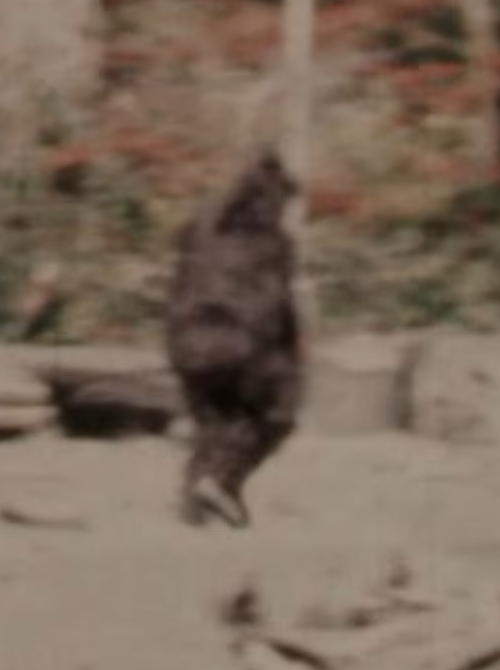
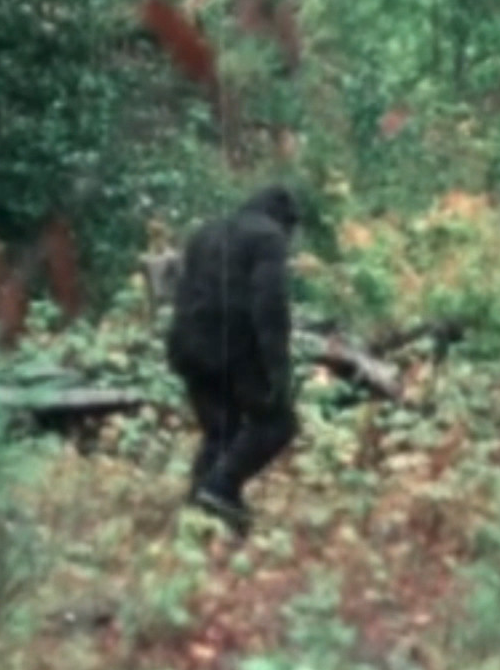
And a video fade between them:
And a video fade between them:
Looks like the same suit to me. Believers in the authenticity of the 1967 film seem to be looking for differences, often based on imagined features. But the truth is that the image quality simply isn't good enough for us to make out any real details, leaving us with only the basic proportions and overall shape to go by.Here's a comparison of a frame from the new 4k PGF scan and one from the new film (screencap from the documentary) where the 'squatch is in a similar pose:
View attachment 93757
View attachment 93758
And a video fade between them:
View attachment 93759
Comparing the two photos you've posted, I see no reason why this couldn't be the same suit, without the need for any extensive alterations. Perhaps the head or face was changed slightly, but to me, the apparent differences could just as easily be explained by differences in posture and lighting conditions.

Bob Jase
Active Member
And sometimes, if the budget was low enough, you just had to take your laugh on the chin and move on.
View attachment 93754
View attachment 93755
Not having a monster suit that could withstand closeups without getting a laugh was not always a barrier to getting your low budget film made and in front of audiences. Judicious use of shadows and darkness, fast cuts, camera motion and smoke could hide a lot... or you could just accept that your monster is what it is, and if an audience laughs then, hey, you get the last laugh because by then you already have their ticket money!
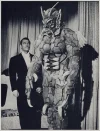
And then there's the She-Creature - and they said who would put boobs on a bigfoot? here's boobs on an amphibian!
Attachments

RTM
Senior Member.
You can see the soles of the feet in the top picture, it reminded me of the video below.
It is from a youtube channel where the hosts are fx artists, they sometimes look at paranormal footage and analyze it etc., in this case they are looking at the PGF.
Just before the two minutes mark they bring up the feet, they claim it looks like boots or footwear. Has this aspect ever ben brought up before?
Link

Todd Feinman
Senior Member
It has been brought up before by others; the whitish soles being explained as big feet with dust from the immediate area.they claim it looks like boots or footwear. Has this aspect ever ben brought up before?
Believers have claimed that footprints demonstrate real feet with toes and an arch. The casts of the footprints were, naturally, provided by Patterson and Gimlin. *Suspicious face* (idk how to communicate without emojis help me)You can see the soles of the feet in the top picture, it reminded me of the video below.
It is from a youtube channel where the hosts are fx artists, they sometimes look at paranormal footage and analyze it etc., in this case they are looking at the PGF.
Just before the two minutes mark they bring up the feet, they claim it looks like boots or footwear. Has this aspect ever ben brought up before?
Link
John J.
Senior Member.
Believers have claimed that footprints demonstrate real feet with toes and an arch. The casts of the footprints were, naturally, provided by Patterson and Gimlin.
Yeah, and if someone knows enough about the indentations made by a foot during walking to raise it as possible evidence, they might know enough to include that knowledge in manufacturing a fake footprint/ cast of a footprint.
And Bigfoot isn't a well-studied creature
 , apart from the Patterson-Gimlin footage and casts we don't have much (claimed) recorded evidence of their ambulation or foot structure (though I get the impression that claimants agree that the feet are big).
In the absence of this knowledge, pretty much any cast of a footprint that doesn't contain other evidence (e.g. hair, testable DNA) might be unfalsifiable. We know how human and anthropoid apes (when they briefly walk bipedally) walk and what their footprints look like, but a Bigfoot is not one of these. It might have a different weight distribution over different parts of the sole/ toes or different foot anatomy which could "explain" any differences from human/ ape footprints. Any similarities might be from the deliberate duplication of features from human/ ape prints/ casts.
I doubt that the Patterson, Gimlin casts are a great step forward in primatology, or even a foot in the door toward acceptance of Bigfoot by naturalists. If there's a breeding population of large non-human hominids across a wide area of North America, we might expect them to leave a far larger footprint (metaphorically speaking).
Last edited:
Todd Feinman
Senior Member
I can't see how there wouldn't be more evidence / encounters if there was a breeding population of unknown hominids in the US. With the fires, etc.If there's a breeding population of large non-human hominids across a wide area of North America, we might expect them to leave a far larger footprint (metaphorically speaking).
I think whatever it is, it exists in the same realm as other really odd cryptids that are reported but also couldn't have hidden breeding populations.
NorCal Dave
Senior Member.
I never completely realized how much the lack of a close-up in the PG film has contributed to its longevity, but it's completely crucial. The film is done so well in the sense that you think you're seeing a lot more detail than we actually are. Short duration, shaky, far away. No way for people watching to nitpick things like the eyes obviously being human underneath. Too far for seams. At the same time, our brain makes so many assumptions about what we're seeing especially when we are told what we should be seeing, like the claims about being able to see individual muscles.
Agreed. I think way back in the early pages of this thread, we brought up the idea that as a hoax, Patterson did it just right, at least with the film. It's almost perfect. The distance is right, the shake is right, there's just enough of everything for the viewer to fill in the details. Again, up thread somewhere is a discussion of the Kodechrome film stock that was used and its level of resolution. While very good for the time, it still had limits, such that things like a zipper or seam in a costume can't be resolved at 80'. The classic shot we usually see, is an exptream crop from the original footage:
RTM
Senior Member.
If there's a breeding population of large non-human hominids across a wide area of North America, we might expect them to leave a far larger footprint (metaphorically speaking).
And if there isn't a large population wouldn't inbreeding become a massive problem?
No, inbreeding wouldn't be a problem... Because they'd be extinctAnd if there isn't a large population wouldn't inbreeding become a massive problem?

Actual answer: I initially thought "100% yes" but I did some due diligence and found some surprising info:
Mountain gorillas could survive for thousands of years at very low population levels due to resistance to the genetic effects of inbreeding
ButExternal Quote:Mountain gorillas could survive for thousands of years at very low population levels of just a few hundred individuals because they appear to be resistant to the genetic effects of inbreeding, a study of gorilla genomes has found.
So it seems like mountain gorillas are quite the exception. So, the answer to your question is still "almost surely" but surprisingly not "surely". Neat!External Quote:"While comparable levels of inbreeding contributed to the extinction of our relatives the Neanderthals, mountain gorillas may be more resilient. There is no reason why they should not flourish for thousands of years to come," Dr Xue said.
The genome comparisons with the more numerous lowland gorilla found that harmful mutations appear to have been largely eliminated within the mountain gorilla's genes, suggesting that they are adapting well to surviving in small populations.
Todd Feinman
Senior Member
They'd be hanging around KOAs trying to get food or beating people up. Waitaminute..
Finally putting the PG film aside is the best thing bigfoot fans could do.
Just as UFO fans endlessly regurgitate old images over and over again trying to find new ways to interpret them, and failing.
Collect new images and videos, where the details of the collection are known. (type of camera, location where collected, etc.)
The drone wars in Ukraine have driven rapid development of drones and imaging systems ideal for surveying large areas to seek out Bigfoot.
Thermal imaging cameras and drones that fly faster than any land animal can run would allow any creature to be observed for more than the few seconds and followed to its lair. Just installing a large number of thermal imaging cameras attached to trees should find Bigfoot, if he/she is there.
But no, we should endlessly squint at this one brief film, right?

Mendel
Senior Member.
If it existed, hunters would find tracks, droppings, fur, and dead animals.Thermal imaging cameras and drones that fly faster than any land animal can run would allow any creature to be observed for more than the few seconds and followed to its lair. Just installing a large number of thermal imaging cameras attached to trees should find Bigfoot, if he/she is there.
No technology needed—the animal does not exist.

Ann K
Senior Member.
But there's no money to be made by putting someone in a raccoon costume...They'd be hanging around KOAs trying to get food or beating people up. Waitaminute..
MonkeeSage
Senior Member.
The producers of Capturing Bigfoot have nicknamed the creature in their film Norma, for Norm Johnson, and they share a frame.
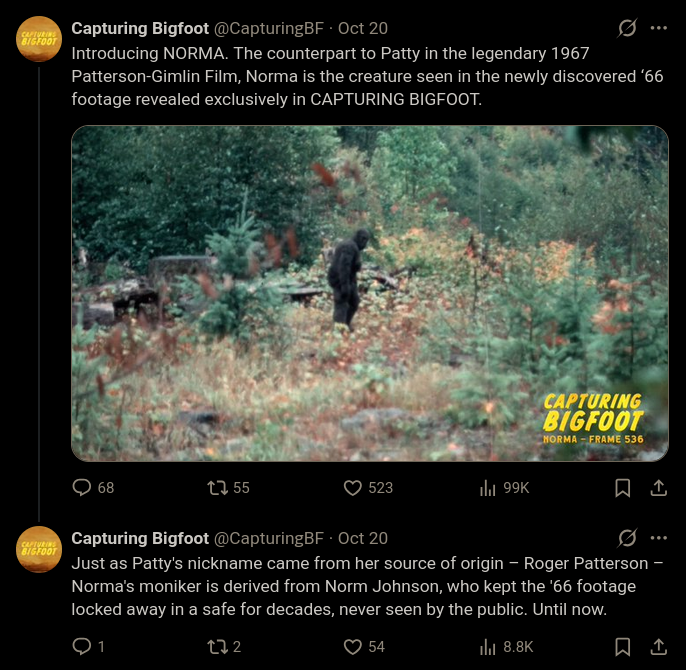
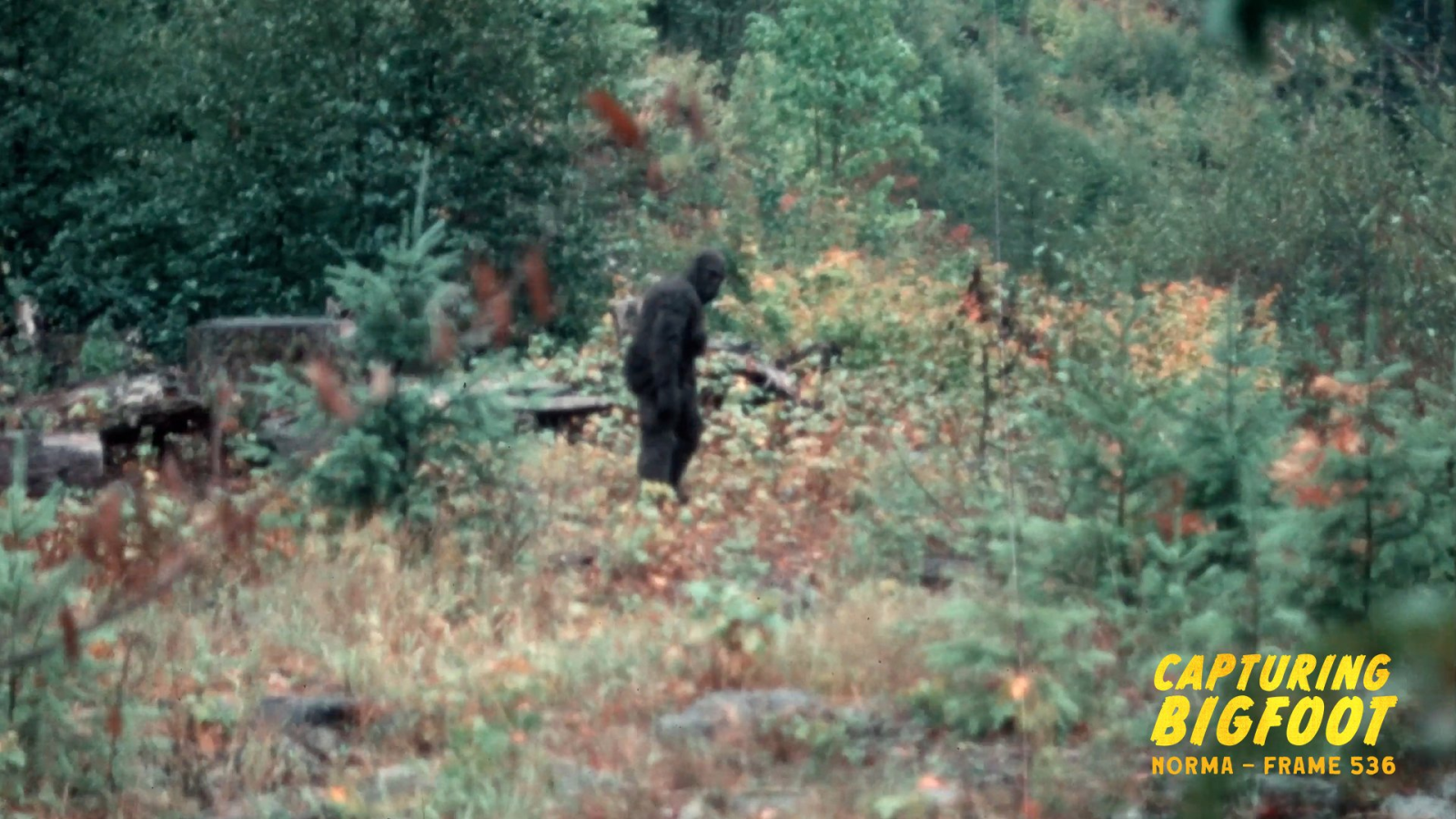
Source: https://x.com/CapturingBF/status/2112564685685821586
Source: https://x.com/CapturingBF/status/2112564685685821586
I am also quite sure it doesn't exist.If it existed, hunters would find tracks, droppings, fur, and dead animals.
No technology needed—the animal does not exist.
But giving people something to do in the woods instead of arguing over old footage would help them accept that fact.
Also, in post #556 isn't there a visible seam showing at the top of the arm?
NorCal Dave
Senior Member.
Believers have claimed that footprints demonstrate real feet with toes and an arch. The casts of the footprints were, naturally, provided by Patterson and Gimlin. *Suspicious face* (idk how to communicate without emojis help me)
But again, as were dealing with an unknown creature, the proponents can't agree on how its foot works. Here is one of the tracks supposedly left by "Patty":
It has very little arch, which Dahinden emphasized in Donskoy's report completed after Dehinden took a copy of the film to the Soviet Union (bold in the original):
http://www.bigfootencounters.com/biology/donskoy1.htmExternal Quote:
Lack of an arch may be caused by the great weight of the creature. **
**The above emphasis was Rene Dahinden's...compare this statement with the findings of anthropologists Grover Krantz and of the two Russians, Dmitri Bayanov and Igor Bourtsev in Chapter 9 of Dahinden's book, "Sasquatch" in the 1993 revised edition. Each of these three sources arrived at the same conclusion totally independent of the others.
So, Dahinden, Donskoy, Krantz, Bayanov and Bourtsev all seem to think "Patty" had little to no arch, something attributed to her weight. Which doesn't make a lot of sense. If Patty is around 6'6" or even 7' on the fringe of what proponents claim and we can see it's stocky but not morbidly obese, and it's a biological creature, there is an upper limit to what it can weigh. Hominids have a known density, like most mammals, that is related to water, as that makes up a majority of the mass.
Shaquille Oneal is 7' 1" tall, so in the ball park for Patty and I'd argue he has a similar solid physique. He claims to have peaked out at around 400 pounds during his career and after retiring:
https://www.etonline.com/shaquille-...star-studded-foundation-gala-exclusive-210653External Quote:
...the Los Angeles Lakers legend shares he's lost a whopping 55 pounds. When the 51-year-old stepped on the scale the other day, he said he came in at 351 pounds.
Before sharing where he wants to get, Shaq first travels down memory lane. He says he weighed 345 pounds when he won his first NBA championship with the Lakers in 2000. He came in at 375 pounds the following year when the Lakers captured their second consecutive NBA title, and he was 395 pounds when he and the late Kobe Bryant led the Lakers to their third straight NBA title in 2002.
Obviously he could weigh a lot more, but his appearance would be different. Patty can't weigh much more than Shaq, if not less, so well within the human distrobution. And, as this rather overpriced piece of art seems to show, he has a prominent arch:
https://www.artsy.net/artwork/walter-iooss-jr-shaquille-oneal-el-segundo-ca-1
But then this video with supposed Bigfoot expert, Thomas Steenburg, that was shared up thread somewhere, and he has a completely different take (link below):
He talks about some of the castings made by Bob Titmus around 9 days after the supposed filming took place. He mentions the track showing evidence of a "mid-tarsal break" (wonky YouTube auto transcripts with corrections):
I'm not sure what he's talking about. Supposedly, Jeff Meldrum who is in the documentary had said something like this, so maybe that's what Steenburgs reference to "anthropologists" is about. I ran it by my son, also an Anthropologist/Bio-Archaeologist when this video was first posted. He directed me to a paper that describes the "mid-tarsal break" like this:External Quote:
1:29
...ground now you also see actual examples of what we call a mid tarsal break which something in 1967left theater(if you weren't) a trained anthropologist you never would have known what that what the significance of that was
(Interviewer) what that is?
Wow in this pass(Now in this cast) this is also the trap line later on as the creature walked away you see what is a dip in the middle that we now call a mid tarsal break which has been noticed ina pair(what) could be authentic Sasquatch footprints ever since and the significant into that is the heel comes down first pushes a mound of dirt up the forefoot hit pushes that mound of dirt back so you get this mound of dirt right
in the middle of the track and it pushes off the last thing to come down istwotoes....
It's the flexible part of ape feet that allows them to bend their foot in the middle. Some humans can sorta do it, but for the vast majority of us, the foot is fused into a rather solid lever, with the toes being the flexible part:External Quote:
The midtarsal break was first described in this journal nearly 75 years ago to explain the ability of non-human primates to lift their heel independently of the rest of the foot
The issue is, the mid-tarsal break gives apes the ability to grasp with their feet, similar to their hands and is very useful in arboreal habitats. Bipedal hominids lost the mid-tarsal break as the fused foot with flexible toes was better adapted to bipedalism. The fused foot without the mid-tarsal break goes back to at least "Lucy", if not further:
https://www.semanticscholar.org/pap...ilva/f258dbf554837cac0202bc009ee81d73f118413aExternal Quote:Study of hominin metatarsals from Australopithecus afarensis (Lucy), A. africanus, Homo erectus, and the metatarsals and a cuboid from the OH 8 foot show little capacity for dorsiflexion at the cuboid-metatarsal joint. These results suggest that hominins may have already evolved a stable midfoot region well adapted for the push-off phase of bipedalism by at least 3.2 million years ago.
Going further back in time to "Ardi" Ardipithecus ramidus from around 4.4 MYA, we find a hominid with a foot adapted to climbing and bones that stiffen the foot for better bipedalism locomotion when on the ground:
https://en.wikipedia.org/wiki/ArdiExternal Quote:The foot of Ardi contains an opposable hallux (big toe) that is similar to chimpanzees.[14] This opposable hallux is believed to have been used to aid in tree climbing.[14] On the outside, Ardi's foot may look like it belongs with other Apes, but on the inside, Ardi's foot contains a bone called the os peroneum, which allows the bottom of the foot to be more rigid.[17] The rigidity of the bottom of the foot was believed to allow Ardi to walk upright, and the other four toes that were aligned performed the "toe off" action during a bipedal motion.[1
So, by 4.4 MYA, the feet of even sometimes bipedal hominids were fusing and losing the mid-tarsal break. If true, the evolution of Bigfoot becomes even more problematic. Not only did a very large hominid evolve bipedalism independent of all other bipedal hominids, as evidenced by the retained mid-tarsal break, it has for 10s of thousands, if not millions of years, retained an adaptation best suited to an arboreal existence, while becoming fully bipedal, with a foot not well adapted to it.
But then Steenburg goes into it say the "foot is fused":
juvinal
So, who knows? I've read other postings where people suggest juvenile Bigfoots are arboreal and become terrestrial bipeds at maturity. Seemingly ignoring that the foot adaptations for these two lifestyles are mutually exclusive.External Quote:
2:26
four foot comes down toes comes down and the foot is fused all the way fuse yeah
Mr Steenburg:
Source: https://www.youtube.com/watch?v=Xnb3GE7HaSE&t=1s

Mauro
Senior Member.
No, inbreeding wouldn't be a problem... Because they'd be extinct
Actual answer: I initially thought "100% yes" but I did some due diligence and found some surprising info:
Mountain gorillas could survive for thousands of years at very low population levels due to resistance to the genetic effects of inbreeding
ButExternal Quote:Mountain gorillas could survive for thousands of years at very low population levels of just a few hundred individuals because they appear to be resistant to the genetic effects of inbreeding, a study of gorilla genomes has found.
External Quote:"While comparable levels of inbreeding contributed to the extinction of our relatives the Neanderthals, mountain gorillas may be more resilient. There is no reason why they should not flourish for thousands of years to come," Dr Xue said.
I did not know that, interesting. Unfortunately, I fear there are non-genetic reasons why mountain gorillas could not flourish for thousand years to come

Or, reversing the answer: the existence of a primate population, small enough not leave plenty of physical proofs of their existence, is, just considering the inbreeding evidence, very improbable (but of course not impossible: nothing not logically forbidden ever is, as mountain gorillas know apparently well! had they been as good at hiding their existance as Bigfoot...So it seems like mountain gorillas are quite the exception. So, the answer to your question is still "almost surely" but surprisingly not "surely". Neat!
)
Last edited:
I think this can be compared to the way really old UFO photos are treated by believers. The Trent photos are a great example. Believers often treat old photos as "better evidence", claiming that the technology needed to fake them didn't exist back when they were taken. They're right that Photoshop didn't exist and that analog photography had certain limitations when it came to methods of faking photos. But they chose to forget that, at the end of the day, none of this really matters. Faking the Trent photos wouldn't have required Photoshop or any advanced digital technology. All that was needed was a model and some fishing line. And the same goes for the PG film. A gorilla suit and some experimentation with posture and gait are really all that would have been needed, since both the proportions and the way the figure walks are consistent with a human in a costume. But it's the same old argument: "It's an old photo/video, therefore it must be real."But no, we should endlessly squint at this one brief film, right?
Similar threads

- Replies
- 5
- Views
- 2K


- Replies
- 20
- Views
- 8K


- Replies
- 35
- Views
- 7K


- Replies
- 9
- Views
- 6K


