They didn't JUST attack it for using particular rats.
That was one problem among many, the sum of which is "a lousy experiment"
http://www.efsa.europa.eu/en/press/news/121004.htm?WT.mc_id=RSS&emt=1
External Quote:
The European Food Safety Authority has concluded that a recent paper raising concerns about the potential toxicity of genetically modified (GM) maize NK603 and of a herbicide containing glyphosate is of insufficient scientific quality to be considered as valid for risk assessment.
EFSA's initial review found that the design, reporting and analysis of the study, as outlined in the paper, are inadequate. To enable the fullest understanding of the study the Authority has invited authors Séralini et al to share key additional information.
Such shortcomings mean that EFSA is presently unable to regard the authors' conclusions as scientifically sound. The numerous issues relating to the design and methodology of the study as described in the paper mean that no conclusions can be made about the occurrence of tumours in the rats tested.
...
Main findings of Initial Review
The task force, whose members were drawn from the Authority's GMO, pesticide and scientific assessment units, has outlined a list of issues about the paper that would need to be resolved before it could be viewed as well-conducted and properly-reported study.
- The strain of rat used in the two-year study is prone to developing tumours during their life expectancy of approximately two years. This means the observed frequency of tumours is influenced by the natural incidence of tumours typical of this strain, regardless of any treatment. This is neither taken into account nor discussed by the authors.
- The authors split the rats into 10 treatment sets but established only one control group. This meant there was no appropriate control for four sets – some 40% of the animals - all of whom were fed GM maize treated or not treated with a herbicide containing glyphosate.
- The paper has not complied with internationally-recognised standard methods – known as protocols - for setting up and carrying out experiments. Many of these procedures are developed by the OECD (Organisation for Economic Cooperation and Development).
- For a study of this type, the relevant OECD guideline specifies the need for a minimum of 50 rats per treatment group. Séralini et al used only 10 rodents per treatment set. The low number of animals used is insufficient to distinguish between the incidence of tumours due to chance rather than specific treatment effects.
- The authors have not stated any objectives, which are the questions a study is designed to answer. Research objectives define crucial factors such as the study design, correct sample size, and the statistical methods used to analyse data - all of which have a direct impact on the reliability of findings.
- No information is given about the composition of the food given to the rats, how it was stored or details of harmful substances – such as mycotoxins – that it might have contained.
- It is not possible to properly evaluate the exposure of the rats to the herbicide as intake is not clearly reported. The authors report only the application rate of the herbicide used to spray the plants and the concentration added to the rats' drinking water but report no details about the volume of the feed or water consumed.
- The paper does not employ a commonly-used statistical analysis method nor does it state if the method was specified prior to starting the study. The validity of the method used is queried and there are questions over the reporting of tumour incidence. Important data, such as a summary of drop outs and an estimation of unbiased treatment effects have not been included in the paper.
- Many endpoints – what is measured in the study – have not been reported in the paper. This includes relevant information on lesions, other than tumours, that were observed. EFSA has called on the authors to report all endpoints in the name of openness and transparency.
I have already debunked the 'prone to cancer' myth/lie and yet they are so dumb they list it as their first complaintExternal Quote:The research was carried out by Caen University in France, and has been peer reviewed by independent scientists to guarantee the experiments were properly conducted and the results are valid.

I see no difference in 'numbers of rats used' in the other studies which I quoted and I strongly suspect all the other myriad of trials used similar numbers a well as this seems standard practice... albeit absolutely shameful.
Are you or anyone else suggesting the other trials are invalid/unprofessional whatever...?
This is a clear and utter whitewash rubbish and anyone who believes differently should be forced to eat it themselves.
Like I said... Yum Yum, enjoy


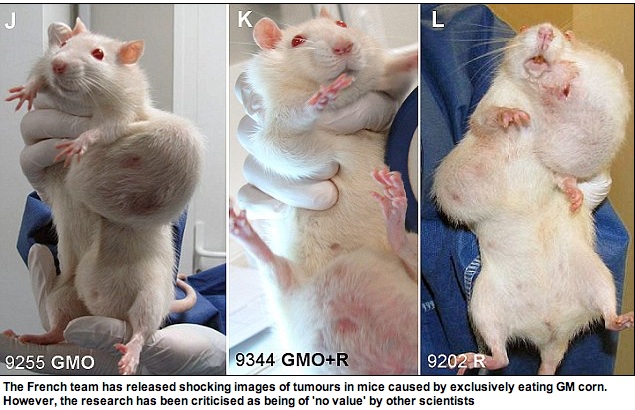
 (note the smiley), to eat this stuff after seeing these pictures and and seeing the results of this test... what can I say.
 http://www.occupymonsanto360.org