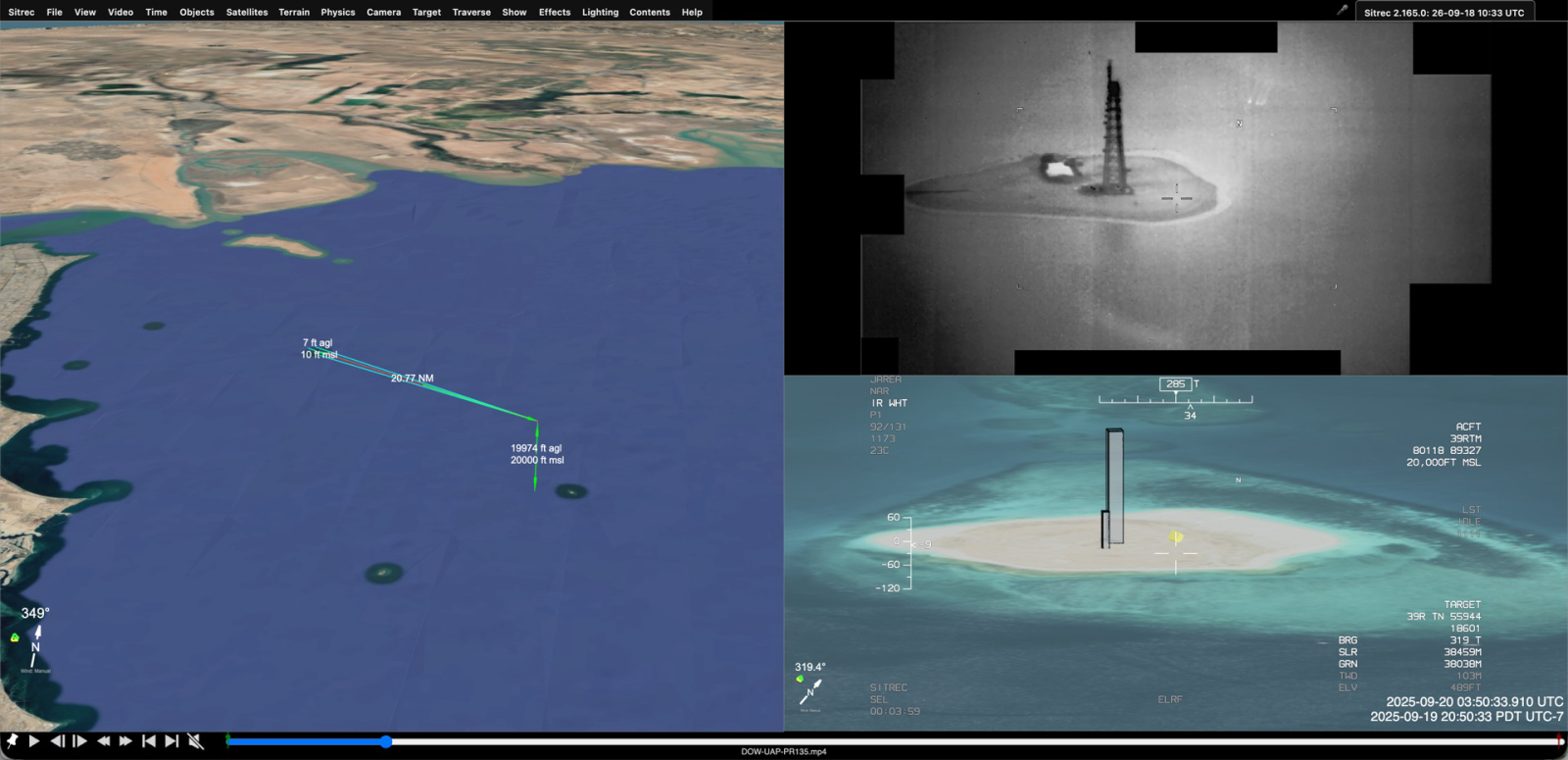
DOW-UAP-PR135/D108

Mick West

Administrator
Staff member
Kubbar Island is a tourist spot off Kuwait. This appears to be it at high tide.

1789773886442.png


https://www.metabunk.org/sitrec/?custom=1/PR135 Kubbar Island and Birds/20260918_231943_3ed3c7a12de9b7d050e07ae713450758.js
1789773691886.png
 
1789775664552.png


This particular video is a what looks like a group of six birds. Ambiguous enough apparently that AARO could not just say it's birds, and so it's a fleet of UAP for the media.

I think I need to add flocks of birds to Sitrec.
 
I have some ideas that draw parallels to bird murmuration. Am I wrong? During murmuration (the collective, synchronized flight of a flock), starlings typically maintain a steady speed of 40–45 km/h, although individual birds or small groups can accelerate to 60–80 km/h if necessary (and, in rare instances, up to 90 km/h during migratory flights). Key characteristics of bird speeds during murmuration include:
- The illusion of speed variation: When observing the starlings' "dance" from the ground, it appears as though parts of the flock are suddenly slowing down (clustering) or speeding up. However, computer modeling by physicists has proven this to be an optical illusion caused by the projection of the 3D flock onto our 2D field of vision. In reality, the birds attempt to fly at a constant, uniform speed.
- The "rule of seven neighbors": Each bird does not monitor the entire flock; instead, a starling orients itself and adjusts its speed and direction based on its six or seven nearest neighbors.
- When a predator (such as a peregrine falcon) attacks the flock, the birds closest to it abruptly change their trajectory. This impulse ripples through the flock at a speed of 20 to 40 meters per second (72–144 km/h). In other words, information propagates through the flock significantly faster than the birds themselves are flying.
 
Last edited:
Avi Loeb and the coauthors of this paper released today agree that this video very likely shows birds and that the speed estimate in the description is a misinterpretation due to parallax and misjudged distance. They analyzed the pulse frequency of each object showing they each "flap" on consistent and independent periods and they also looked at the parallax explanation for the much higher estimated speed. One helpful point is that they compared the pulse frequency of the objects in this video to a catalog of videos that the Galileo Project has recorded of things known to be birds, and found it to be within range of those.

External Quote:
Every object beats steadily at 7.1–7.9 Hz, each
independent of the others. Analysis of each beat eliminates video compression, pixel
sampling, and sensor defects as explanations. We then apply the same frame-by-frame
analysis to infrared video of flying animals from the ground-based camera array of the
Galileo Project near Las Vegas [9, 10] and find several examples of objects with beats
at bird wingbeat frequencies.
External Quote:
Each of the six objects beats steadily
at 7.1–7.9 Hz, at its own frequency and phase, which neither the video nor the sensor
produces. Flying animals recorded by infrared cameras beat in the same way, in
brightness and apparent size together, at 3.4–10.0 Hz. Finally, the reported speed and
direction are what a slow object at 60–80% of the aircraft's height would produce
when no range is measured. The simplest explanation is a small flock of birds, nearer
to the aircraft than the ground point on which the speed was estimated. The number
of objects, their changing arrangement, and the report's description of objects that
were agile and changed direction are all consistent with this interpretation.
The frequencies of the six objects lie within the range measured for birds in cruising
flight [6–8].

Source: https://avi-loeb.medium.com/the-six-infrared-dots-in-a-declassified-uap-video-is-a-flock-of-birds-3a0a38f33ca7

Linked paper (also attached): https://lweb.cfa.harvard.edu/~loeb/JHM.pdf
 

Attachments

Back
Top