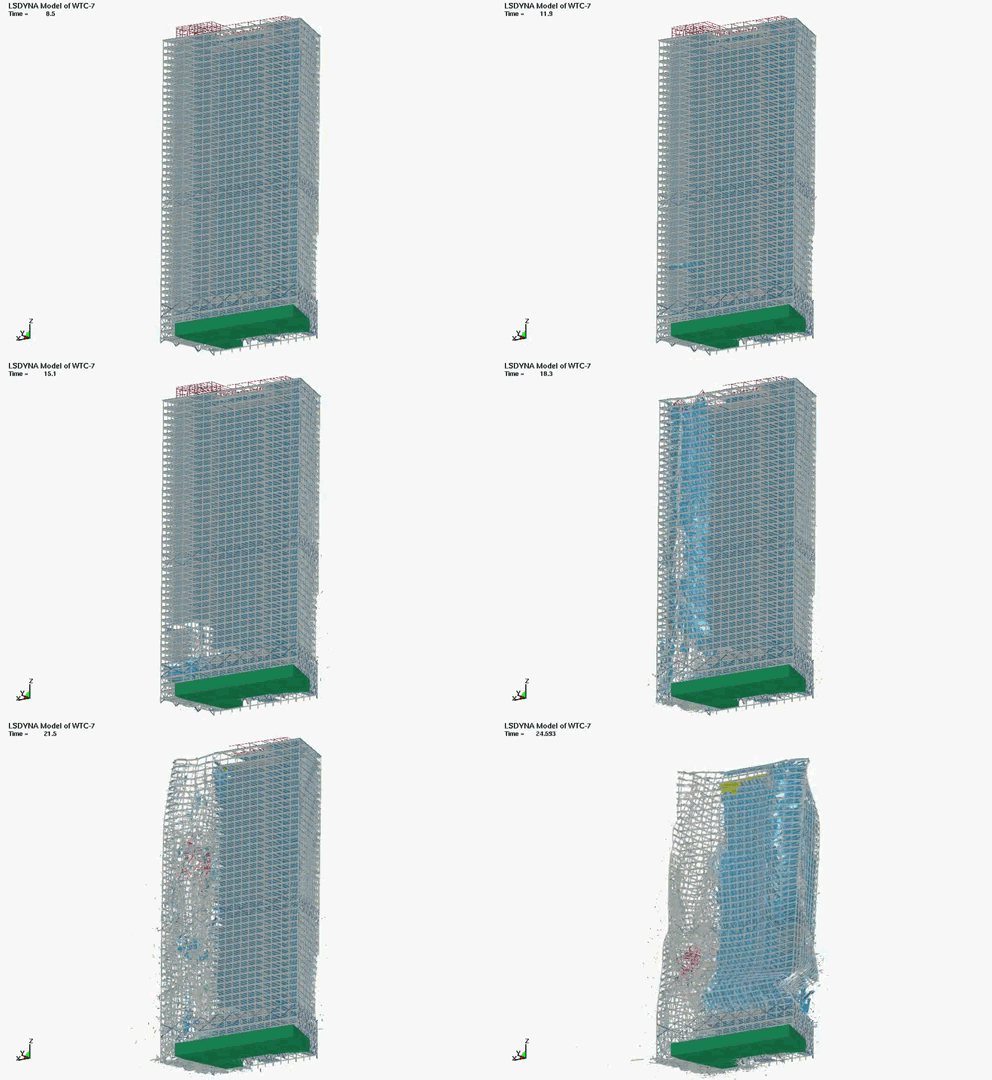
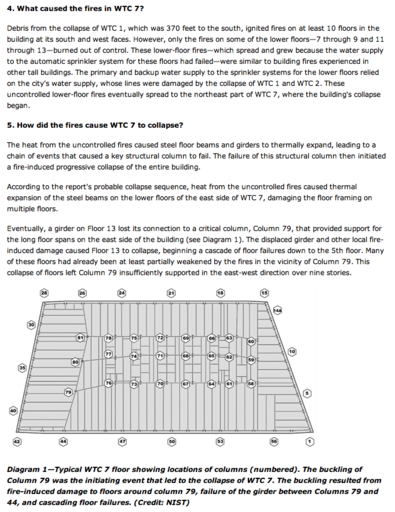
This study has identified thermal expansion as a new phenomenon that can cause structural collapse. For the first time we have shown that fire can induce a progressive collapse.
...
No design professional is assigned the explicit responsibility for ensuring the adequate fire safety performance of a building's structural system.
Architects typically use catalogued test data to specify fireproofing thickness to meet the fire ratings in the building code. Structural engineers design buildings to withstand its weight and to resist earthquake and wind loads, but are not required to consider fire as a load condition in structural design. Fire protection engineers design the active fire protection systems in buildings—such as sprinklers, fire alarms, and smoke management systems. They may or may not be called upon to assist the architect with the design of the passive fire protection system—such as fireproofing and compartmentation.
WTC 7, which included floor spans as long as 54 feet, had a structural system design that is in widespread use in other tall buildings. The length of floor spans is important. Longer beams can be subject to proportionally greater thermal expansion effects, but such effects may also be present in buildings with shorter span lengths depending on the design of the structural system.
We strongly recommend that building owners, operators, and designers evaluate buildings to ensure the adequate fire performance of the structural system. Of particular concern are the effects of thermal expansion in buildings with one or more features such as: long-span floor systems, connections not designed for thermal effects, asymmetric floor framing, and/or composite floor systems.
If thermal effects concerns are raised by this evaluation, possible retrofits may include strengthening connections, strengthening floor framing, increasing structural redundancy, and adding additional fireproofing to vulnerable areas. There clearly are ways available to address any concerns that arise from this analysis, but this situation should be analyzed by owners, operators, and designers for each structure on a case-by-case basis.