Daytime moon

JMartJr

Senior Member.
So I am seeing a number of folks posting in various plces that claim that "Decades ago (or when I was a kid, or the like) you never saw the moon in the daytime, eg:
Capture.JPG


(This one is over a decade old, which at least illustrates that the moon was visible in the daytime THAT long ago...)

One more current:
moon 2.JPG


Explaining about how the orbit of the moon around the Earth, and the rotation of the Earth, makes it inevitable that at some times the moon would be visible in the daytime is complex (especially with people who don't believe space is real and the like) but I'd like to be able to take one more step, and show not only that it OUGHT to be visible in the daytime, but that it WAS -- I'd love to find references to the moon being observed in the daylight or photos or even artwork clearly showing a daytime moon, from as far back as it can be found. I am struggling to find anything with Google searches, if anybody has any of that handy, or wants to invest a bit of time hunting something down, I'd be grateful.
 
@JMartJr

A solar eclipse is due to a daytime moon.

From Wikipedia
External Quote:
The oldest recorded solar eclipse was recorded on a clay tablet found at Ugarit, in modern Syria, with two plausible dates usually cited: 3 May 1375 BC or 5 March 1223 BC, the latter being favored by most recent authors on the topic
I suppose the moon can't really be seen in these circumstances though as the illuminated side faces away from observers on Earth so maybe historic records of eclipses don't strictly count as evidence of a visible moon. They establish that the moon can be in the daytime sky though.
 
This seems to share qualities with the "Mandela Effect" — where the lack of a memory ("I don't have specific memories of the Moon visible during the day") becomes a false memory ("I remember that the Moon didn't use to be visible during the day.") Except that a lot of people do remember the Moon being visible during the day, so it doesn't catch on.

And like the great Winter Of The Drone, it's also partially attributable to folks looking at the sky less than they did before smart phones and such.
 
Salomon Trismosin "Splendor solis" from 1582, from a treatise on alchemy. Since anybody can paint anything, and since there was a lot of symbolism in alchemy (As we see, for example, when we note that the king is standing in a fire in this painting!) so this is not a naturalistic painting, still it is the oldest image of the Sun and moon in the sky together that I have found.
sun  and moon.JPG

I feel like there has GOT to be some reference to observing the moon by daylight in the writing of somebody like Galileo or Brahe or one of those guys, but no joy finding it so far...
 
I was THERE "decades ago", and I remember seeing the daytime moon during the 1940s. But back then, I didn't have a television set (or a PlayStation, or a computer, or an internet) to keep me in the house all the time. Maybe that provides a clue for the clueless who make that silly claim.
 
According to Wikipedia, Aristarchus, who lived around 300BC (quite a few decades ago), used the angle between the half moon and the sun, presumably measured when both were in the sky at the same time, to ascertain the distance to the Sun. With his somewhat crude measurements he did not get the right answer but he did determine that the sun is substantially farther away than the moon.
 
Here's the first reasonably old excerpt I found, from the Bluffton Chronicle, 28 March 1889.

1734822306750.png


"Well, if you have ever seen the moon in the daytime, it is because you have not been a very diligent observer of the Heavens."

And, of course, this is referencing a Bible story: Joshua 10:13...

External Quote:
And the sun stood still, and the moon stayed, until the people had avenged themselves upon their enemies. Is not this written in the book of Jasher? So the sun stood still in the midst of heaven, and hasted not to go down about a whole day.
Old enough for you?
 
That's (those're) great, thanks.

I found a reference from a book called "Mr. Palomer" by Italo Calvino in 1983 -- in the book, the reviewer says Calvino has Mr. Palomar repeat Galileo's observation of the moon in the daytime. The reference in the book does not seem to actually mention Galileo, and is not very old -- and I can;t find direct reference to Galileo observing the daytime moon... yet.
 
Last edited:
Here's another that specifically mentions the idea that you cannot see the moon in the day as the sort of thing a child would believe:

1734857796378.png


Source: Boston Evening Transcript, April 7 1891 (but seems to be a reprint from the London magazine Tit-Bits).

In fact I found this exact anecdote repeated in numerous American newspapers in the archives through the 1880s and into the 1890s, the earliest being the Sarnia Observer of March 28 1879. Must have been a slow news decade...
 
Going back to the 19th century should cover the memory of any living person. :-)

It's hard to catch a full moon at daylight, and impossible in the winter.
 
A solar eclipse is due to a daytime moon.
A lunar eclipse can be seen at twilight, when the sun is barely below the horizon. I was once out walking in the park in perfectly well-illuminated twilight when the moon rose with a bite out of it already.
 
So I am seeing a number of folks posting in various plces that claim that "Decades ago (or when I was a kid, or the like) you never saw the moon in the daytime, eg:
View attachment 75161

(This one is over a decade old, which at least illustrates that the moon was visible in the daytime THAT long ago...)

One more current:
View attachment 75162

Explaining about how the orbit of the moon around the Earth, and the rotation of the Earth, makes it inevitable that at some times the moon would be visible in the daytime is complex (especially with people who don't believe space is real and the like) but I'd like to be able to take one more step, and show not only that it OUGHT to be visible in the daytime, but that it WAS -- I'd love to find references to the moon being observed in the daylight or photos or even artwork clearly showing a daytime moon, from as far back as it can be found. I am struggling to find anything with Google searches, if anybody has any of that handy, or wants to invest a bit of time hunting something down, I'd be grateful.

There is also 'daytime Earth'.......from the Moon....

daytime earth.jpg
 
I'm kind of obsessed with this claim because it's something a lot of flerfs like to say and it's, in my opinion, even more obviously false than "the Earth is flat". I find it really interesting that many of these old examples y'all have dug up note it as an unintuitive thing when it really isn't. I wonder if it really is that the cultural association of the moon with nighttime is just that powerful.
 
and I can;t find direct reference to Galileo observing the daytime moon... yet.
This passage in "Dialogo sopra i due massimi sistemi" (Dialogue concerning the two chief world systems) explicitly says the Moon can be seen both by day and by night:
SALV. Anzi vel farò io creder pur ora. Ditemi un poco:
quando la Luna è presso che piena, sí che ella si può
veder di giorno ed anco a meza notte, quando vi par
ella piú splendente, il giorno o la notte?
https://moodle2.units.it/pluginfile.php/273610/mod_resource/content/1/DIALOGO SOPRA I DUE MASSIMI SISTEMI.pdf (page 110).

Salviati [the character of the dialogue who supports heliocentrism]: Indeed, I will make you believe that too [referring to what was being discussed in the previous paragraphs, if the Earth reflects the light of the Sun too]. Tell me, please: when the Moon is near fullness, so it can be seen by day and also at midnight, when does it seem brighter to you, by day or by night?
 
Last edited:
Do the people who are making this claim believe that it is the moonrise/-set times that have changed over the decades, or the illumination of the moon during its risen hours that has changed? Do they have a model for that, and anything to back it up (he asks, knowing the answer is "of course they don't, they probably don't understand the question")?

The only alternative is that we've been pumping chemicals into the atmosphere that would make an equally-illuminated moon up there less visable down here. Someone should look into that.

(Maybe in a previous life I was a sheep-dog, as I do seem to enjoy herding disparate groups into tighter clusters.)
 
I'd expect that historic nautical tables (like Kepler computed) would show times for moonrise and moonset.
It's even better. They show how close the moon is to the sun.

Article:
In celestial navigation, lunar distance, also called a lunar, is the angular distance between the Moon and another celestial body. The lunar distances method uses this angle and a nautical almanac to calculate Greenwich time if so desired, or by extension any other time.

Using a sextant, the navigator precisely measures the angle between the moon and another body. That could be the Sun or one of a selected group of bright stars lying close to the Moon's path, near the ecliptic. At that moment, anyone on the surface of the earth who can see the same two bodies will, after correcting for parallax, observe the same angle. The navigator then consults a prepared table of lunar distances and the times at which they will occur. By comparing the corrected lunar distance with the tabulated values, the navigator finds the Greenwich time for that observation. Knowing Greenwich time and local time, the navigator can work out longitude.

Article:
Initially, the almanacs provided the data required for the method of lunar distances, a technically demanding and mathematically complex method of determining longitude before the invention of accurate clocks for shipboard use. The common availability of precise chronometers on ships beginning in the early 1800s, and the development of methods of "sight reduction" by Sumner, St.-Hilaire and others, provided an easier procedure for navigators to determine their position at sea. The almanacs provided the necessary data for these methods.

Chronology:
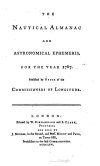
1766 First edition of The Nautical Almanac and Astronomical Ephemeris appears, published by Astronomer Royal of England, with data for 1767. The book provided the information necessary for the method of lunar distances used to determine longitude.

This is from that almanach, at https://archive.org/details/the-nautical-almanac-and-astronomical-ep/page/n23/mode/1up?view=theater :
The_Nautical_Almanac_and_Astronomical_Ep_0005.jpg
The_Nautical_Almanac_and_Astronomical_Ep_0023.jpg


Clearly, the sun and the moon must have been visible at the same time, or this method could not be used.
 
I have looked at older tables. The Prutenic tables from the 16th century are written in Latin, and they don't show the distance as clearly (I think), though I expect they could've been computed from the data on the sun and moon.
The Alfonsine tables date back to the 13th century, before printing was invented.

I believe that any fundamental change in the moon's behaviour since these early astronomical tables would've made history, because since that time (and before), countless sailors and explorers depended on the predictability of the sun and moon to figure out where they were.
 
Clearly, the sun and the moon must have been visible at the same time, or this method could not be used.

And the beauty of such tables is that they answer the question "but to what extent can the tables, and thus the model they are calculated from, be trusted?": that may call itself a "nautical" almanac, but you don't need to be at sea to simply verify that the predictions are correct and evaluate their error bars).

I'd really like to see the equations they were using for the creation of such tables - how many parameters are there in their model, what deviations are they prepared to approximate away with an average - and the numerical methods practically employed to generate them (I presume difference equations based on differential equations, but who knows?).

Great find! Thank you!
 
I have looked at older tables. The Prutenic tables from the 16th century are written in Latin, and they don't show the distance as clearly (I think), though I expect they could've been computed from the data on the sun and moon.

Oh, man, I love the devotion to sexagesimal - with the prime unit of angle being the sextant (a sixth of a full circle, so 60 degrees in common parlance).
sextant.png

I'll confess I still don't know how to interpret those tables, but at least I've worked out how to parse them.

Image from /Canones mediorum seu aequalium motuum ac prosthaphaereseon Lunae/: https://www.e-rara.ch/zut/wihibe/content/zoom/143340 , via
/Prutenicae tabulae coelestium motuum/, Reinhold, Erasmus, Tubingae, 1551: https://www.e-rara.ch/zut/wihibe/content/structure/143067

TIL a new word!
External Quote:

Prosthaphaeresis

Prosthaphaeresis (from the Greek προσθαφαίρεσις) was an algorithm used in the late 16th century and early 17th century for approximate multiplication and division using formulas from trigonometry. For the 25 years preceding the invention of the logarithm in 1614, it was the only known generally applicable way of approximating products quickly.
-- https://en.wikipedia.org/wiki/Prosthaphaeresis
I say "learn", but I can guarantee I will have forgotten it by lunchtime.

EDIT: I'm just have my only little ramble/chit-chat with myself here now!
I also find it fascinating that they appear to have no movable type for the /minuta prima/ (minute: ' ) or the /secunda minuta/ (second: " ) symbols such that a scribe must have had to manually add them to the documents after printing, yet apparently they do have the Sol symbol. They ought to give their type foundry a quick telephone call, and get some new symbols 3d printed, if they're using them so often.
sol_but_no_minutes.png

(from the /Epilogismos tês psêphophorias/ document.)
 
Last edited:
Do the people who are making this claim believe that it is the moonrise/-set times that have changed over the decades, or the illumination of the moon during its risen hours that has changed? Do they have a model for that, and anything to back it up (he asks, knowing the answer is "of course they don't, they probably don't understand the question")?
It seems to be a case of "The moon has changed since I was a kid, therefore everything we were told is wrong!" Similar to the folks who thing the Sun is now brighter and more white than they remember from childhood (not coincidentally, childhood was the time we all had picture books and watched cartoons showing the Sun as a big yellow circle, and drew pictures of it using our big yellow crayons!)

Which conspiracy theory this all supports seems to be To Be Determined, it could fit Flat Earth/Space is Fake, or Mandela Effect nonsense, or presumably others I haven't thought of this morning.
 
It seems to be a case of "The moon has changed since I was a kid, therefore everything we were told is wrong!" Similar to the folks who thing the Sun is now brighter and more white than they remember from childhood (not coincidentally, childhood was the time we all had picture books and watched cartoons showing the Sun as a big yellow circle, and drew pictures of it using our big yellow crayons!)

Which conspiracy theory this all supports seems to be To Be Determined, it could fit Flat Earth/Space is Fake, or Mandela Effect nonsense, or presumably others I haven't thought of this morning.
Every Tuesday the Matrix resets with new conspiracies.
 
I spotted this on Facebook the other day:

Screen Shot 2025-05-29 at 3.50.21 PM.png


Not exactly sure what he's trying to say (conspiracy belief rots the brain), but I couldn't help noticing the similarity to a joke I made in an "anti-science" parody video 17 years ago:

Screen Shot 2025-05-29 at 3.57.08 PM.png
 
Similar to the folks who thing the Sun is now brighter and more white than they remember from childhood (not coincidentally, childhood was the time we all had picture books and watched cartoons showing the Sun as a big yellow circle, and drew pictures of it using our big yellow crayons!)

Which conspiracy theory this all supports seems to be To Be Determined, it could fit Flat Earth/Space is Fake, or Mandela Effect nonsense, or presumably others I haven't thought of this morning.

If the Sun's got brighter in the past few years, it's probably responsible for global warming.
So it's probably just a coincidence that atmospheric CO2​ has risen at the same time.

But if the Sun's got brighter in the past few years, I expect astronomers, meteorologists, cereal farmers, holiday reps and ice cream salesmen would've noticed, to name but a few.
 
Q: Could the claim be true in certain conditions that only existed at certain locations and times?
I'm specifically thinking of the periods of massive air pollution where certain cities were cloaked in smog during business hours.
 
Q: Could the claim be true in certain conditions that only existed at certain locations and times?
I'm specifically thinking of the periods of massive air pollution where certain cities were cloaked in smog during business hours.
No.
The moon is not limited to business hours.

The condition for "did not see the moon" is "rarely looked at the sky".
 
If the Sun's got brighter in the past few years, it's probably responsible for global warming.
So it's probably just a coincidence that atmospheric CO2​ has risen at the same time.

But if the Sun's got brighter in the past few years, I expect astronomers, meteorologists, cereal farmers, holiday reps and ice cream salesmen would've noticed, to name but a few.
The sun has gotten brighter in the past few years... it's been getting steadily brighter for millions of years, after all.
 
Back
Top