
Inverted triangle object over Mexico City

Starflint

Senior Member
A golden inverted triangle that appeared somewhere in Mexico in March 2021

Source: https://www.youtube.com/watch?v=16KbXN1Hhfw

As well as the golden inverted triangle that also appeared in March 2025 (with slightly clearer image quality)

Source: https://www.facebook.com/reel/1608025767194579

Judging by the image quality, both videos appear to be reposts.
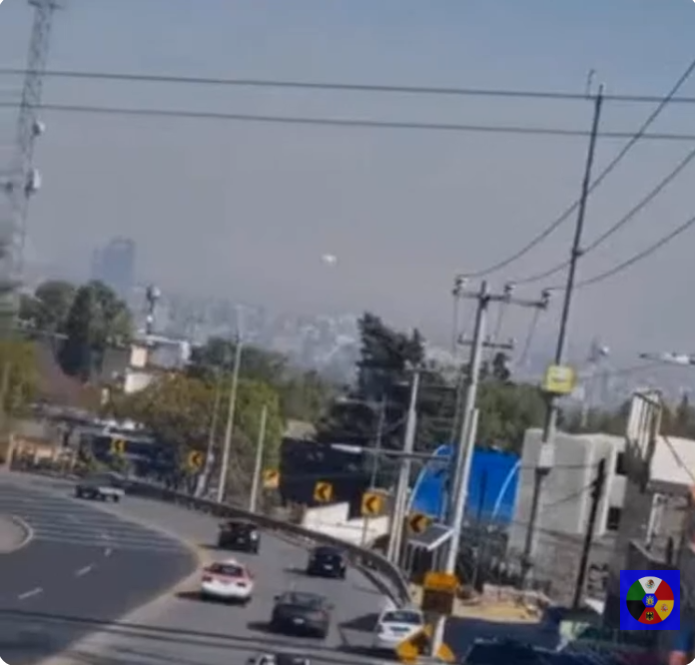
1777740927114.png


The exact location of the 2021 video is currently unknown, but the second video is said to have been filmed in San Andrés Totoltepec, Mexico.
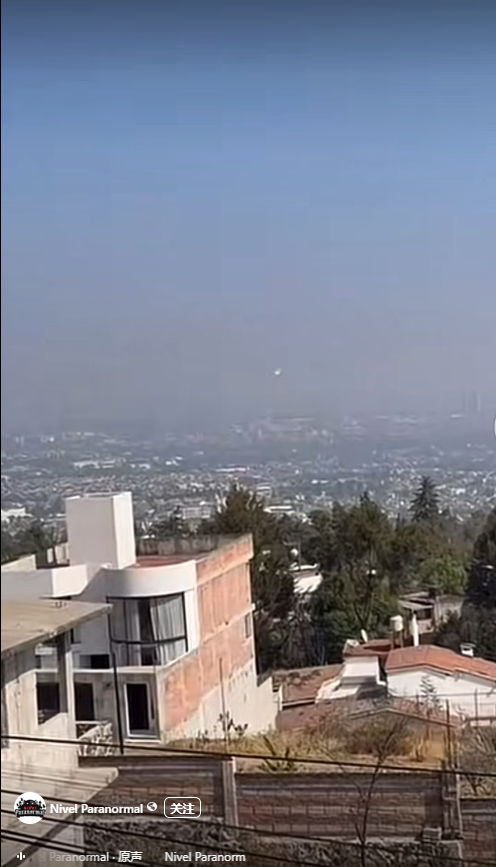
1777740988880.png


This location is situated south of Mexico City's center, where, theoretically, reflections would be easily visible. Based on the footage, it looks like a reflection from some kind of building in hazy weather, especially since it was observed in March both times, suggesting it might be a building in the same location. However, I haven't found the exact coordinates of the two videographers at the time, so I cannot confirm if it is a reflection from a specific building in Mexico City.
 
Judging by the image quality, both videos appear to be reposts.
1777740927114.png

I have found this location - here is the blue roof on the right, and the mast.

1777744861108.png


I am pretty sure that the video was shot from this footbridge over the highway:

1777744983940.png


You can see the cables and this distinctive street lamp with three holes in the arm in close-up as the camera moves around at the end of the video. Plus the "AUTO LAVADO" banner seen in the video is there in June 2021 Street View.

1777745550609.png
1777746648739.png


Co-ordinates: 19.258950°, -99.173519°

I marked the Torre Mayor with a big yellow pin and it appears to be in the right kind of place, but I haven't done anything high-tech!

1777745311319.png


As for the other video, I haven't found the exact building in the foreground but somewhere on the hilltop above San Andrés Totoltepec as suggested looks good. Approx area is 19.243°, -99.173°.
 
Last edited:
As for the other video, I haven't found the exact building in the foreground but somewhere on the hilltop above San Andrés Totoltepec as suggested looks good. Approx area is 19.243°, -99.173°.
Thanks to your excellent preliminary scouting work, I was able to easily narrow down and pinpoint the second filming location(19°14'30.21"N 99°10'12.39"W),This shooting location is only 350 meters away from the approximate coordinates you provided. Unfortunately, there is no street view available here, so I had to confirm it based on the observation angle and that unique house in the southeast corner featuring curved walls and a white patio(19°14'31.88"N 99°10'12.72"W)
1777773502795.png
1777773526858.png
 
Last edited:
I was able to easily narrow down and pinpoint the second filming location
Can you explain your method here and which map you used?
EDIT: Note to self, I really should read previous posts more thoroughly!
I think it's correct (there are many points that confirm this), but it's interesting that the camera position/foreshortening makes the bulkhead on the building (blue box) with the curved window appear to be flush with the front wall, when it's actually set back a few metres.
Also, your map image makes it appear the side wall of the building is grey concrete, with dark lines, rather than the red brick we see in the video still.

Untitled.jpg
 
Last edited:
Can you explain your method here and which map you used?
It's nothing special; I just used Google Earth, using the upper edge of the building's inverted triangular reflective surface as the x-axis, and then used the map's ruler tool to draw a long Y-axis line from its center (representing the possible shooting angle). Then, I searched based on the approximate city location given in the video (San Andrés Totoltepec). Since the location of the first video had already been solved and the filming dates for both videos were nearly identical, it was highly likely that the second filming location was nearby. Combining the unique appearance of the houses in the foreground at the start of the second video, their general orientation, and the characteristic of being on the edge of a hillside (which eliminates the need to filter through many of the lower-lying residential areas), I slowly searched along that "Y" axis until I found a match. Geolocation isn't my strong suit, so I had to use this clumsy method; there was definitely a bit of luck involved.
 
Last edited:
Nice work @Giddierone @Mick West @Trailblazer @Starflint

Perhaps the name of this building should be expanded to "Torre Mayor del OVNI triangular".

I plotted the identified locations for my own orientation, and so I share it here for posterity.

Google Earth screenshot (KML attached)
Google Earth - Torre Mayor del OVNI triangular en la Ciudad de México.png


March 2021 (bottom) with March 2025 just under 2 km North of it, and Torre Mayor a further 18 km due North from there.

Google Maps screenshot
Google Maps - Torre Mayor del OVNI triangular en la Ciudad de México.png


Given the right conditions, the Torre Reforma building (2016) next to Torre Mayor (2003) must surely be another candidate for triangular UFO sightings in the future.

Photo of Torre Mayor (left) and Torre Reforma (right)
Torre_Reforma-_Oficinas-_Vista_este.jpg

Source: ArchDaily
 

Attachments

Can you explain your method here and which map you used?
I think it's correct (there are many points that confirm this), but it's interesting that the camera position/foreshortening makes the bulkhead on the building (blue box) with the curved window appear to be flush with the front wall, when it's actually set back a few metres.
Also, your map image makes it appear the side wall of the building is grey concrete, with dark lines, rather than the red brick we see in the video still.
I don't think the side wall is red brick, it looks more like painted concrete. The illusion with the rooftop structure is quite strong but you can just see enough of the base of it to see that it's not flush with the front wall.

1777814744447.png
 
I don't think the side wall is red brick, it looks more like painted concrete. The illusion with the rooftop structure is quite strong but you can just see enough of the base of it to see that it's not flush with the front wall.

View attachment 90107
The walls in #5 seem different. I'd assumed the walls in the video still were built like this nearby (see below) i.e. red brick with grey cement columns. Ah, but maybe the brick has since been given a cement render which is now lighter than the columns.

Screenshot 2026-05-03 at 14.36.11.png
1777815585092.png
 
The walls in #5 seem different. I'd assumed the walls in the video still were built like this nearby (see below) i.e. red brick with grey cement columns. Ah, but maybe the brick has since been given a cement render which is now lighter than the columns.
That's right, and the map is already from April 3rd. It's highly likely that the cement mortar was applied to the exterior brick walls after the video was filmed in March. Perhaps by the next map update, the house will already have its white exterior paint applied
 
Article:
Confined masonry is a construction system where the masonry walls are built first, and the concrete columns and beams are poured in afterwards to enclose (confine) the wall. It has typically performed well in past earthquakes worldwide, when built according to code requirements. Its satisfactory earthquake performance is due to the joint action of masonry walls and their confining elements.


Source: https://www.youtube.com/watch?v=zv_q8saRZfQ

Article:
Confined masonry is the most popular type of construction in Mexico, and it is widely used in the central part of the country.

This type of construction is practiced both in the form of non-engineered construction (mainly found in rural areas and suburbs of urban centres) and engineered buildings e.g. industrial facilities and formal housing developments built under the supervision of qualified professionals ...

Confined masonry construction was introduced in Mexico City, Mexico in the 1940's to control the wall cracking caused by large differential settlements under the soft soil conditions. Several years later, this system became popular in other areas of highest seismic hazard in Mexico due to its excellent earthquake performance ...

I remember seeing this method of construction in Cairo a very long time ago, where I noted rebar often extending upwards from the top beams of domestic buildings. This doesn't always mean the buildings are unfinished. It allows for the addition of an extra floor in the future, when the owner (or new owner) desires and can afford it.

Something I didn't know about was the earthquake resistance. Wood construction is apparently unpopular in Mexico due to termite damage and rot. Although wood being more flexible and lighter than brick, block, or concrete could provide better earthquake resistance. Either way, survivability still depends on sound engineering, so copying of a proven construction method is safer, particularly for unregulated construction.
 
Back
Top