Hi I am new here, I wanted to share my new wx app with the forum - Contrail Analysis of Persistence

rmacleod

New Member
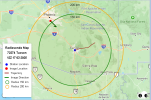
I wanted to share a weather analysis tool / application i have been developing. It calculates RHi at standard flight elevations and max RHi for a single radiosonde data set as well as producing a radiosonde map showing the WMO station location, radiosonde trajectory, contrail image location and direction. The app is somewhat technical so ii thought that the metabunk forum might have some members that would find the application interesting and hopefully useful. And of course suggestions or comments for improvement are always welcome. The app could be considered an extension of Mick's Calculator for RHi and Contrail Persistence Criteria, which i used to verify the RHi calculations in the development of this app which was very helpful.

CONTRAIL ANALYSIS OF PERSISTENCE RHI CALCULATIONS=======
Station ID: 72274 Tucson
Obs Date and Time UTC: 12Z 17 03 2025
IMAGE: Date and Time UTC: 1420 17 03 2025
LEVELS:
300.0 hPa Elev:9521m T=-38.1°C RH=79% RHi≈114% Persistence:Yes
250.0 hPa Elev:10642m T=-47.5°C RH=52% RHi≈82% Persistence:No
200.0 hPa Elev:12040m T=-58.9°C RH=55% RHi≈96% Persistence:Yes
Max RHi (7,000-14,000m): 222.0 hPa Elev:11521m T=-55.0°C RH=68% RHi=115%
CONCLUSION: Persistent contrails possible max RHi=115%

Link to app: Contrailwx.info
 

Attachments

  • 20250317_082057.jpg
    20250317_082057.jpg
    179.4 KB · Views: 40
  • cap map 03172025 rhi 116.png
    cap map 03172025 rhi 116.png
    233.2 KB · Views: 40
I'm a little confused by the examples in the documentation. For example this first one:

1762740707926.png


shows the conclusion that "persistent contrails are not possible", when the image clearly shows that they were.

I think it mostly highlights the limitation of radiosonde data, which is very sparse in both spatial and temporal coverage.

In this case the sounding was about four hours after the photo was taken.

Looking at earth.nullschool.net, for instance, shows that an area of high humidity was passing across Florida from west to east that day - at 250mb the RH was above 95% in the area where the photo was taken at 2000Z but had dropped to below 40% by 0000Z, when the sounding balloon was launched.

1762741259093.png

1762741311540.png


My concern is that this data could be used by chemtrail believers to claim that contrails cannot be contrails because "the conditions weren't right for persistence", when in fact they clearly were (as can be seen by the contrail behaviour!).

Even the data from these maps above is only modelled data - it is more fine-grained than the radiosonde network but small pockets of higher humidity will often be missed, so it's still quite easy to get contrails persisting in parts where the models say they shouldn't.
 
My concern is that this data could be used by chemtrail believers to claim that contrails cannot be contrails because "the conditions weren't right for persistence", when in fact they clearly were (as can be seen by the contrail behaviour!).
I agree with your observation that "small pockets of higher humidity will often be missed", and it would be unrealistic to expect otherwise. "Persistent", though, is a subjective assessment, isn't it? Your picture shows contrails at low altitudes, but although there seems to be cloud cover in the distance on the right side, it looks as if the sky is clear at higher altitudes, and it's not at all certain how long the nearer contrails will last. Is there a definition of what period of time "persistent" means in this context? (Forgive me if that information is in there already, please. I'm not familiar enough with the app to translate all the terms!)

Anything that can be demonstrated can also be misinterpreted, but I think there are better arguments against the existence of "chemtrails" than a photo of the sky.
 
I'm a little confused by the examples in the documentation. For example this first one:

View attachment 85750

shows the conclusion that "persistent contrails are not possible", when the image clearly shows that they were.

I think it mostly highlights the limitation of radiosonde data, which is very sparse in both spatial and temporal coverage.

In this case the sounding was about four hours after the photo was taken.

Looking at earth.nullschool.net, for instance, shows that an area of high humidity was passing across Florida from west to east that day - at 250mb the RH was above 95% in the area where the photo was taken at 2000Z but had dropped to below 40% by 0000Z, when the sounding balloon was launched.

View attachment 85751
View attachment 85753

My concern is that this data could be used by chemtrail believers to claim that contrails cannot be contrails because "the conditions weren't right for persistence", when in fact they clearly were (as can be seen by the contrail behaviour!).

Even the data from these maps above is only modelled data - it is more fine-grained than the radiosonde network but small pockets of higher humidity will often be missed, so it's still quite easy to get contrails persisting in parts where the models say they shouldn't.
The image in question was taken at 3:00 pm local time as shown on the image. The 0Z obs are launched at 5pm local time, so the image is 2 hours before the radiosonde launch. 2 hours is well within the temporal data window for radiosonde obs. My only comment in relation to the nullschool maps is that radiosonde obs are direct measurements of the atmosphere and nullschool uses GFS models which are not as accurate when observing local conditions. The contrails in the image strongly correspond to the NWS station location and sonde trajectory. I agree that chemtrail believers could use this data to try and prove chemtrails are real.
Bottom Line
Radiosondes (RAOBs) are far more accurate than GFS at documenting RH in the 300–200 hPa layer — by a factor of 3–5× in RMSE and no systematic dry bias.
GFS (and all global models) are trained/validated on RAOBs, but cannot match their precision due to physics, resolution, and assimilation limits.
 
The 0Z obs are launched at 5pm local time,
7pm local time, in winter. 8pm in summer.

Florida is GMT -5, or GMT -4 in summer.

So there was a four hour gap between the photo and the radiosonde launch. (And an additional half hour or so before it reached contrail altitude, assuming the balloon rose at about 1,000ft per minute.)

As I showed from the modelled maps, four hours can be enough for a massive change in humidity. In this case it dropped from close to 100% relative to water to well below 100% relative to ice within those four hours, which is why the photo shows persistent contrails while the nearest radiosonde data shows that there shouldn't be any.

And that's the problem I am highlighting - using 12 hourly radiosondes is not much use unless the photos happen to coincide very closely with a launch. It will end up being counterproductive because people who don't understand the limitations will say "Ah ha! Those must be chemtrails! The data proves it!"

The contrail avoidance schemes to route flights around ISSRs run into the same problem. In reality, the best way to spot areas of ice saturation is often not modelling or radiosondes – it's looking at the sky and seeing where the contrails form!
 
7pm local time, in winter. 8pm in summer.

Florida is GMT -5, or GMT -4 in summer.

So there was a four hour gap between the photo and the radiosonde launch. (And an additional half hour or so before it reached contrail altitude, assuming the balloon rose at about 1,000ft per minute.)

As I showed from the modelled maps, four hours can be enough for a massive change in humidity. In this case it dropped from close to 100% relative to water to well below 100% relative to ice within those four hours, which is why the photo shows persistent contrails while the nearest radiosonde data shows that there shouldn't be any.

And that's the problem I am highlighting - using 12 hourly radiosondes is not much use unless the photos happen to coincide very closely with a launch. It will end up being counterproductive because people who don't understand the limitations will say "Ah ha! Those must be chemtrails! The data proves it!"

The contrail avoidance schemes to route flights around ISSRs run into the same problem. In reality, the best way to spot areas of ice saturation is often not modelling or radiosondes – it's looking at the sky and seeing where the contrails form!
Sondes are launched at 5:00 am and 5:00 pm local time according to WMO sonde operational guidelines. So the 5:00 pm launch was 2 hours before image, well within sonde data viability recommendations. I did notice that the winds at flight elevation for the date in question were around 140 km/hr, so it could very well be that the ISSR was over the image location and moved east by the time of the sonde launch.
Thanks for your feedback, some very good insight into the obs with the upper air maps !!
 
Sondes are launched at 5:00 am and 5:00 pm local time according to WMO sonde operational guidelines.
Looks like we were both wrong. The standardised launch time is actually one hour before the 00Z and 12Z time, so 11pm and 11am GMT. That is 5pm and 5am in the CST time zone but would be 6pm and 6am in Florida (EST).

The idea is that the balloon will be roughly halfway through its two hour flight at the "correct" time.

External Quote:
Why 5 a.m. and 5 p.m. MDT? . . . Weather observations must be taken at the same time everywhere to accurately represent the state of the atmosphere. So, all weather stations use "coordinated universal time" (UTC); sometimes called Greenwich Mean Time (GMT; the time along the prime meridian). The prime meridian runs through the Old Royal Observatory in Greenwich (near London). Using UTC helps avoid confusion caused by various time zones, and the use of daylight saving time. Worldwide, weather balloons are released an hour before it is noon in Greenwich (1100 UTC) and again an hour before midnight (2300 UTC). When it is 11 a.m. (1100) in Greenwich, it is 5 a.m. MDT in Montana, and when it is 11 p.m. (2300), it is 5 p.m. MDT in Montana. During the months when we are on "standard time" (MST), balloons are released at 4 p.m. MST and 4 p.m. MST from Great Falls and Glasgow.
https://formontana.net/launch.html

I learned something new here - I wasn't aware of that one hour offset.
 
Even the data from these maps above is only modelled data - it is more fine-grained than the radiosonde network but small pockets of higher humidity will often be missed, so it's still quite easy to get contrails persisting in parts where the models say they shouldn't.
I discussed some of these problems here:

The use of often highly inaccurate radiosonde (weather balloon) relative humidity (RH) readings for contrail prediction is a common problem in the "chemtrail" conspiracy community. Exhaust contrails need RH level above around 60%, and temperatures below about -40°C/-40°F. Unfortunately many of the radiosondes simply don't work at that temperature (and are inaccurate at warmer temperatures). They are also very widely spaced (hundreds of miles apart) and are generally only used every 12 hours, during which time the local RH at altitude can vary as much as 80%, for the simple reason that the air at that altitude is moving at up to 100 miles per hour.

The linked thread references:
https://web.archive.org/web/2016020...ics.com/data/uploads/2012/11/Refsonde-GRL.pdf

This shows huge differences in the accuracy of sondes. The red line being the most accurate.
1762990208823.png


Now, this is from 2003, and things might have changed with the instruments. But the time and space resolution problem would remain.

Radiosondes (RAOBs) are far more accurate than GFS at documenting RH in the 300–200 hPa layer — by a factor of 3–5× in RMSE and no systematic dry bias.
That's a rather specific claim that does not seem to match observations. Can you elaborate why you think this is so?
 
Back
Top