
Forest Grove, OR "mystery sound" (Feb 2016): a steady 1147.6 Hz tone, looks like a pressure whistle

SkyAugur

Member
In Feb 2016 a loud high-pitched noise kept Forest Grove, Oregon up at night for a few weeks. The city, the gas company and a university crowd-mapping project never found the source, and it stopped around Feb 27. The fire marshal's guess at the time was an attic fan or heat pump.
Washington Post: https://www.washingtonpost.com/news...g-experts-and-terrifying-an-oregon-community/
NBC: https://www.nbcnews.com/news/us-news/mystery-forest-grove-oregon-noise-may-never-be-solved-n579456
KOIN clip:


I ran the news clips through a spectrogram. Every outlet's recording has the same steady tone at 1147.6 Hz (all within 2 Hz of each other), with clean exact multiples above it. It holds within about 1 Hz for 15 seconds at a time, and it isn't a multiple of 60 Hz, so probably not a motor or transformer.

The interesting part is how it starts and stops: the pitch settles down a few Hz when it starts and chirps up 10-15 Hz when it cuts off (chart below). A fan or heat pump would wind up and down over seconds and drop in pitch when it stops. This looks more like something whistling from gas or air pressure, like a valve or regulator.

Can't place the actual device from the clips, but it narrows it down.
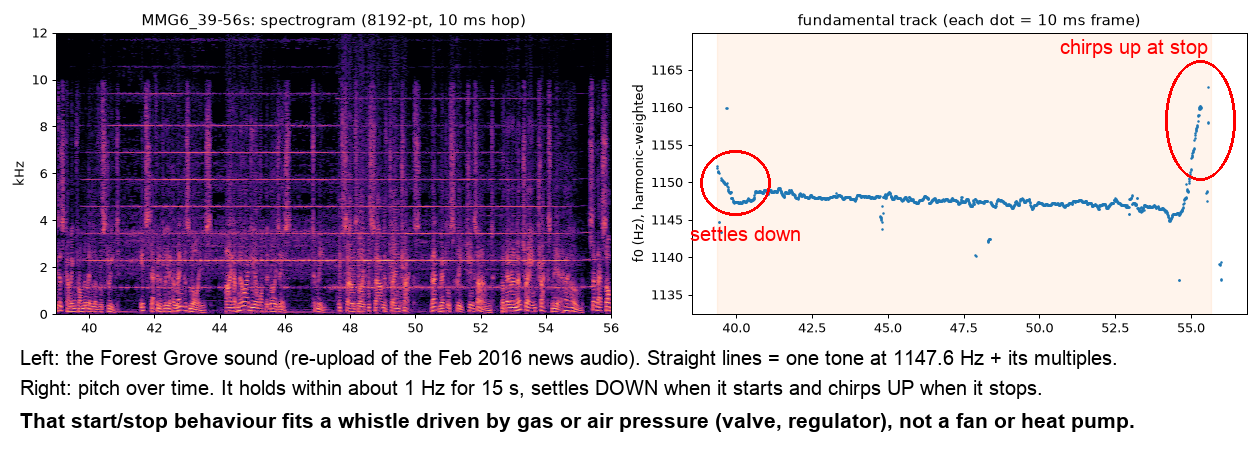
forestgrove_post.png
 
It does have that characteristic.

Hard to imagine a 1KHz single source acoustic signal couldn't be located. A supercaridiod microphone and calibrated VU meter would be a good starting point. Something like the MKH 8050 super-cardioid by Sennheiser as an example of highly directional microphones.

View attachment 94230

Agreed, a shotgun mic and a walk around the neighborhood would have found it in an evening. Shame it stopped on Feb 27 before anyone tried. Now all we have is the news audio :( (as far as we know I guess)
 
Agreed, a shotgun mic and a walk around the neighborhood would have found it in an evening. Shame it stopped on Feb 27 before anyone tried. Now all we have is the news audio :( (as far as we know I guess)
The directionality of the microphone doesn't help much if the sound is already sufficiently loud, unless your technique is to identify the dropouts at 120⁰ that should give a fairly narrow angle.

A better technique might be to use two microphones mounted on a wide bar, fed into headphones for one ear each, to improve directional hearing. (Could also use tubes.)

If you want a highly directional reception, use a parabolic reflector to make a parabolic microphone.
 
Every outlet's recording has the same steady tone at 1147.6 Hz
That's a very interesting piece of spectral analysis, particularly the consistency of the 1,147.6 Hz frequency across the recordings.

I think there are two important distinctions worth exploring before ruling out electrical machinery.(I do have a electronic/electrical engineering background but havent really used it like this in a while so this took some thinking about and research, its also a bit long winded also)

1-The American electricity supply operates at 60 Hz, compared with 50 Hz in Europe (fyi European Debunkers). Conventional transformer hum is principally associated with twice the supply frequency.

The fundamental sound frequency is twice the power line operating frequency of the transformer.
Acme Electric — What causes transformer noise?

However, transformers also generate harmonics. These are whole-number multiples of the fundamental frequency, meaning a 120 Hz hum can have additional components at 240, 360, 480 Hz and upwards like 1200HZ.

But also
The noise spectrum is composed of multiple harmonics of the line frequency, 60 Hz
Transformer Technology — Quiet by Design: Understanding and Reducing Transformer Noise

The ninth and tenth harmonics of 120 Hz would be 1,080 and 1,200 Hz. Interestingly, the nineteenth multiple of 60 Hz is 1,140 Hz, just 7.6 Hz below the reported tone. Nevertheless, 1,147.6 Hz isn't an exact mains harmonic, so ordinary transformer hum remains an unlikely explanation.

I may need to think about this a bit more there is a ±0.03 Hz tolerance so the 19th harmonic of 1040 could go as high as 1040.57, @SkyAugur what was your actual lowest bound figure? Electronic motor controllers can generate other frequencies from the standard 60 Hz supply also.)

Could mechanical resonance be involved? Possibly, but resonance normally amplifies an existing excitation frequency rather than shifting a sustained mains harmonic to an unrelated frequency.

the natural response of the system will be damped out.
Penn State — Undamped Harmonic Forced Vibrations

This leaves the sustained vibration following the driving frequency. A separate resonant or nonlinear mechanism would therefore need to be demonstrated.

2- Electrical frequency versus mechanical noise? A second distinction is that ruling out direct electrical hum doesn't rule out mechanical noise from an electrically driven fan or pump.

A conventional two-pole AC motor has a synchronous speed of 3,600 RPM on America's 60 Hz supply, but induction motors run slightly slower under load.

Speed of an operating electrical motor with load is lower than the synchronous speed
Engineering ToolBox — Electrical Motors: Speed at Operating vs. Synchronous Load

The accompanying table gives approximately 3,450 RPM for a typical loaded two-pole motor.
1794625035794.png


More importantly, fans and impellers produce their own acoustic frequencies, determined by blade count and rotational speed.

Calculation: (Number of blades x fan RPM) / 60 Hz
AMCA International — Basics of Fan Noise, slide 54

For example, a hypothetical 20-blade blower running at 3,442.8 RPM would produce a blade-passing frequency of exactly 1,147.6 Hz, potentially accompanied by higher harmonics. That's remarkably close to a conventional two-pole induction motor's typical operating speed.

A fan or pump can also change pitch during startup and shutdown as its rotational speed changes. Admittedly, the reported upward chirp at cutoff would need further explanation, since a freely slowing fan would normally decrease in pitch.

So I think the absence of an exact 60 Hz relationship is useful evidence against direct electrical hum, particularly from a transformer, but it doesn't eliminate an electrically driven fan or pump.

The frequency stability, harmonics and precise startup/shutdown behaviour deserve closer examination before choosing between a rotating mechanical source and a pressure-driven whistle in my opinion.

Its tricky one, I may have over looked something and not a simple problem I think.
 
A frequency of 1147.6Hz corresponds to a wavelength of almost exactly 30cm (a little under a foot).

That means air rushing past a pipe that's open at one end and 7.5cm (about 3 in) long, or open at both ends and 15 cm long.

Since a close-ended pipe only produces the odd harmonics, the resonator would be something like an open pipe, about 6 inches long.

I have no theory as to the frequency drop and rise at the beginning and end.
 
The directionality of the microphone doesn't help much if the sound is already sufficiently loud
Not sure I understand this. With highly directional microphones, the rear is sensitive to a loss of directionality purely because most of its directionality is from the front. I mean, if you are so close to a sound source that both direct and primary/secondary reflections are creating an omnidirectional sound field around you, then yes agree. But then you are probably right on top of the very loud source anyway. Same effect as stuffing your head inside a bass bin at a Metallica* concert. (*Other rock bands available).

A better technique might be to use two microphones mounted on a wide bar, fed into headphones for one ear each, to improve directional hearing. (Could also use tubes.)
Personally I'd just keep it simple and work with bearings from a directional monophonic setup. Wide spaced microphones (in my experience anyway - YMMV) produce a smeared stereo image. Shotguns (tubes, but not simply a tube), did not work well as crossed stereo pairs (again, weird stereo sound stage) but one might work ok in a mid side configuration.

If you want a highly directional reception, use a parabolic reflector to make a parabolic microphone.
Yes, best case. I had one once, it was fun.

I have no theory as to the frequency drop and rise at the beginning and end.
A fan or heat pump would wind up and down over seconds and drop in pitch when it stops
Given the resonant pipe theory, if the air is provided by a pump, with the change in velocity affecting pitch, much like a flute being played, might we be seeing the modulation effect of the motor controller? Power is applied to the motor which initially is overspeed and then brought back to 'spec' (via a feedback loop of PRM). After time T the controller 'releases' the motor which races a bit until power it's is turned off. Wild guess of course, perhaps vintage control electronics and fading electrolytic capacitors.

All a bit academic now anyway.
 
A frequency of 1147.6Hz corresponds to a wavelength of almost exactly 30cm (a little under a foot).

That means air rushing past a pipe that's open at one end and 7.5cm (about 3 in) long, or open at both ends and 15 cm long.

Since a close-ended pipe only produces the odd harmonics, the resonator would be something like an open pipe, about 6 inches long.

I have no theory as to the frequency drop and rise at the beginning and end.
Could it be something like a change in aperture, as seen in flautists' pitch bending?

Source: https://www.youtube.com/watch?v=Yd-CGxKJnyQ

The funny thing about that is that the change demonstrated might be considered counterintuitive if you just consider end effects.
End effects: smaller diameter = less end effect = shorter actual resonant wavelength = higher resonant frequency
Embouchure: covering port more = lower resonant frequency
I suspect, like much of fluid dynamics, "it's complicated", and I'm certainly no expert.
 
@jon_eir checked. No shaft-rate line near 57 Hz in any of the four clips (TV audio often cuts the low end, so that alone isn't much), no ~57 Hz sidebands around the tone, and the loudness doesn't pulse at shaft rate. It hits full volume in about 50-120 ms and stops in 50-450 ms. A fan would take seconds to spin up and would drop in pitch as it stopped. Lowest per-clip figure is 1146.9 Hz, so still ~7 Hz above 1140.

@Mendel there's a clear 2nd harmonic, so that fits your open pipe.

@FatPhil the aperture idea fits the glides better than anything I had. One clip starts ~5 Hz high and settles in half a second, and two of the stops chirp up 8-13 Hz right before they cut. A valve changing the opening as it opens and shuts could do both, maybe.

@Dave51c possible, but the starts and stops are all under half a second, which seems fast for a motor ramping up or down.
 
Yes, like that. Though this one could've used some proofreading ("Resorant").
Not sure I understand this. With highly directional microphones, the rear is sensitive to a loss of directionality purely because most of its directionality is from the front. I mean, if you are so close to a sound source that both direct and primary/secondary reflections are creating an omnidirectional sound field around you, then yes agree. But then you are probably right on top of the very loud source anyway. Same effect as stuffing your head inside a bass bin at a Metallica* concert. (*Other rock bands available).
You overestimate the directionality. Look at the polar pattern you posted:
Screenshot 2026-11-13 at 20.28.09.png

Up to 45⁰ you get maybe 2dB of attenuation, that is not easy to discern, so you have about a 90⁰ angle where the microphone is very sensitive. This microphone will attenuate background noise from the side or the rear (and in a live sound situation, I would place the monitor speakers at 120⁰), but it won't be very good at "homing in" on a source in front of it. (And if the 1147 Hz sound is already clearly audible, there is no need to attenuate the background noise.)

Incidentally, the same is true for antenna reception: using a simple dipole, you get good reception for a wide range of angles. That's why a radio bearing is taken by turning the antenna to where the reception is worst, and then looking at 90⁰ from that. For this microphone polar pattern, we see a sharp notch at 120⁰ (which represents a cone, but still), so looking for that dropout may give a more clearly defined direction to the sound source.

Personally I'd just keep it simple and work with bearings from a directional monophonic setup. Wide spaced microphones (in my experience anyway - YMMV) produce a smeared stereo image. Shotguns (tubes, but not simply a tube), did not work well as crossed stereo pairs (again, weird stereo sound stage) but one might work ok in a mid side configuration.
The idea is not to get a faithful or natural stereo image, because we're after a single sound source. We get better directionality if we extend the stereo baseline, like in this WW2 anti-air "Horchgerät" (listening device):
Bundesarchiv_Bild_101I-674-7757-09,_Flakhelferinnen_am_Horchgerät.jpg

I think this works because the extended baseline amplifies the phase shift produced by the directional misalignment.
Given the resonant pipe theory, if the air is provided by a pump, with the change in velocity affecting pitch, much like a flute being played, might we be seeing the modulation effect of the motor controller? Power is applied to the motor which initially is overspeed and then brought back to 'spec' (via a feedback loop of PRM). After time T the controller 'releases' the motor which races a bit until power it's is turned off. Wild guess of course, perhaps vintage control electronics and fading electrolytic capacitors.
A resonance is only at a steady frequency when the airflow has stabilized. (An organ winding down with some pipes open is a very weird sound. ;) ) So if we're looking at some vent on a high-pressure line opening and closing, then I would not expect the frequency to be stable as it opens and closes, but it would be stable during the open state.

And yes, as @FatPhil points out, musicians use this. Which is why breathing technique is very important for wind instrument players (and vocalists), to produce stable notes.
 
Turns out this was mostly worked out back in 2016, it just never got around. An audio engineer, Langston Holland, sent Andrew Dawes (the Pacific U physicist who mapped the reports) an analysis matching it to a copper tube ringing on a defective AC compressor valve, i.e. a heat pump. Atlas Obscura wrote it up last year: https://www.atlasobscura.com/articles/forest-grove-sound-mystery

A few things that back it up further though:
  • Dawes' one doubt was that the HVAC example rises in pitch as it dies off, and he couldn't hear that in the recording. In the TV clips two of the stops do chirp up 8-13 Hz right at the end.
  • The size fits. A 1/4" to 3/8" copper line clamped at both ends rings at ~1147 Hz over roughly 15-19 cm, about the same as the 15 cm pipe @Mendel worked out.
  • I also checked six heat pump squeals on YouTube. They can be just as steady and harmonic, anywhere from about 300 to 3,400 Hz, so a heat pump can make this. None had the chirp at the end though, so it'd be a specific fault like Holland's valve, not just any noisy unit.
  • Reports stopped at the end of Feb, but March 2016 was just as cold and wet, so it wasn't seasonal. More like the unit got fixed or the valve finally failed, which Holland predicted at the time.
Nobody found the actual unit so it's not proven, but a failing heat pump valve is the best fit so far (trying to find audio to match against this). The fire marshal's guess was likely close.
 
Great follow-up on the shaft-rate frequency and sidebands. That's useful additional analysis.

I'm not going to reference this reply as heavily as my last one, as we're getting fairly deep into the weeds now, and I think there's enough technical understanding in this thread now to discuss these possibilities without breaking everything down to first principles!

I still feel an electronically controlled fan or pump, particularly one using pulse-width modulation (PWM) or a variable-frequency drive, deserves consideration.

My main concern is that we're assuming the sound starts and stops when the motor itself starts and stops. A worn bearing, intermittent mechanical contact, or vibration exciting a resonance within the fan or pump housing could produce noise without the motor actually starting or stopping. PWM switching frequencies can change independently of motor speed for thermal protection maybe, in response to overheating or excessive load and these could in principle create accelerating or deaccelerating curve's unlike traditional fans. So an upward chirp doesn't necessarily mean the fan itself is accelerating.

PWM drives can generate audible tonal noise through electrical switching and the resulting motor vibrations, independently of the blade-passing frequency. ASHRAE's discussion of motor noise and drive carrier frequencies covers this phenomenon.

Early PWM drives produced extreme motor noise at objectionable frequencies.

These processes can produce changing acoustic frequencies during either the acceleration or deceleration phase, potentially explaining rising or falling pitches, including brief chirps.

This functionality allows activation of two different acceleration and deceleration rates based on a logic input or a frequency threshold.
Schneider Electric — Ramp Switching on Altivar Motor Drives

This confirms that electronic motor controllers can deliberately change acceleration and deceleration profiles.

This parameter randomly modulates the switching frequency in order to reduce audible motor noise.
Schneider Electric — Motor Noise and Switching Frequency

So while the absence of a 57 Hz shaft signature and the rapid onset and cutoff strengthen your pressure-whistle hypothesis, I do agree; personally, it sounds more like tube ringing or a defective AC pressure relief valve. Either way, I think your analysis is narrowing down the possibilities nicely, particularly your last reply. I'm just reluctant to rule out motor-controlled equipment quite yet.

One other question about the recordings: are these four genuinely independent recordings, or could some be different news outlets reusing the same original audio?
 
Turns out this was mostly worked out back in 2016, it just never got around. An audio engineer, Langston Holland, sent Andrew Dawes (the Pacific U physicist who mapped the reports) an analysis matching it to a copper tube ringing on a defective AC compressor valve, i.e. a heat pump. Atlas Obscura wrote it up last year: https://www.atlasobscura.com/articles/forest-grove-sound-mystery
Metabunk is different from other websites, in that conspiracy theorists love to hand out a bunch of links or videos, and say "here's your evidence" without going into details. That's why we have a "link policy" https://www.metabunk.org/threads/metabunks-link-policy.5158/ that usually requires us to quote the relevant bits from the link, like so:
Article:
On the last day of February, Dawes received an email from Langston Holland, an audio engineer in Florida. Holland had heard the Sound on the news and thought it sounded familiar. He presented Dawes with a frequency analysis of it and an example of what he believed to be the likely culprit: a faulty HVAC unit. Laying the two analyses side by side, Holland wrote that "the noise signature almost perfectly matches the copper tube ringing attached to a defective AC compressor valve." Dawes had already been thinking along similar lines, but noted that when the HVAC noise dies off, there's a slight pitch increase, and no such increase can be heard on the Forest Grove Sound recording. Holland suggested that this may be a matter of acoustics—the higher the frequency, the harder it is for a sound to travel, and so that pitch increase may have just been lost to the wind. "Given that air damps high frequencies quicker," he wrote, "I also bet if you got close to the source you'd see the brief pitch changes above 5.76kHz as well." Holland closed out one of his emails by saying, "My guess is that the poorly sealing valve is going to wear to the point where it'll stop making noise anyway. :)"

But because they never found the actual HVAC unit, never traced the sound to a definitive culprit, Dawes is reluctant to fully commit to their theory. "You never get 100 percent confirmation, probably for anything," he told me. "It's always this gray, 'Maybe, seems like a likely answer.' But who knows, it could be something else."

(I used the Wayback Machine to avoid the paywall.)
 
Last edited:
Metabunk is different from other websites, in that conspiracy theorists love to hand out a bunch of links of videos, and say "here's your evidence" without going into details. That's why we have a "link policy" https://www.metabunk.org/threads/metabunks-link-policy.5158/ that usually requires us to quote the relevant bits from the link, like so:
Article:
On the last day of February, Dawes received an email from Langston Holland, an audio engineer in Florida. Holland had heard the Sound on the news and thought it sounded familiar. He presented Dawes with a frequency analysis of it and an example of what he believed to be the likely culprit: a faulty HVAC unit. Laying the two analyses side by side, Holland wrote that "the noise signature almost perfectly matches the copper tube ringing attached to a defective AC compressor valve." Dawes had already been thinking along similar lines, but noted that when the HVAC noise dies off, there's a slight pitch increase, and no such increase can be heard on the Forest Grove Sound recording. Holland suggested that this may be a matter of acoustics—the higher the frequency, the harder it is for a sound to travel, and so that pitch increase may have just been lost to the wind. "Given that air damps high frequencies quicker," he wrote, "I also bet if you got close to the source you'd see the brief pitch changes above 5.76kHz as well." Holland closed out one of his emails by saying, "My guess is that the poorly sealing valve is going to wear to the point where it'll stop making noise anyway. :)"

But because they never found the actual HVAC unit, never traced the sound to a definitive culprit, Dawes is reluctant to fully commit to their theory. "You never get 100 percent confirmation, probably for anything," he told me. "It's always this gray, 'Maybe, seems like a likely answer.' But who knows, it could be something else."

(I used the Wayback Machine to avoid the paywall.)
@Mendel thanks, noted, I'll quote from now on. Your quote has the key line too: Dawes said no pitch increase could be heard at the end. In the TV clips there is one, two of the stops chirp up 8-13 Hz.

@jon_eir fair question. Checking whether the four clips are separate recordings or the same audio re-aired, and looking for PWM/VFD sidebands. Will report back.
 
Back
Top