

SkyAugur
Member
In Feb 2016 a loud high-pitched noise kept Forest Grove, Oregon up at night for a few weeks. The city, the gas company and a university crowd-mapping project never found the source, and it stopped around Feb 27. The fire marshal's guess at the time was an attic fan or heat pump.
Washington Post: https://www.washingtonpost.com/news...g-experts-and-terrifying-an-oregon-community/
NBC: https://www.nbcnews.com/news/us-news/mystery-forest-grove-oregon-noise-may-never-be-solved-n579456
KOIN clip:
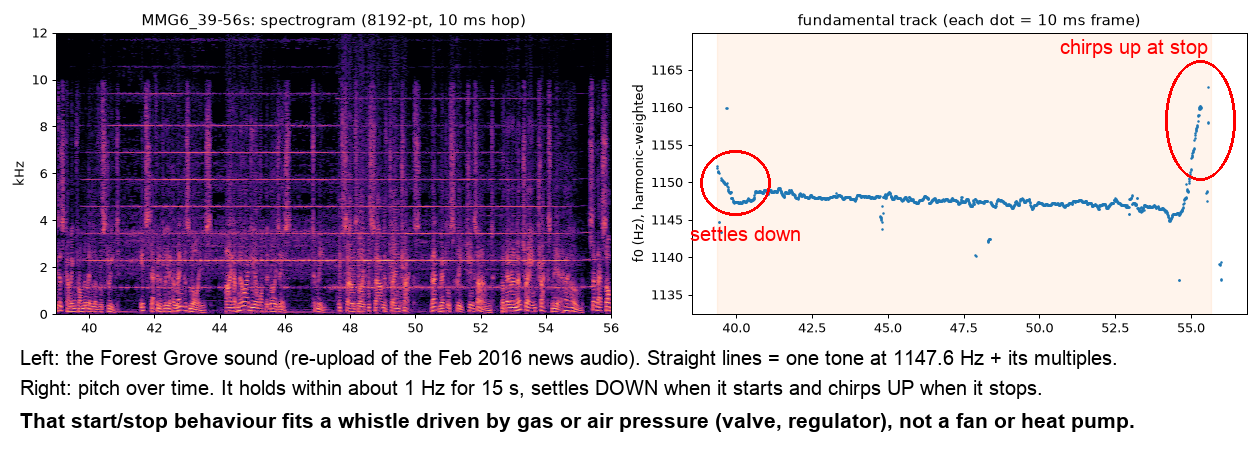
I ran the news clips through a spectrogram. Every outlet's recording has the same steady tone at 1147.6 Hz (all within 2 Hz of each other), with clean exact multiples above it. It holds within about 1 Hz for 15 seconds at a time, and it isn't a multiple of 60 Hz, so probably not a motor or transformer.
The interesting part is how it starts and stops: the pitch settles down a few Hz when it starts and chirps up 10-15 Hz when it cuts off (chart below). A fan or heat pump would wind up and down over seconds and drop in pitch when it stops. This looks more like something whistling from gas or air pressure, like a valve or regulator.
Can't place the actual device from the clips, but it narrows it down.
Washington Post: https://www.washingtonpost.com/news...g-experts-and-terrifying-an-oregon-community/
NBC: https://www.nbcnews.com/news/us-news/mystery-forest-grove-oregon-noise-may-never-be-solved-n579456
KOIN clip:
I ran the news clips through a spectrogram. Every outlet's recording has the same steady tone at 1147.6 Hz (all within 2 Hz of each other), with clean exact multiples above it. It holds within about 1 Hz for 15 seconds at a time, and it isn't a multiple of 60 Hz, so probably not a motor or transformer.
The interesting part is how it starts and stops: the pitch settles down a few Hz when it starts and chirps up 10-15 Hz when it cuts off (chart below). A fan or heat pump would wind up and down over seconds and drop in pitch when it stops. This looks more like something whistling from gas or air pressure, like a valve or regulator.
Can't place the actual device from the clips, but it narrows it down.

 (as far as we know I guess)


