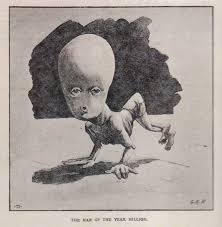
Giddierone
Senior Member.
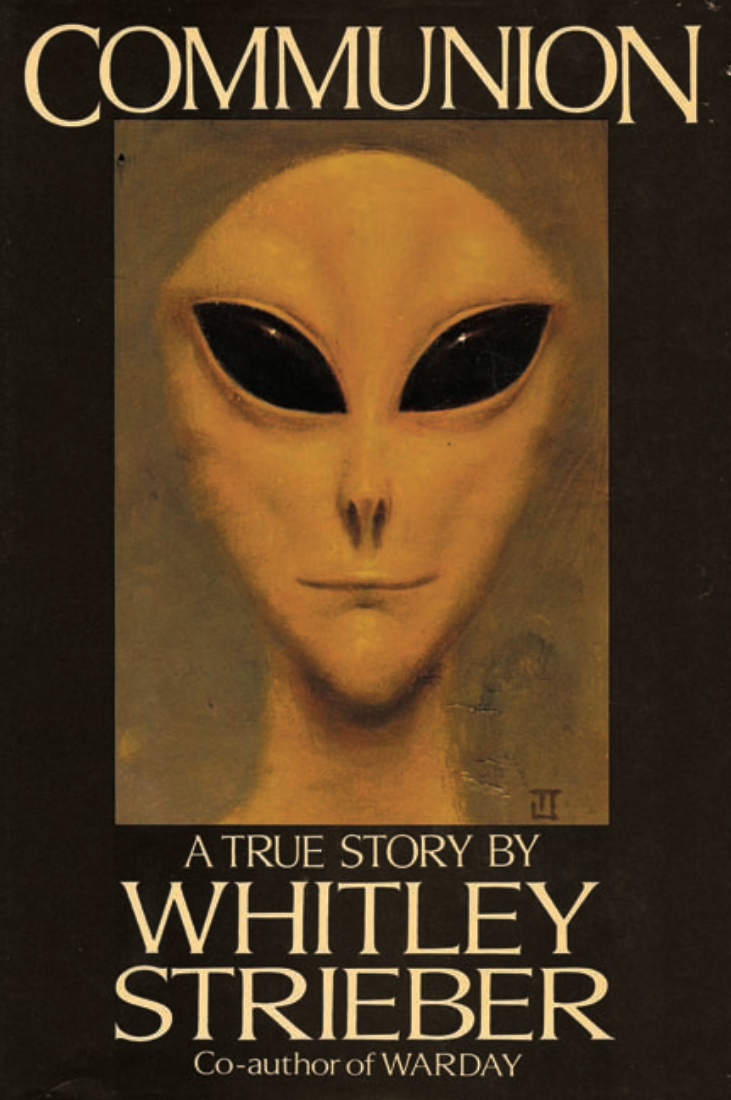
Anecdotes about people seeing the cover of Whitley Strieber's Communion (1987) for the first time and it triggering a reaction in them such as the shock of recognition or the sudden stirring of a memory are numerous.
(the same anecdote appears in After the Flying Saucers Came - Greg Eghigian, 2024)
Others who describe similar encounters with the cover include immunologist and ufology commentator Garry Nolan. The list goes on, but it seems the book cover can't be mentioned without someone telling of a similar reaction upon first seeing it.
It was painted by Ted Seth Jacobs (1927-2019). He was an accomplished realist painter and draftsman.

The cover illustration he created with Whitley Strieber is a marked departure from his other art.
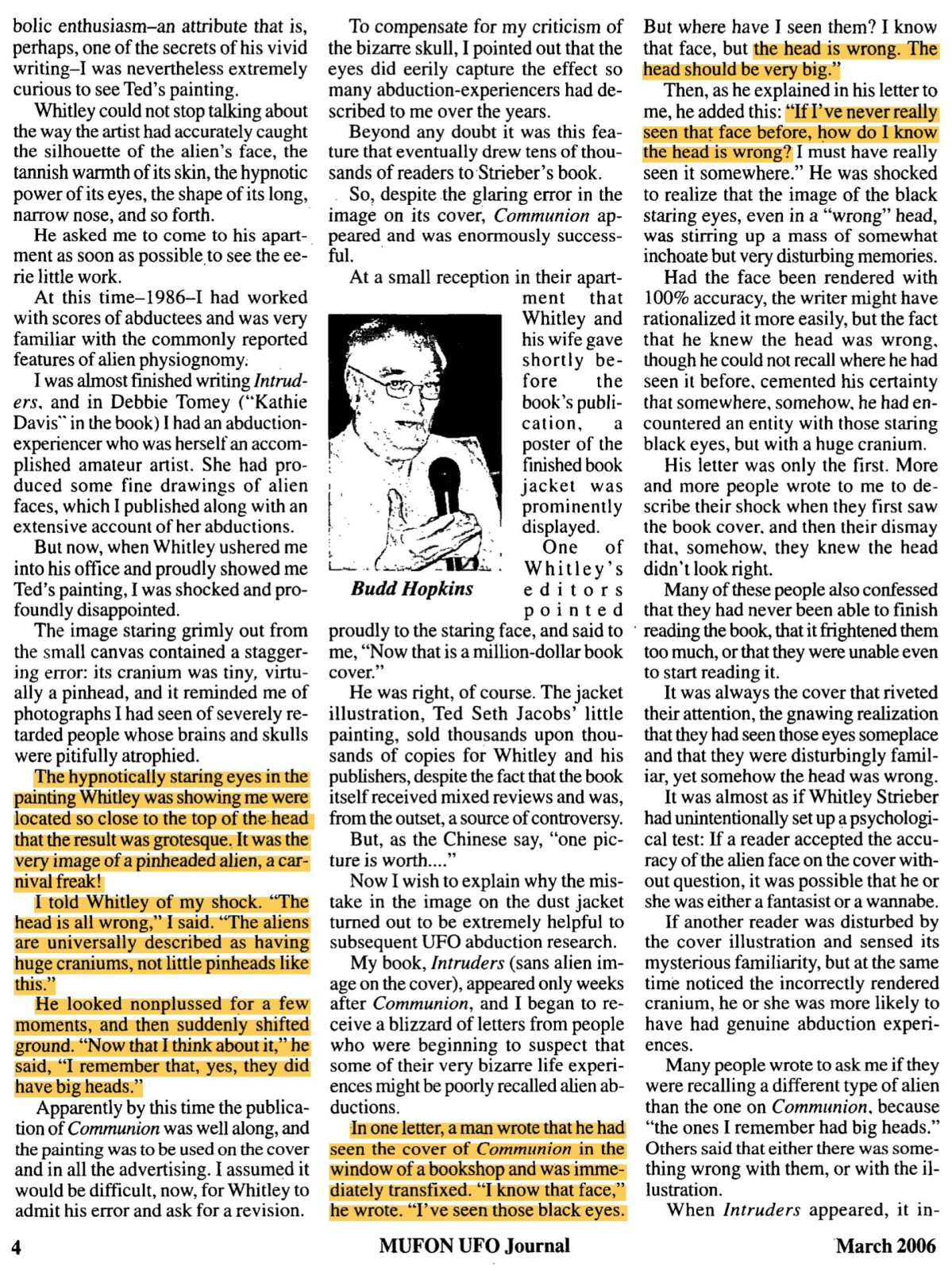
Alien Abduction researcher (and also an accomplished artist) Budd Hopkins hated the cover saying it was "Pinheaded" and the proportions were all wrong.
Folklorist Thomas Bullard did a comparative study of hundreds of alien abduction reports in UFO Abductions: The Measure of a Mystery. Volume 1: Comparative Study of Abduction Reports, 1987. He followed it up in 1999 with What's New in Ufo Abductions? Has the Story Changed in 30 Years?
One of the notable changes he tracked was the description of the eyes of the aliens people claimed to encounter. Between 1966 and 1996 there was what he called an "unmistakable trend" toward larger darker eyes.
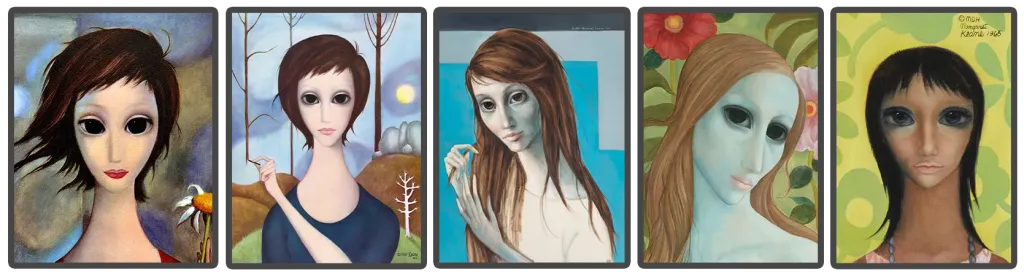
Details from Keane's young women (from left to right) Daisy, 1963, Draw Double, 1963, Girl With Long Hair, 1964, Bouquet, 1968, Girl of the Island, 1965
Proportionally the Communion cover resembles Keane's art far more than it does existing depictions of aliens (as Budd Hopkins might have agreed — see above). They share very similar proportions, head shape, chin shape, long neck, and other grey alien-like characteristics: pallid skin tone, slight smile, small nose, faint eyebrows. They nearly always gaze directly at the viewer. They almost never had ears and often had long slender fingers without nails.
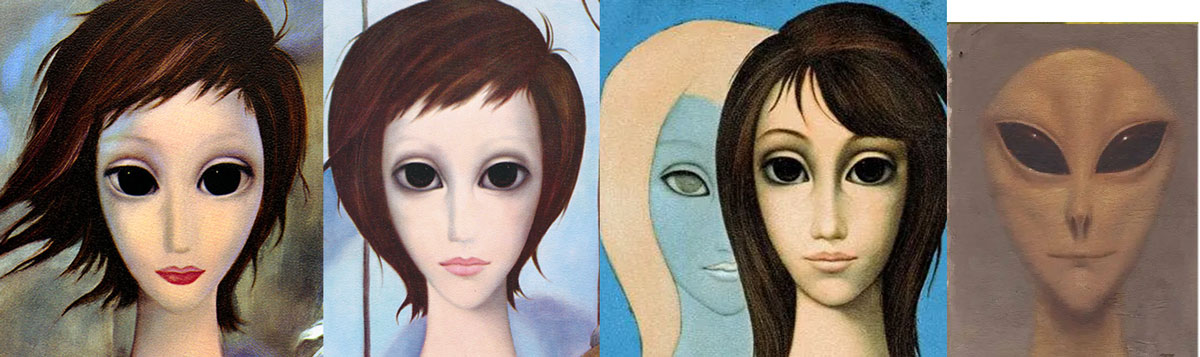
It seems obvious that Strieber and Jacobs were aware of Keane's art. I'd argue they used it as a template.
So, since Keane's art (which was very popular, her lithographs were mass-produced) already existed in the culture many years prior to Communion might those anecdotes of triggered memories and the sense that "I've seen that face before" have something to do with Keane's creations?
Dancing Naked in the Mind Field, (geneticist) Kary Mullis, 1998External Quote:Some time later I was in a bookstore in La Jolla. I noticed a book on display by Whitley Strieber called Communion On the cover was a drawing that captured my attention. An oval-shaped head with large inky eyes staring straight ahead.
I bought the book and immediately began reading it. It was Strieber's personal account of being abducted by aliens. He wrote of waking up in his cabin in the woods of New York State and seeing an owl staring at him. He spoke to the owl, then two beings, who looked like the figure on the cover of the book. appeared in his doorway and escorted him out of the house. He wrote that he had smelled burning cinnamon and smolder-ing cheese around them, so I burned some myself to see if that might excite a memory, but it didn't.
While I was reading this book my daughter. Louise, called from Portland. "Dad, there's a book I want you to read. It's called Communion.
"I'm reading it right now."
The Abduction Enigma - Kevin D. Randle, 1999External Quote:I did not think much about any of these things again until 1987. I was walking through a bookstore when a strange picture caught my eye. It was the cover of a new book called Communion. Mesmerized by those huge black eyes of the creature on the jacket, I bought the book immediately, hurried home, and read it cover to cover.
They Know us Better Than we Know Ourselves - Bridget Brown, 2007External Quote:Maureen explains that in 1988 she passed Communion in the book-
store: "After seeing the cover of Communion and being both drawn and
repulsed by it, 'cause it terrified me, I read the book and that's when I
realized that a lot of things Whitley Strieber had written about sounded
all too familiar to me."
Intimate Alien, David Halperin, 2020External Quote:Rima Laibow was a psychiatrist who had a private practice outside of
New York City. After a patient of hers in 1988 happened to see an image of
a large-eyed alien on a book jacket, she confessed to Laibow she had
fragmentary memories of encounters with similar creatures.
(the same anecdote appears in After the Flying Saucers Came - Greg Eghigian, 2024)
Intimate Alien, David Halperin, 2020External Quote:Fast forward to 1987. I'm nearly forty years old, a tenured professor of religious
studies at the University of North Carolina, Chapel Hill. I'm in a book-
store on Franklin Street, across from the campus. Prominently displayed
on one table are several stacks of a hardcover book called Communion,
by one Whitley Strieber. A face stares up at me from the book jacket.
It's a face I've never seen before, though all of us will see it many
times in the years to come. Shaped like a light bulb, as light bulbs used
to be. Dominated by two slanted, enormous, anatomically impossible
eyes: almond-shaped, black, without iris or pupil or any visible lids, each
with a gleam of white amid the blackness and just the hint of a split run-
ning from end to end. I've never seen anything like this—not in Close En-
counters of the Third Kind or E.T., not in the UFO literature of my youth.
I have no idea that this face and the being to which it's attached will
become an icon, a cultural staple, instantly recognizable when used in
cartoons and comic strips, taking its place in three-dimensional miniature
on the dollar-store racks at Halloween time, alongside the plastic witches
and ghosts and spiders that are the traditional, time-honored inhabitants
of the boo-I-scared-you gallery.
Others who describe similar encounters with the cover include immunologist and ufology commentator Garry Nolan. The list goes on, but it seems the book cover can't be mentioned without someone telling of a similar reaction upon first seeing it.
It was painted by Ted Seth Jacobs (1927-2019). He was an accomplished realist painter and draftsman.
The cover illustration he created with Whitley Strieber is a marked departure from his other art.
Alien Abduction researcher (and also an accomplished artist) Budd Hopkins hated the cover saying it was "Pinheaded" and the proportions were all wrong.
Folklorist Thomas Bullard did a comparative study of hundreds of alien abduction reports in UFO Abductions: The Measure of a Mystery. Volume 1: Comparative Study of Abduction Reports, 1987. He followed it up in 1999 with What's New in Ufo Abductions? Has the Story Changed in 30 Years?
One of the notable changes he tracked was the description of the eyes of the aliens people claimed to encounter. Between 1966 and 1996 there was what he called an "unmistakable trend" toward larger darker eyes.
But, something also occurred in that time period 1966-1996. Artist Margaret Keane (1927-2022) created and popularised a distinct style of big-eyed figure whose eyes included large dark irises. They were almost exclusively female.External Quote:In the early days these eyes often had irises of human or smaller size. A steady darkening has followed, with only 17% of the eyes described as wholly or almost entirely dark in the first period, while this description grew to 48% in the middle years and then to 71%. Here then is one abduction motif that has changed too dramatically to ignore or to excuse as an accident of faulty reporting.
Details from Keane's young women (from left to right) Daisy, 1963, Draw Double, 1963, Girl With Long Hair, 1964, Bouquet, 1968, Girl of the Island, 1965
Proportionally the Communion cover resembles Keane's art far more than it does existing depictions of aliens (as Budd Hopkins might have agreed — see above). They share very similar proportions, head shape, chin shape, long neck, and other grey alien-like characteristics: pallid skin tone, slight smile, small nose, faint eyebrows. They nearly always gaze directly at the viewer. They almost never had ears and often had long slender fingers without nails.
It seems obvious that Strieber and Jacobs were aware of Keane's art. I'd argue they used it as a template.
So, since Keane's art (which was very popular, her lithographs were mass-produced) already existed in the culture many years prior to Communion might those anecdotes of triggered memories and the sense that "I've seen that face before" have something to do with Keane's creations?


 )
)