"The craters that never were: Anthropogenic origins of alleged impact structures in the Chiemgau region"

jdog

Senior Member.
An October 21, 2026 paper in Meteoritics and Planetary Science touches on some interesting bunk that had been presented as science at planetary science conferences and published in less-rigorous journals:
External Quote:

Public fascination with impact craters often drives bold speculations, but rigorous verification is critical. In southeastern Bavaria, numerous depressions have been proposed to represent impact craters associated with a catastrophic event in Celtic times (between 900 BC and 600 BC)—the so called "Chiemgau Impact." To date, the evidence presented in support of the proposed Chiemgau Impact has not been independently validated as diagnostic of a confirmed impact event, and this interpretation has been repeatedly challenged in the scientific literature.
Plus:
External Quote:

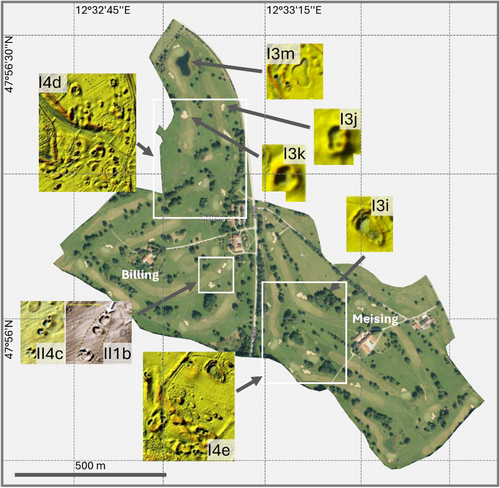
We localized and critically examined these structures in the field as well as using publicly available high-resolution LIDAR data, aerial imagery (historic and recent), and development plans. The majority of these images show structures which are demonstrably anthropogenic, including gravel pits, WWII bomb craters, retention basins, and—most notably—golf course features such as bunkers and ponds.
Example of part of the purported impact field examined in more detail, demonstrating their alternatingly sandy and pondy nature:

maps70255-fig-0005-m.webp

External Quote:

FIGURE 5

Geographic features illustrated in Figures 3 and 4 (I3i-I3m, I4d+e, II1b, II4c) of Ernstson and Poßekel (2025) and West and Ernstson (2026), identified by those authors as impact craters, correspond to structures within a golf course (Golfclub Chieming) that today function as greens, sand bunkers, and ponds. Coordinates are given in Table 1. Background map: © Bayerische Vermessungsverwaltung (2024), data source: Geoportal Bayern www.geoportal.bayern.de.
The critique suggest that the earlier authors embrace a broad theory of catastrophism and reject evidence that glaciers and later human settlement altered the landscape and point out that the idea has been embraced by local officials and tourism interests happy to be the site of "what is likely the most significant impact event of the Holocene to date."

Fringe theories can get published or presented in posters at AGU, but that doesn't mean they're a) true or b) immune to scientific criticism, though the Chiemgau guys seem really, really mad that "Wikipedia has mutated to a manipulation machine, initiated by well-known scribblers and opponents of the Chiemgau Impact who remain unrepentant to this day."
 
An October 21, 2026 paper in Meteoritics and Planetary Science touches on some interesting bunk that had been presented as science at planetary science conferences and published in less-rigorous journals:
Thank you for that, a fun read!

The relevant paper is available in full via Wiley Online Library,
"The craters that never were: Anthropogenic origins of alleged impact structures in the Chiemgau region", Robert Huber, Hans Lauterbach, Robert Darga, Meteoritics & Planetary Science 1–12 (2026) https://onlinelibrary.wiley.com/doi/full/10.1111/maps.70255

External Quote:
CONCLUSIONS
Our analysis of depressions in southeastern Bavaria, which were interpreted as being of impact origin in recent publications, shows that the majority of the proposed "impact craters" are, in fact, clearly identifiable anthropogenic structures, including gravel pits, bomb craters, water retention basins, and numerous golf course features, with origins documented in historical maps, development plans, and aerial imagery. None of the examined features provide credible evidence for an impact origin, and many can be traced to specific construction phases within the last few decades. These findings are consistent with the existing evidence base, in which the proposed Chiemgau Impact has not been supported by independently verified impact evidence. The persistence of the impact-crater interpretation despite readily available contradictory evidence highlights the importance of applying systematic verification methods to exclude anthropogenic origins—such as cross-checking with historical and cartographic sources—before advancing extraordinary geological claims.

-Ah, to my surprise it can be downloaded as a PDF, attached below.
 

Attachments

Last edited:
Thank you for that, a fun read!

The relevant paper is available in full via Wiley Online Library,
"The craters that never were: Anthropogenic origins of alleged impact structures in the Chiemgau region", Robert Huber, Hans Lauterbach, Robert Darga, Meteoritics & Planetary Science 1–12 (2026) https://onlinelibrary.wiley.com/doi/full/10.1111/maps.70255

External Quote:
CONCLUSIONS
Our analysis of depressions in southeastern Bavaria, which were interpreted as being of impact origin in recent publications, shows that the majority of the proposed "impact craters" are, in fact, clearly identifiable anthropogenic structures, including gravel pits, bomb craters, water retention basins, and numerous golf course features, with origins documented in historical maps, development plans, and aerial imagery. None of the examined features provide credible evidence for an impact origin, and many can be traced to specific construction phases within the last few decades. These findings are consistent with the existing evidence base, in which the proposed Chiemgau Impact has not been supported by independently verified impact evidence. The persistence of the impact-crater interpretation despite readily available contradictory evidence highlights the importance of applying systematic verification methods to exclude anthropogenic origins—such as cross-checking with historical and cartographic sources—before advancing extraordinary geological claims.

-Ah, to my surprise it can be downloaded as a PDF, attached below.
Darn, I thought I had linked to it!

My attention to detail has cratered lately.
 
Thank you for that, a fun read!

The relevant paper is available in full via Wiley Online Library,
"The craters that never were: Anthropogenic origins of alleged impact structures in the Chiemgau region", Robert Huber, Hans Lauterbach, Robert Darga, Meteoritics & Planetary Science 1–12 (2026) https://onlinelibrary.wiley.com/doi/full/10.1111/maps.70255

External Quote:
CONCLUSIONS
Our analysis of depressions in southeastern Bavaria, which were interpreted as being of impact origin in recent publications, shows that the majority of the proposed "impact craters" are, in fact, clearly identifiable anthropogenic structures, including gravel pits, bomb craters, water retention basins, and numerous golf course features, with origins documented in historical maps, development plans, and aerial imagery. None of the examined features provide credible evidence for an impact origin, and many can be traced to specific construction phases within the last few decades. These findings are consistent with the existing evidence base, in which the proposed Chiemgau Impact has not been supported by independently verified impact evidence. The persistence of the impact-crater interpretation despite readily available contradictory evidence highlights the importance of applying systematic verification methods to exclude anthropogenic origins—such as cross-checking with historical and cartographic sources—before advancing extraordinary geological claims.

-Ah, to my surprise it can be downloaded as a PDF, attached below.
Interesting reading.
Have the proponents fleshed out the theory with anything more that saying 'that looks like a crater'?
And what is the minimum size for a meteor crater that would not be immediately obliterated by wind, rain and vegetation in that local climate? And what is the minimum size meteor that would even generate a crater?
Any metor fragments been found associated with any of these 'craters'?

The paper almost sounds like a term paper for some college class teaching how to conduct and document research.
 
Have the proponents fleshed out the theory with anything more that saying 'that looks like a crater'?
And They're not even that strong "that looks like a crater" statements:
External Quote:
As Fig. 8 shows, the shape is far from being circular, ...
where figure 8 is:
image016.jpg

and I think we can agree with their description at that point, however, they continue:
External Quote:
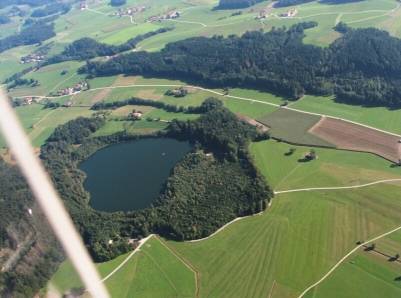
...but in parts, the shore matches exactly a circle. We suggest therefore that the Tüttensee was formed by the impact of a fragmented projectile similar to the irregularly shaped craters of the Kaalijarvi and Henbury meteorite crater fields. .
By "in parts ... matches exactly" - do they mean "mostly doesn't match"? I include that final sentence because I have visited Kaali on Saaremaa, and it bears no resemblence to the above shapeless mess:
A-Location-of-the-Kaali-main-impact-crater-on-Saaremaa-Island-Estonia-is-indicated.png

img link: https://meteoritegallery.com/wp-con...r-on-Saaremaa-Island-Estonia-is-indicated.png
via: https://meteoritegallery.com/kaalijarv-iab/
960px-Kaali_meteorite_crater.jpg

img link: https://thumb.wikimedia.org/wikiped...e_crater.jpg/960px-Kaali_meteorite_crater.jpg
via: https://et.wikipedia.org/wiki/Kaali_kraater
That's a "the shore matches exactly a circle" claim that I think is supported by the evidence, and that crater is perhaps twice the age of their claimed one (but recent enough for the event to have become part of oral folk-history across much of northern europe.)
 
Back
Top