
That football and the Spidercam cable (England vs Norway : World Cup 2026)

GM4AJK

Senior Member
Yes, I'm going there; someone on MB had to. I nearly posted this in the "Skydentify" forum as it seems to be yet another case of teasing information out of 6 pixels. But here we go.

In the quarter-final between England and Norway, it's claimed that moments before England's goal, the ball struck a cable supporting the Flying SpiderCam. Everyone (and I actually mean the Twitter/X crowd) is focused on an apparent change in the direction of the ball's flight after the goal kick is taken, a change I myself can't seem to see. However, as with all "close-quarter" after-the-fact analysis, there appears ot be a glaring omission in everyone's thoughts. If the cable is supporting the Spidercam, where is the Spidercam? Surely it must be below the ball's height if the ball hits a cable. Yet we can all see the ball, yet there's no Spidercam in any video I've watched.

Can the astute MB observers find the SpiderCam? And, despite FIFA releasing the ball sensor data (laughable graphs anyway) the one thing FIFA have not released is video taken from the SpiderCam itself, which I assume (never assume!) at goal kicks it lifted as high as it'll go to avoid contact and get the best panoramic view. Can anyone shed any light on that piece of speculation from me? Does anyone know what the SpiderCam does at goal kicks?
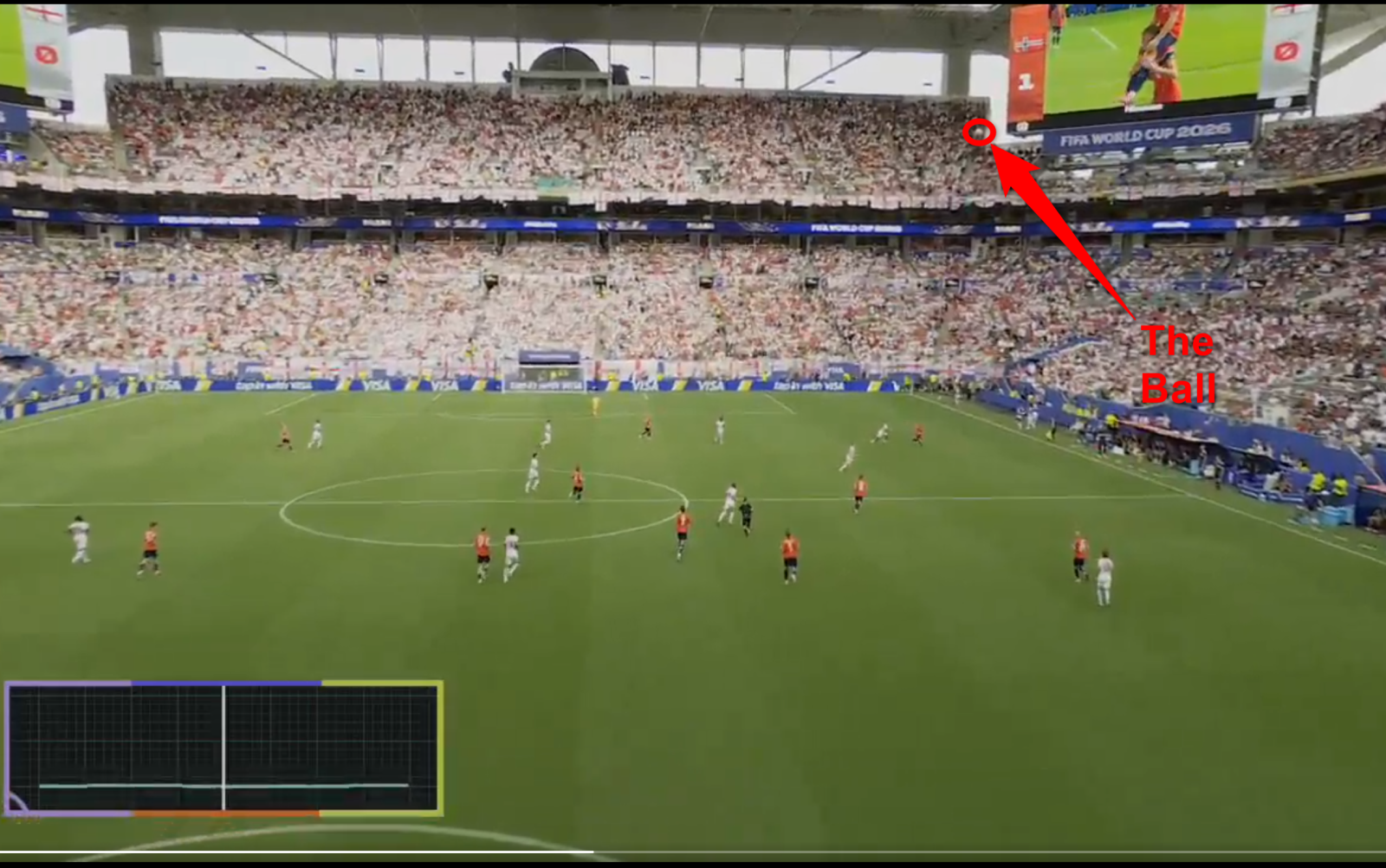
2026-07-13_10h45_25.png


Everyone (and I actually mean the Twitter/X crowd) is focused on an apparent change in the direction of the ball's flight after the goal kick is taken, a change I myself can't seem to see.
I think what people are referring to (I could be wrong) is around 7 seconds in the FIFA media video from behind the goal (where the freeze frame is taken), the ball appears to make quite a deflection to the right as it falls. It's near the edge of the top tier stadium at that point (and travels up, in view, in quite a straight line), but gets much further right than that when the ball drops.

I'm of the opinion it's more to do with camera angle than ball's trajectory, but I'm just trying to help people see what others are talking about.
 
Last edited:
So I found where the SpyderCam was actually a few moments after the ball landed, and Google's AI, along with the stadium dimensions and the way the SpyderCam is rigged, says it's impossible for the ball to have struck a cable. Here's where I found the SpyderCam (highlighted by the red circle):-

Here's the video this image was taken from:
 

Attachments

  • 2026-07-13_13h26_21.png
    2026-07-13_13h26_21.png
    1.3 MB · Views: 1
And, despite FIFA releasing the ball sensor data (laughable graphs anyway) the one thing FIFA have not released is video taken from the SpiderCam itself, which I assume (never assume!) at goal kicks it lifted as high as it'll go to avoid contact and get the best panoramic view.
Isn't the fifamedia video you posted the spidercam video?
 
And I have now figured out that the first video I posted, the official FIFA video of the goal kick from behind the goals, was in fact the SpyderCam's video.

 
OK, time to take a deep breath and suck it up. I may not be @Mick West and a Sitrec guru, but I know enough Python, AI, and FreeCAD to model it out (roughly). It seems to me there is, in fact, a potential for the cable to interfere with the ball. This model doesn't even account for the catenary in the cable, which would lower it more than the straight-line representation. [edit: I had to, of course, make an assumption about how high the ball reached after the goal kick and used AI's estimate of 28 to 32 metres, but I see enough ambiguity here not to argue either way now).


Last edited:
OK, time to take a deep breath and suck it up. I may not be @Mick West and a Sitrec guru, but I know enough Python, AI, and FreeCAD to model it out (roughly). It seems to me there is, in fact, a potential for the cable to interfere with the ball. This model doesn't even account for the catenary in the cable, which would lower it more than the straight-line representation. [edit: I had to, of course, make an assumption about how high the ball reached after the goal kick and used AI's estimate of 28 to 32 metres, but I see enough ambiguity here not to argue either way now).


View attachment 92023
You used the spidercam's position at start of the clip but it looks like the camera moves toward the center of the field while the ball is in the air, so the cable position would be different during the apex of the trajectory.
How did you determine the cables anchor points position?
It's a fun case to illustrate the kind of work you can do on UAP cases.
 
What exactly is the issue here? I'll confess I haven't kept up with the World Cup, I just refuse to pay for commercial TV that's full of commercials that I have to pay for.

There is a clearing kick by the goalie that goes down near midfield that supposedly hits a Spydercam cable....and what? I don't know soccer rules that well, but would this be some sort of "interference" call resulting in a do over? If it were obvious, I guess that makes sense, but in the videos, IF the ball touches the cable at all, it has no appreciable effect on it.

Is the claim that the ball obviously struck the cable, deflected noticeably and caused the Norwegians to pull up expecting some sort of interference call allowing the wiley Britts to sneak a goal? Having seen that an unfair goal had been scored, FIFA then went back and doctored the ball tracking data to eliminate the obvious cable strike?

Or is it more nefarious? Was FIFA in cahoots with the Britts for diabolical reasons, and rigged the game? The plan was to wait for the right goal kick, then in a coordinated effort, move the Spydercam to the needed location to make the proper support cable droop (cantenary) at the right spot as to deflect the ball in an advantages way for the Britts. Thus, helping to ensure, or at least influence, a final between European and South American soccer powerhouses Spain and Argentina?

Spain vs Brazil would have worked too, but not Brazil vs Argentina, too Latin America. Note the bracketing ensured this could not happen:

1783958324423.png


FIFA is going to have to work the Spydercam cables, and every other trick they have, in the semis or they could be stuck with a complete snoozer like France vs England. Fun for those continentals reliving the 100 years war, but not very compelling in the rest of the world.

Spain vs England? Meh, pretty much the same thing, Frances Drake going after the Spanish main, but nothing the rest of the world is interested in.

France vs Argentina? Better. At least 440 million South Americans are now interested, many likely rooting for France.

Argentina vs Spain? Winner! That's the jackpot match-up. The Europe of South America vs (arguably) the South America of Europe. The colonials vs the colonizers. The son battles the father. Zeus meets Chronos.
 
There is a clearing kick by the goalie that goes down near midfield that supposedly hits a Spydercam cable....and what?
The rule is play should be stopped and a drop ball.

Not too sure about the drop ball because they are uncontested these days so dunno who the drop ball goes to in this instance.

But yeah, it's that play should've stopped if it did happen which is the main complaint.
 
You used the spidercam's position at start of the clip but it looks like the camera moves toward the center of the field while the ball is in the air, so the cable position would be different during the apex of the trajectory.
How did you determine the cables anchor points position?
It's a fun case to illustrate the kind of work you can do on UAP cases.
It does indeed move forward. In fact, you can see in one of the videos that after Anderson receives the ball and moves forward, the Spydercam again comes into view, top left of the screen, moving forward and up. ( @Mick West worth noting these cameras and the Spydercam position to feed into Sitrec/AI).

The point for me was just knowing if the cable and ball trajectory were even close enough to interfere with each other at all. My crude recreation told me they were much closer than I had previously speculated and, unlike a UAPer, I changed my opinion from "no chance at all" to "I don't know, it looks close". My real point is how new evidence changed my opinion of the overall situation. Do I have an answer? Nope, the videos don't show a collision to me, but they do to others. Pixel picking again, def UAP territory ;)
 
I used Sitrec to make a panorama video


I really can't see where there's a change in trajectory.

I suspect there probably was a contact, as several people claimed to see it at the time. I don't think it was consequential. Unlikely anything will happen.
 
I suspect there probably was a contact, as several people claimed to see it at the time.
Can you clarify this?

As far as I'm aware (probably not very) only the goalkeeper seems to have seen it. I'm not sure the reactions of manager and others is more about having something to complain about after the goal (believing their keeper) rather than actually seeing it.

Also why do you suspect contact when the (supposed) data from the ball's sensor suggests not (assuming you are aware of the ball's sensor's data)?
 
Last edited:
As far as I'm aware (probably not very) only the goalkeeper seems to have seen it. I'm not sure the reactions of manager and others is more about having something to complain about after the goal (believing their keeper) rather than actually seeing it.
Haaland on the pitch seems to indicate that there was contact. There were reports of the Norwegian bench immediately reacting.

Also why do you suspect contact when the (supposed) data from the ball's sensor suggests not (assuming you are aware of the ball's sensor's data)?
Looking at the graph the massive impact from the kick causes a peak to about 70 (unknown units, assuming the line just before the top represents 100) Afer that's wobbles, with no contact, in the 5-10 range
1783974158111.png


A contact with the wire could be 1 or less, and lost in the noise. The actual amount isn't really the issue. The question is there was ANY contact.

Of course, it could also just be a bad pass. I've not seen any compelling physical evidence otherwise.
 
Back
Top