
You are using an out of date browser. It may not display this or other websites correctly.
You should upgrade or use an alternative browser.
You should upgrade or use an alternative browser.
Debunked: Patents. As Evidence of Chemtrails, Geoengineering, Existence, Operability, or Intent
- Thread starter Mick West
- Start date

MikeC
Closed Account
I addressed a long list of patents in this thread on above top secret - http://www.abovetopsecret.com/forum/thread760080/pg1

Marin B
Senior Member
I saw that Rolls Royce has a recently published patent application for an Aircraft Vapour Trail Control System. The stated objective is
. The background section has a pretty straight-forward explanation how contrail-cirrus form and the potential impact on climate. This might be useful information to share with a chemtrail believer who argues that today's jets don't create persistent contrails. If so, then why is one of the largest manufacturers of aircraft engines filing for patent protection on engines that can reduce contrail formation? Of course, the committed CT-believer will probably argue back that "they" are doing this only to make it look like today's jets still make persistent contrails...External Quote:to manage the formation of contrails by aircraft engines in a manner that reduces negative impact on the climate
Marin B
Senior Member
Looking back on some of the older posts on this thread I noticed that a few references/links were made to "patents", when actually they were just patent applications. Anyone can file a patent application which will get published - the publication number begins with the year of publication. If a patent issues, then it will be republished with a patent number (U.S. patents are now issuing with patent numbers in the 9 millions).
I took a look at the status of some of the wacky publications mentioned in the list that included
Hyperspace torque generator
All the ones I looked into, had been abandoned - i.e. no patent ever issued. The status of a U.S. patent application can be found using the patent office's PAIR website.
To be patentable, the patent application is supposed to be directed to a "new and useful process, machine, manufacture, or composition of matter, or any new and useful improvement thereof" (35 USC Sec. 101). The Hyperspace torque generator application was rejected because it didn't satisfy this requirement; the patent office said that the invention "is not deemed to be credible."
The patent application must also "contain a written description of the invention, and of the manner and process of making and using it, in such full, clear, concise, and exact terms as to enable any person skilled in the art to which it pertains" (35 USC Sec. 112). This was another ground for rejecting the hyperspace application. The patent examiner said "there is insufficient structure and discussion of operability so as to enable one skilled in the electrical arts to make and use the invention."
Patents are supposed to describe an operable invention in order to be valid. But it's pretty clear that a lot of them get through the patent office without a very thorough examination.
I took a look at the status of some of the wacky publications mentioned in the list that included
Hyperspace torque generator
All the ones I looked into, had been abandoned - i.e. no patent ever issued. The status of a U.S. patent application can be found using the patent office's PAIR website.
To be patentable, the patent application is supposed to be directed to a "new and useful process, machine, manufacture, or composition of matter, or any new and useful improvement thereof" (35 USC Sec. 101). The Hyperspace torque generator application was rejected because it didn't satisfy this requirement; the patent office said that the invention "is not deemed to be credible."
The patent application must also "contain a written description of the invention, and of the manner and process of making and using it, in such full, clear, concise, and exact terms as to enable any person skilled in the art to which it pertains" (35 USC Sec. 112). This was another ground for rejecting the hyperspace application. The patent examiner said "there is insufficient structure and discussion of operability so as to enable one skilled in the electrical arts to make and use the invention."
Patents are supposed to describe an operable invention in order to be valid. But it's pretty clear that a lot of them get through the patent office without a very thorough examination.

Ross Marsden
Senior Member.
I saw that Rolls Royce has a recently published patent application for an Aircraft Vapour Trail Control System. The stated objective is. The background section has a pretty straight-forward explanation how contrail-cirrus form and the potential impact on climate. This might be useful information to share with a chemtrail believer who argues that today's jets don't create persistent contrails. If so, then why is one of the largest manufacturers of aircraft engines filing for patent protection on engines that can reduce contrail formation? Of course, the committed CT-believer will probably argue back that "they" are doing this only to make it look like today's jets still make persistent contrails...External Quote:to manage the formation of contrails by aircraft engines in a manner that reduces negative impact on the climate
It has a very good high-level explanation of the formation and dissipation of contrails.
The patent idea is that engine efficiancy could be modified so as to, effectively, lower the Contrail Critical Temperature for the engine, thus moving the environment conditions from the "Always contrails" to the "No contrails" region on the Appleman Chart. Think of the Appleman Chart curved lines being movable. Less efficient engines have those lines further to the left (cooler).
The engine controller (pilot) may go for more power to maintain trust, or possibly, the engine parameters may not allow that.
The patent discusses routing soulutions to reduce contrails, and this is then another option.
Marin B
Senior Member
Rolls Royce has quite a few other recent patent applications that also came up from a search of cirrus + contrails.
2015/0292402
2015/0284102
2015/0284101
2015/0284103
2015/0285158
2015/0292402
2015/0100219
2015/0100220
2015/0292402
2015/0284102
2015/0284101
2015/0284103
2015/0285158
2015/0292402
2015/0100219
2015/0100220

Hama Neggs
Senior Member
Less efficient engines have those lines further to the left (cooler).
Typo? I thought that MORE efficient engines had cooler exhaust. One of us has it backward.

Typo? I thought that MORE efficient engines had cooler exhaust. One of us has it backward.
The chart shows the critical temperature. Less efficient engines are hotter, so they have a cooler critical temperature.
i.e. the air needs to be cooler, so the exhaust cools down quicker, allowing it to pass through the zone of water supersaturation. Consider this chart which shows the mixing line.
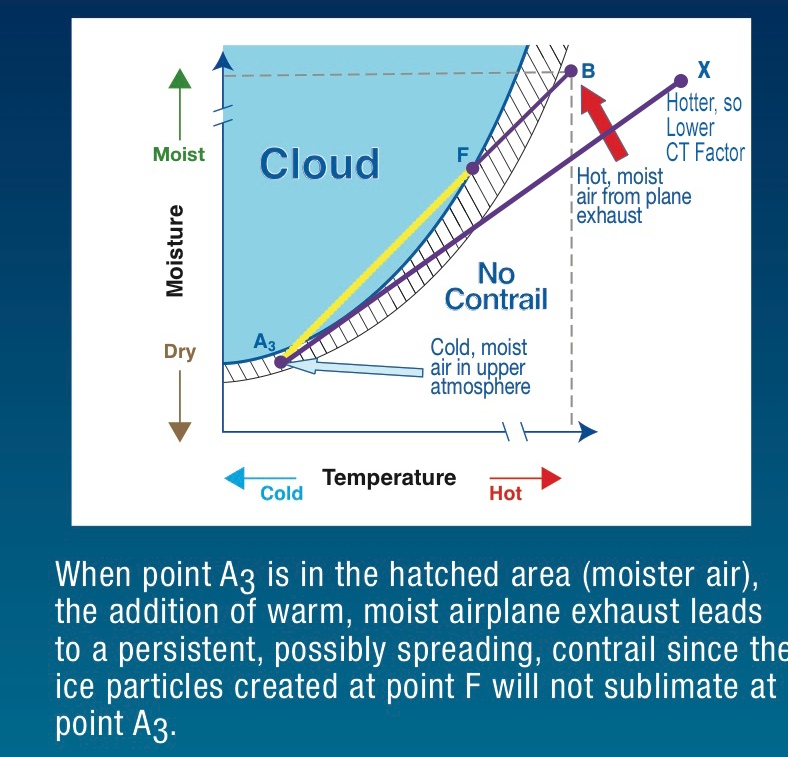
B is the exhaust of an efficient engine. X is less efficient, the exhaust is hotter. Point A3 is ambient air. If the ambient air is cooler, then the line will pass through the "Cloud" (water supersaturation) region.

Dan Page
Senior Member.
After scanning through that patent, I am impressed at how thoroughly Rolls Royce has studied contrail formation, persistence, and it's effect on climate during the day and night. Nightime use would be most beneficial due to decreasing contrail formation and thus allowing the land below to cool, assuming there are no cloud layers below. The one problem I see is that the process involves reducing the efficiency of the engine by aprox 10% for the time period that flight is within the contrail forming area. Airlines operate on very thin margins, and even buy/lease new airplanes to get the most efficient aircraft possible (like the B787), so, unless they are penalized for making contrails, they are not likely to want to install these devices, which would themselves likely be costly if an engine has to be retrofitted.It has a very good high-level explanation of the formation and dissipation of contrails.
The patent idea is that engine efficiancy could be modified so as to, effectively, lower the Contrail Critical Temperature for the engine, thus moving the environment conditions from the "Always contrails" to the "No contrails" region on the Appleman Chart. Think of the Appleman Chart curved lines being movable. Less efficient engines have those lines further to the left (cooler).
The engine controller (pilot) may go for more power to maintain trust, or possibly, the engine parameters may not allow that.
The patent discusses routing soulutions to reduce contrails, and this is then another option.
But this is most definetely a positive step and maybe future engines will have these factory installed and they will operate without any pilot intervention, and reduce contrails significantly.
Marin B
Senior Member
I couldn't find mention of this patent anywhere on this site, so I'm adding it to the list. On the 9/11 Truth Movement FB page there was a discussion about Metabunk and one of the posters said:
"Apparatus and method for ejecting matter from an aircraft"
From a quick read, it's pretty clear that the purpose of the invention is to remove leaked oil from the engine:
It doesn't seem like the person even bothered to read the patent, maybe just saw the title and jumped to conclusions:External Quote:
If I could. I'm not sure what to think about the whole chemtrail thing BUT.. I would like to ask my West why is there a patent 5,104,069 there. This is a patent by Boeing for a apparatus & method for ejecting materiel from an aircraft - a sprayer. This is NOT crop dusting. It's a sprayer. I do not see to many Boeing Aircraft spraying low over farms.
"Apparatus and method for ejecting matter from an aircraft"
From a quick read, it's pretty clear that the purpose of the invention is to remove leaked oil from the engine:
It's common for attorneys who write patent applications to describe an invention more broadly than the original intended purpose, in case the invention is later used for a different purpose. That way the patent may have more value. So here, the title of the patent makes it sound like the invention has a much broader purpose than what the inventors probably contemplated.External Quote:
BACKGROUND OF THE INVENTION
Commercial aircraft include various fluid drain masts which eject fluids, such as oil, waste gases and other liquids, from one or more exterior locations on the aircraft. For example, on some jet engines oil from the engine gearbox is allowed to drain out of a mast located at the bottom of the engine nacelle.
A problem associated with conventional fluid drain masts results when the ejected oil or corrosive liquid contacts a downstream portion of the aircraft leaving an unsightly stain on the aircraft...
SUMMARY OF THE INVENTION
The present invention pertains to a device for ejecting fluid from an aircraft. In the following detailed description the present invention will be described for application in evacuating oil from an aircraft engine nacelle. It should be appreciated, however, that the present invention may be used to evacuate other fluids and gases from an aircraft.
From a quick read, it's pretty clear that the purpose of the invention is to remove leaked oil from the engine:
More specifically, the purpose is:
Removing leaked oil, etc., from the engine is already done with drain masts. This patent is simply a modification of that in order to prevent unsightly stains.External Quote:The present invention pertains to apparatus for ejecting matter, such as gases and fluids, from an aircraft so as to prevent the matter from contacting a downstream portion of the aircraft.
The great invention seems to simply be angling the drain mast downwards a bit, so it shoots away from the plane.External Quote:A problem associated with conventional fluid drain masts results when the ejected oil or corrosive liquid contacts a downstream portion of the aircraft leaving an unsightly stain on the aircraft.
Marin B
Senior Member
The great invention seems to simply be angling the drain mast downwards a bit, so it shoots away from the plane.
Maybe the 9/11 Truther will make his way over here and see that he got what he wanted


skephu
Senior Member.
Ken Caldeira has a patent for cloud formation and precipitation.
https://www.google.com/patents/WO2014082036A1?cl=en or https://www.google.com/patents/US9526216?cl=en
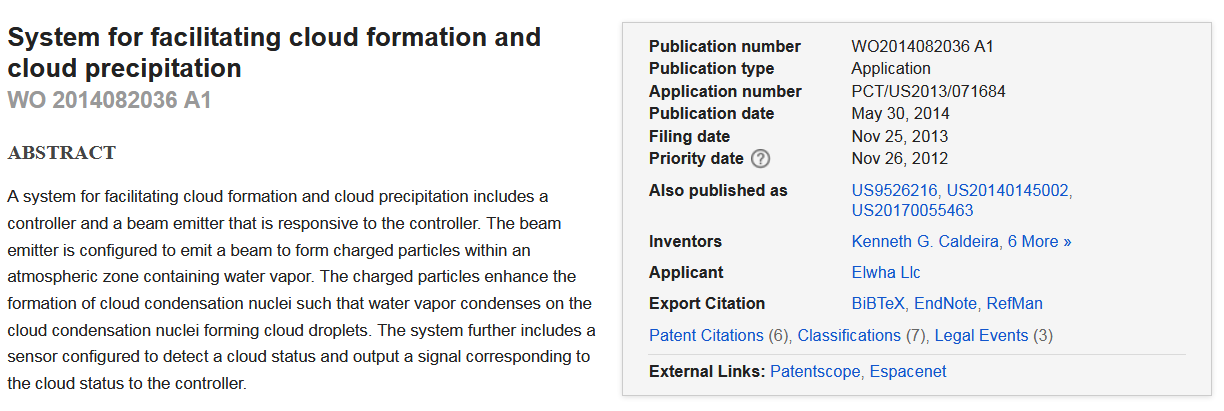
Good stuff for the chemtrail crowd
https://www.google.com/patents/WO2014082036A1?cl=en or https://www.google.com/patents/US9526216?cl=en
Good stuff for the chemtrail crowd
Ross Marsden
Senior Member.
I haven't read the full description, but from the Abstract, it looks like a wind-up for the chemmies.Ken Caldeira has a patent for cloud formation and precipitation.
https://www.google.com/patents/WO2014082036A1?cl=en or https://www.google.com/patents/US9526216?cl=en
View attachment 26814
Good stuff for the chemtrail crowd
Question is: why would he bother?

I don't think it's a wind-up. It sounds like cloud seeding by ionisation, which is the mechanism by which cosmic rays are thought to seed cloud formation, isn't it?
Ross Marsden
Senior Member.
Yes, that is correct.I don't think it's a wind-up. It sounds like cloud seeding by ionisation, which is the mechanism by which cosmic rays are thought to seed cloud formation, isn't it?
However, in the patent description he never mentions that the water vapor must come to saturation before it will condense on the CCN. He implies that water vapor will condense on CCN, regardless of the state of saturation (which he has instruments to measure - the only mention of saturation in the description).
Also, clouds droplets don't commence precipitation upon reaching some "critical size" which is what he states. They have a fall speed that depends on their size. All cloud droplets are falling, the smallest at maybe a few mm/sec; even they are "precipitating".
OK, on second thought maybe it is legit, but it appears to have been written by someone not altogether familiar with some very basic concepts of cloud physics.

Ray Von Geezer
Senior Member

Ray Von
Marin B
Senior Member
I saw that Rolls Royce has a recently published patent application for an Aircraft Vapour Trail Control System. The stated objective is. The background section has a pretty straight-forward explanation how contrail-cirrus form and the potential impact on climate. This might be useful information to share with a chemtrail believer who argues that today's jets don't create persistent contrails. If so, then why is one of the largest manufacturers of aircraft engines filing for patent protection on engines that can reduce contrail formation? Of course, the committed CT-believer will probably argue back that "they" are doing this only to make it look like today's jets still make persistent contrails...External Quote:to manage the formation of contrails by aircraft engines in a manner that reduces negative impact on the climate
Here's another patent from the airline industry, this time Boeing, that might be useful in refuting the chemtrail conspiracy myth that modern day jets don't create persistent contrails.
US 9311539 - Aircraft contrail detection
External Quote:
BACKGROUND
Condensation trails (contrails) are visible trails of water vapor that are created from aircraft engine exhaust. Contrails are often visible as white cloudy streaks across the sky, indicating a path recently traveled by an aircraft. The visibility of contrails, including the duration of time in which contrails remain visible before dissipating, is dependent upon various atmospheric conditions surrounding the aircraft, including among others, air temperature, barometric pressure, and humidity.
Because aircraft contrails form directly behind an aircraft and may be visible from anywhere from seconds to hours, contrails create a visual reference that points directly to the aircraft that creates them. Anyone that sees a contrail only has to follow the contrail to the end to see the aircraft that is the source of the contrail. For commercial and private aviation, this phenomenon is not a problem. However, for aircraft that are designed to avoid detection, a contrail can be a significant problem.

hmvmark
New Member
"It may be worth adding how much a patent costs. A couple of hundred pounds in the UK. http://www.ipo.gov.uk/types/patent/p-applying/p-cost.htm"I added it after you mentioned it, thanks!
If you'd have read the page you cited:-
The application process is:
complicated - only 1 in 20 applicants get a patent without professional help, expensive - with professional help, applications typically cost £4,000, long - it usually takes 5 years
If you get a patent, you'll also have to pay to renew it each year and the costs of legal action if you need to defend it.
Americanscan'tread.co.uk
Ray Von Geezer
Senior Member
If you'd have read the page you cited:-
Americanscan'tread.co.uk
Only after using a patented time machine.
http://web.archive.org/web/20140829103137/https://www.gov.uk/apply-for-a-patent
In 2014 it was £280, and apparently not so difficult. Thanks Brexit!
Mick is a Brit BTW.
Ray Von
Last edited:
Marin B
Senior Member
Another Rolls Royce patent application regarding mitigating contrail formation published last week.
It's not yet available on Google/patents, but when it is, presumably the link will be www.google.com/patents/US20180178920
When I had a conversation with a self-proclaimed chemtrail activist at a party earlier this year who brought up patents as evidence for chemtrailing, I regret not countering her argument with my knowledge of the Rolls Royce patents. Maybe next time...
Title & Abstract (I bolded the key sentence.)
It's not yet available on Google/patents, but when it is, presumably the link will be www.google.com/patents/US20180178920
When I had a conversation with a self-proclaimed chemtrail activist at a party earlier this year who brought up patents as evidence for chemtrailing, I regret not countering her argument with my knowledge of the Rolls Royce patents. Maybe next time...
Title & Abstract (I bolded the key sentence.)
External Quote:
United States Patent Application 20180178920
Kind Code A1
SWANN; Peter ; et al. June 28, 2018
Aircraft Electrically-Assisted Propulsion Control System
Abstract
This invention concerns an aircraft propulsion system in which an engine has an engine core comprising a compressor, a combustor and a turbine driven by a flow of combustion products of the combustor. At least one propulsive fan generates a mass flow of air to propel the aircraft. An electrical energy store is provided on board the aircraft. At least one electric motor is arranged to drive the propulsive fan and the engine core compressor. A controller controls the at least one electric motor to mitigate the creation of a contrail caused by the engine combustion products by altering the ratio of the mass flow of air by the propulsive fan to the flow of combustion products of the combustor. The at least one electric motor is controlled so as to selectively drive both the propulsive fan and engine core compressor.
External Quote:
Aircraft Electrically-Assisted Propulsion Control System
Abstract
This invention concerns an aircraft propulsion system in which an engine has an engine core comprising a compressor, a combustor and a turbine driven by a flow of combustion products of the combustor. At least one propulsive fan generates a mass flow of air to propel the aircraft. An electrical energy store is provided on board the aircraft. At least one electric motor is arranged to drive the propulsive fan and the engine core compressor. A controller controls the at least one electric motor to mitigate the creation of a contrail caused by the engine combustion products by altering the ratio of the mass flow of air by the propulsive fan to the flow of combustion products of the combustor. The at least one electric motor is controlled so as to selectively drive both the propulsive fan and engine core compressor.
That appears to be a hybrid electric/kerosene engine. You'd think that contrail suppression would be more a side benefit. I guess though that they could selectively kick in the electric motor when in Ice Supersaturated Regions, then recharge the batteries when not.
Similar threads
- Replies
- 116
- Views
- 19K

- Replies
- 10
- Views
- 2K

- Replies
- 2
- Views
- 894


- Replies
- 3
- Views
- 2K


