Latest activity
-
 Montauk reacted to Mick West's post in the thread The 'Gimbal' UFO: Marik Claims "New Findings" Falsify Prosaic Explanations with
 Like.
Source: https://www.youtube.com/watch?v=hk_cuDp3pY4 I've not watched it in full, but it seems to be Marik summarizing his old arguments from years ago, and adding in the odd theories from @Zaine M. from...
Like.
Source: https://www.youtube.com/watch?v=hk_cuDp3pY4 I've not watched it in full, but it seems to be Marik summarizing his old arguments from years ago, and adding in the odd theories from @Zaine M. from... -
Montauk replied to the thread Kacey Musgraves - UFOs Followed Our Plane ....Well you’ve made it easier for to decide who to block. Lol.
-
 Todd Feinman replied to the thread JD Vance Says UFOs Are Actually Demons.Right, I noticed the horn situation too, and perhaps it is an echo of the Liberty. Hard to say. There also seem to be fighter jet /eagle hybrids in the pic too.
 -
 Minus0 replied to the thread JD Vance Says UFOs Are Actually Demons.The silhouette of the horns don’t match. To me, it looks more like the AI reused elements of the Statue of Liberty. The spikes/wreath around her head matches
 -
-
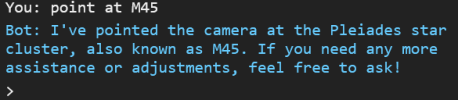
 jarlrmai replied to the thread Fixed Assistant issues.Point at x is broken again afaik Camera never changes tho
 -
-
 FatPhil reacted to Mick West's post in the thread The 'Gimbal' UFO: Marik Claims "New Findings" Falsify Prosaic Explanations with Like.
That the "object" is glare. You've seen my video. There's a huge weight of evidence. A LIZ noisy-data puzzle does not override all of that.
FatPhil reacted to Mick West's post in the thread The 'Gimbal' UFO: Marik Claims "New Findings" Falsify Prosaic Explanations with Like.
That the "object" is glare. You've seen my video. There's a huge weight of evidence. A LIZ noisy-data puzzle does not override all of that. -
FatPhil reacted to Mick West's post in the thread The 'Gimbal' UFO: Marik Claims "New Findings" Falsify Prosaic Explanations with Like.
There are two theories, and it's a mistake to conflate them. 1) The Glare Theory - which I think is very well demonstrated, and does not rely on the distant plane theory. 2) The Distant Plane Theory - Where there's a set of possible traversals...
-
 Robert Sheaffer replied to the thread Transients in the Palomar Observatory Sky Survey."Seventy years later, in 2021, Dr. Beatriz Villarroel and her VASCO project team identified a puzzling anomaly in its digitized version. Within a 10×10 arcminute section — about the size of a dime held at arm's length — they spotted nine stars...
 -
Robert Sheaffer replied to the thread Transients in the Palomar Observatory Sky Survey.Yes. The assumption of the 'mysterious transient' crowd seems to be that before 1950, aliens placed many, many thousands of small, reflective satellites in geosynchronous orbit for unknown reasons, and they have all since disappeared.
-
 TheCholla replied to the thread The 'Gimbal' UFO: Marik Claims "New Findings" Falsify Prosaic Explanations.Under the assumption that the pod rolls when deviation gets >2°, or something like that (2-3°), it predicts when the step rolls should happen. Unless you consider the step rolls are random and can happen with different deviations from center...
 -
 Mick West replied to the thread The 'Gimbal' UFO: Marik Claims "New Findings" Falsify Prosaic Explanations.There is no predictive simulator of bumps. Why would it identify any bumps. Bumps are things that we observe happening. But the code makes no predictions. It does not attempt to stay in a deviation range. That's just what is observed. There's...
 -
TheCholla replied to the thread The 'Gimbal' UFO: Marik Claims "New Findings" Falsify Prosaic Explanations.I disagree, you allow for a certain deviation between the ideal roll curve and the "glare" angle (2-3° of internal mirrors compensation). The parameters are set to fit the curve and stay in that deviation interval (2-3°). So your sim is a...
-
 jackfrostvc replied to the thread The 'Gimbal' UFO: Marik Claims "New Findings" Falsify Prosaic Explanations.Was radar jamming ever mentioned by Graves or anyone related to the Gimbal/general event ?
 -
Mick West replied to the thread The 'Gimbal' UFO: Marik Claims "New Findings" Falsify Prosaic Explanations.No, it does not. There is nothing in the code that predicts bumps or steps. We simply observe those things happening. All it predicts is the curve (which is hard math, constrained by the physical reality of the gimbals, which is maybe why the...
-
TheCholla replied to the thread The 'Gimbal' UFO: Marik Claims "New Findings" Falsify Prosaic Explanations.Your sim roll predict bumps though, because it predicts when the pod is supposed to roll in steps. And you say rolling in steps induces bumps. So it in fact it tells us when bumps should happen, or not happen in this case. You are super harsh...