Mick West's latest activity
-
 Mick West replied to the thread Kacey Musgraves - UFOs Followed Our Plane ....Kacey's reaction: Source: https://x.com/KaceyMusgraves/status/2043087174006911318
 -
Mick West reacted to Giddierone's post in the thread Photos of Clouds and Skies (That you took yourself) with
 Like.
Like.
-
Mick West replied to the thread Transients in the Palomar Observatory Sky Survey.I think the headline here should be that this new paper seems to prove the null hypotheses. As it says A Bruehl-style calendar-day comparison gives a descriptive post-test asymmetry (RR = 1.35, 95% CI [0.91, 2.00]), but that statistic is tied...
-
Mick West replied to the thread Starlink train over UK/EU 21:13 7/4/26?.Fixed! (2.44.6) Also, ICYMI, there's now a "Satellte Mode" under the Camera Menu that works a lot better when pointing the camera more straight up or down. Also, fixed that annoying judder when panning rotated camera.
-
Mick West replied to the thread Starlink train over UK/EU 21:13 7/4/26?.There's a bit of an issue with labels in the look view, which might be confusing things. I will fix.
-
Mick West replied to the thread Starlink train over UK/EU 21:13 7/4/26?.The stars are fine. The satellite is just a bit off. It's because it's a manually created TLE, made from visual observations. Based on that, the angular difference is perfectly acceptable.
-
Mick West reacted to HoaxEye's post in the thread Transients in the Palomar Observatory Sky Survey with Like.
A new paper has been submitted to ArXiv: Independent Recovery of Vanishing Sources on POSS-I Photographic Plates Using Automated Source Detection and Cross-Epoch Matching by Zachary Hayes Source: https://arxiv.org/abs/2604.04810 PDF attached. I...
-
Mick West replied to the thread Transients in the Palomar Observatory Sky Survey.It seems to be a query around the tile center, not stars. Vasco60 use the 90' as you have a default search_radius_arcmin: float = 90.0 in class SpikeConfig: and cli_pipeline.py:610 does not override it to 1.5
-
Mick West replied to the thread Transients in the Palomar Observatory Sky Survey.No, it's not. It's reducing the PS1 bright star fetch from 35' to 3.0' (which should actually be 45' to cover the 60x60' tile). The 90' is still there.
-
Mick West replied to the thread Transients in the Palomar Observatory Sky Survey.That's fixed in my version of the code, vasco/external_fetch_usnob_vizier.py Hunk 1 — default cap bumped: - row_limit: int = 20000...
-
Mick West replied to the thread Transients in the Palomar Observatory Sky Survey.But it seems in your code, the 5-arcsecond Gaia cone match is done before the PM back-propagation, and the back-propagation is then only applied to the sources that matched — i.e., the ones already eliminated as known Gaia stars. The sources that...
-
-
Mick West replied to the thread Transients in the Palomar Observatory Sky Survey.Your code also uses 90', is this to replicate their code? https://github.com/jannefi/vasco60/blob/5dbf452/vasco/mnras/spikes.py#L117 class SpikeConfig: rmag_key: str = "rMeanPSFMag" rules: List[Any] | None = None...
-
Mick West replied to the thread Transients in the Palomar Observatory Sky Survey.My (computer-generated) notes so far.
-
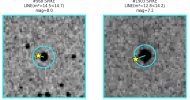
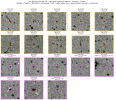
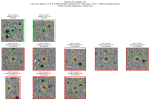
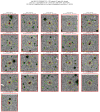
Mick West replied to the thread Transients in the Palomar Observatory Sky Survey.I got some of the code running and experimented with visualizing the filtering. What the pipeline is doing is finding all the blobs of light in the planes, and then rejecting ones that are known stars or that don't look like points of light...
-
-
Mick West replied to the thread Kacey Musgraves - UFOs Followed Our Plane ....Better quality videos extracted from Instagram for analysis