Angels as Clouds
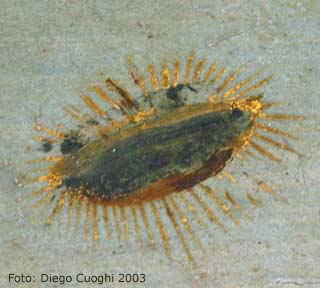
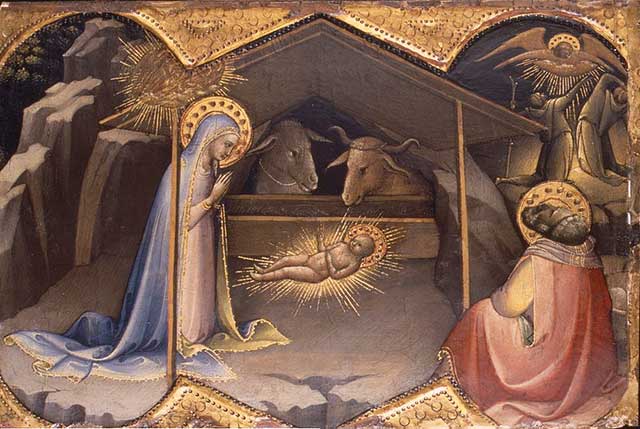
Most of the famous "UFO" paintings on this site turn out, on closer inspection, to be clouds. Not naturalistic weather clouds — clouds drawn by a Renaissance workshop as a pictorial container for the sacred: a mandorla-shaped white form with a sharp outline, often with an angel emerging, sometimes with beams of light and a dove descending. When a 21st-century reader, having grown up with flying saucers as the only cultural vocabulary for disc-shaped things in the sky, encounters such a cloud in a 15th-century Nativity, they read it as a craft. The painter intended an angel.
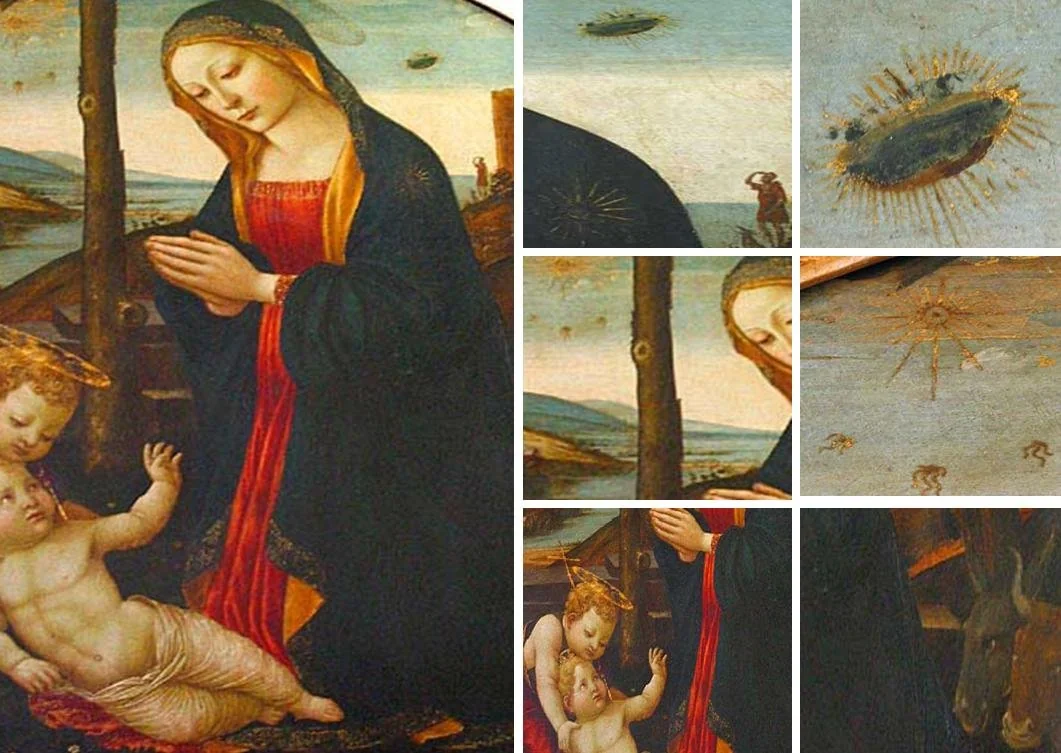
The image on the right is a close-range photograph of the "UFO" over Mary's shoulder in the Palazzo Vecchio Madonna with Saint Giovannino (c. 1485), taken by Diego Cuoghi in 2003. Visible around its rim are fragments of pure gold leaf (oro zecchino). Cuoghi's reading, which is the one offered here, is that the cloud was originally gilded in its entirety and that the gold leaf has largely flaked away over the intervening five centuries, leaving the dark brownish-grey paint layer beneath — the "leaden metallic disc" of the UFO literature. Restored to its 15th-century appearance, on this reading, the shape would have read as a golden aureole rather than a metal disc.
This essay traces the iconographic rule — bright cloud = angel/divinity — from its Hebrew Bible roots to its Baroque climax, then collects the parallels that make the rule visible as a rule.
1. Scripture: the cloud is how the divine is present
The identification is not an invention of the painters. It comes directly out of the Hebrew Bible, where the divine presence takes the form of a cloud more often than any other natural figure. God leads the Israelites through the wilderness as a pillar of cloud by day (Exodus 13:21). The Glory of the Lord descends on Sinai in a thick cloud (Exodus 19:16), and later fills Solomon's Temple so densely that the priests cannot stand (1 Kings 8:10–11). Ezekiel's vision opens with a "whirlwind… a great cloud, and a fire infolding itself", and the Son of Man in Daniel comes "with the clouds of heaven".
The New Testament continues the convention. At the Transfiguration "a bright cloud overshadowed them; and behold, a voice out of the cloud". At the Ascension "a cloud received him out of their sight". At the Second Coming "he cometh with clouds; and every eye shall see him". The shepherds in the field hear their angel while "the glory of the Lord shone round about them" — a phrase painters render as a glowing cloud every time.
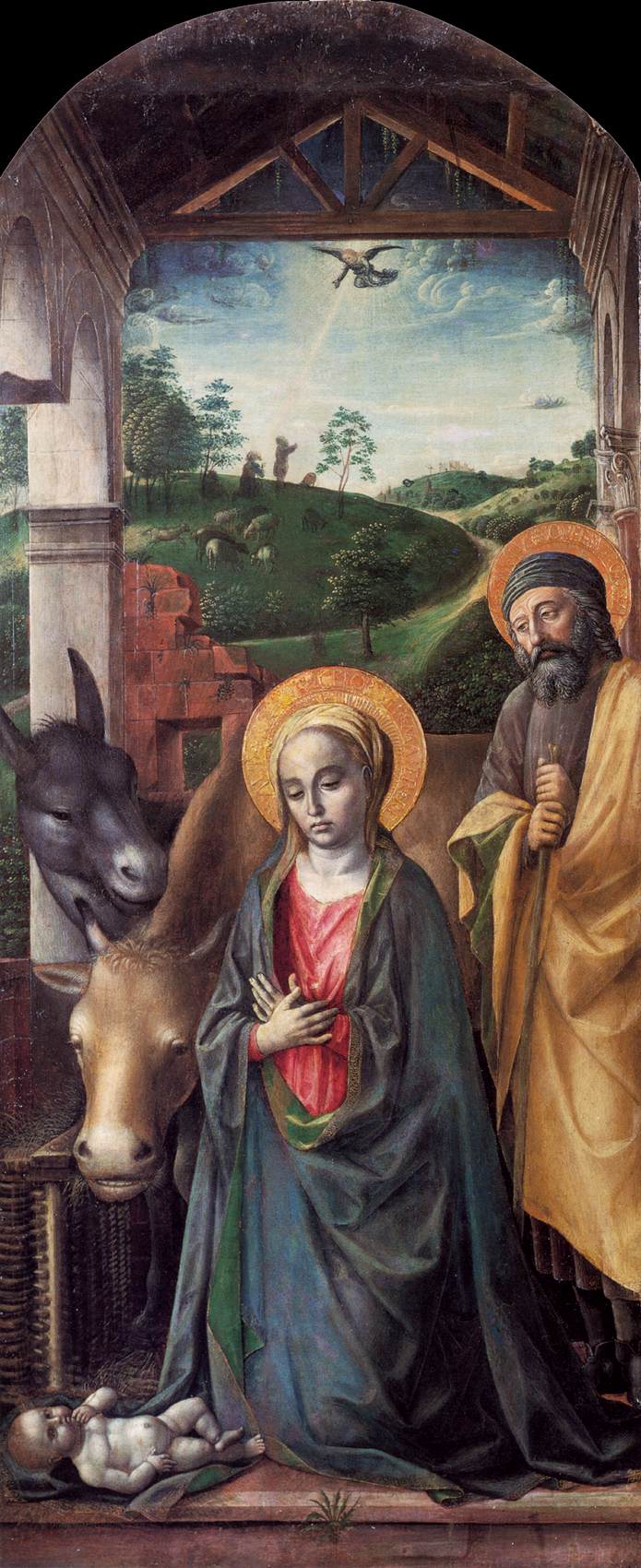
And the apocryphal Nativity in the Protevangelium of James (2nd century) gives the painters their single most reused image. Where Luke only has "the glory of the Lord", James has a luminous cloud that actually shelters the cave of the Nativity, so bright "the eyes could not bear it". That detail — light too strong to look at — is why, in hundreds of Nativities for the next fifteen centuries, a shepherd raises his hand to his forehead. It comes from James, not Luke.
"And, behold, a luminous cloud overshadowed the cave. And the midwife said: My soul has been magnified this day, because mine eyes have seen wondrous things… And immediately the cloud disappeared out of the cave, and a great light shone in the cave, so that the eyes could not bear it."
Protevangelium of James 19:2 (apocryphal, 2nd c.; Roberts–Donaldson translation) — the textual source for "cloud over the manger".2. The Fathers: why clouds?
The theological underpinning was given by Pseudo-Dionysius the Areopagite in the Celestial Hierarchy (probably late 5th or early 6th century), one of the most influential single documents in medieval angelology. Dionysius argues that Scripture shows angels in a deliberately veiled form so that the human mind, unable to look at pure divinity, can be led toward it through dignified symbols. Clouds, he writes, are among the best of those symbols — hiding a hidden light, carrying the first emanation of the divine, concealing and revealing at the same time. For every Western theologian and painter working after the ninth century, Dionysius is in the background of any serious picture of an angel.
"The Word of God attributes to them the appearance of a cloud, signifying, through this, that the holy minds are filled super-mundanely with the hidden Light, receiving the first manifestation without boasting over it as such, which they distribute ungrudgingly to the second…"
Pseudo-Dionysius the Areopagite — The Celestial Hierarchy, ch. 15 §6 (late 5th–early 6th c.; Parker translation, 1899).Marco Bussagli, in his Storia degli Angeli (Rusconi, 1991) and in the catalogue essays for Le Ali di Dio ("The Wings of God"), tracks this "Cloud Angel" type through Carolingian ivories, Ottonian manuscripts, the Utrecht Psalter, and into Trecento Italian painting. The essential iconographic lesson, in Bussagli's account: an angel is not mandatorily anthropomorphic. Very often, particularly in early and early-medieval art, the angel is the cloud — a radiant mass without a human figure inside. Later painters put a winged person inside, but the cloud stays.
"All things considered the Middle Ages turned out to be a central period for the development of the Angels iconography, whose solutions were to be re-interpreted in a markedly naturalistic way by the later culture of Renaissance and Baroque. Such is the case of the 'Cloud Angels', that would be later propounded as winged figures over soft cushions of vapour."
Marco Bussagli, Le ali di Dio catalogue essay, quoted in Diego Cuoghi, Arte e UFO? No grazie, solo arte — Parte 5 (2002).3. Early Christian and Byzantine: cloud-borne everything
In the Roman catacomb paintings and the early mosaic cycles — Santa Maria Maggiore (5th c.), San Vitale (6th c.), Santa Prassede (9th c.) — the hand of God emerges from a cloud, Christ ascends on a cloud, angels descend as clouds with faces barely emerging. The Byzantine mandorla, the almond-shaped halo of light that surrounds Christ in Majesty or the Transfiguration, is a codified version of the same idea: a cloud-shaped body of divine light.
Crucially, by the 9th century the convention is so stable that when a figure in an illumination stands inside a band of light with an angel next to it, no caption is needed. The viewer knows. That is what makes modern mis-reading possible: we have lost the visual literacy medieval people had.
4. Trecento and Quattrocento: the motif hardens into a standard vignette
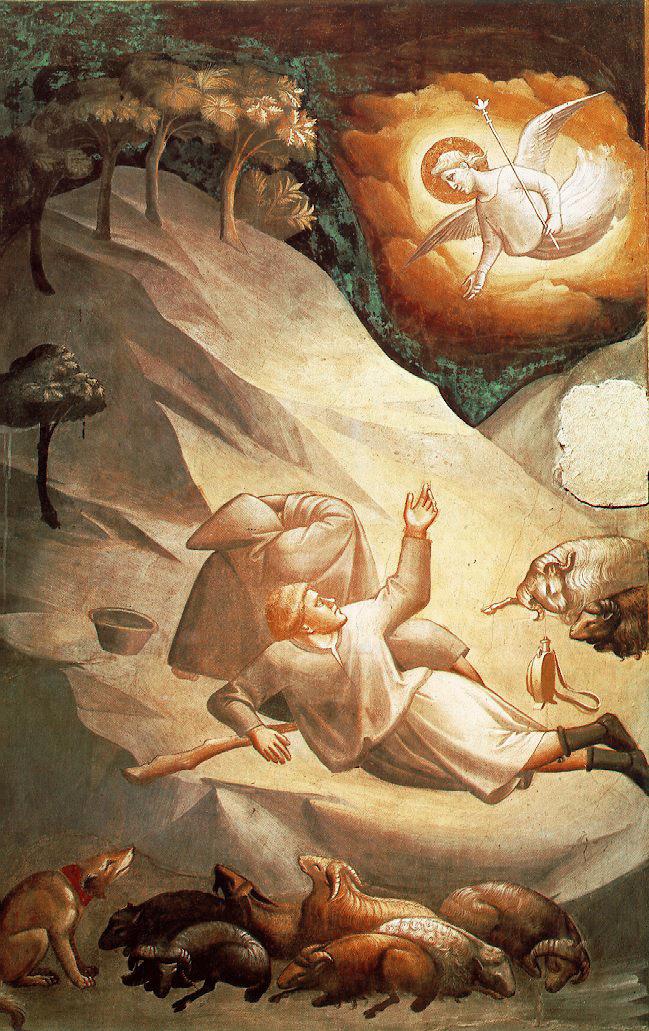
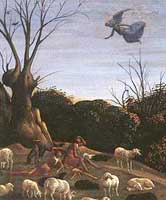
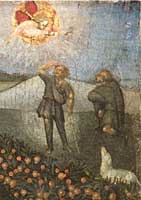
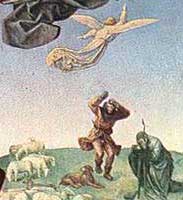
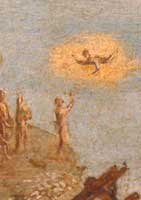
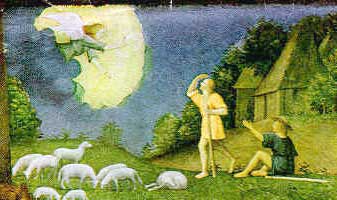
Italian Trecento painters fix the Annunciation-to-the-Shepherds formula in its classic form. Taddeo Gaddi's Baroncelli Chapel fresco at Santa Croce (c. 1328–38) shows everything that will recur for the next three hundred years: an angel inside a bright orange-gold cloud mandorla; a shepherd on the ground, leaning back, one hand raised to his forehead; a dog at his feet, mouth open, alarmed by the light. Giotto, Duccio and the Lorenzetti brothers work similar formulas.
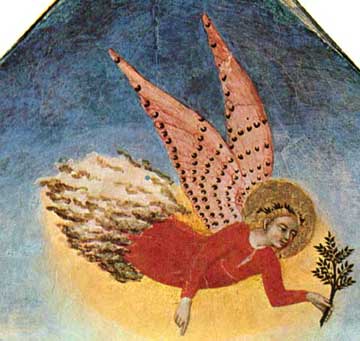
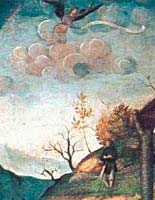
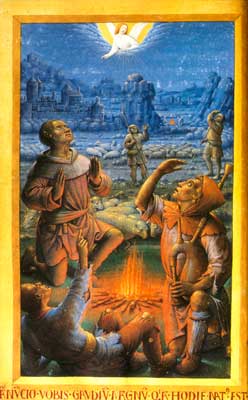
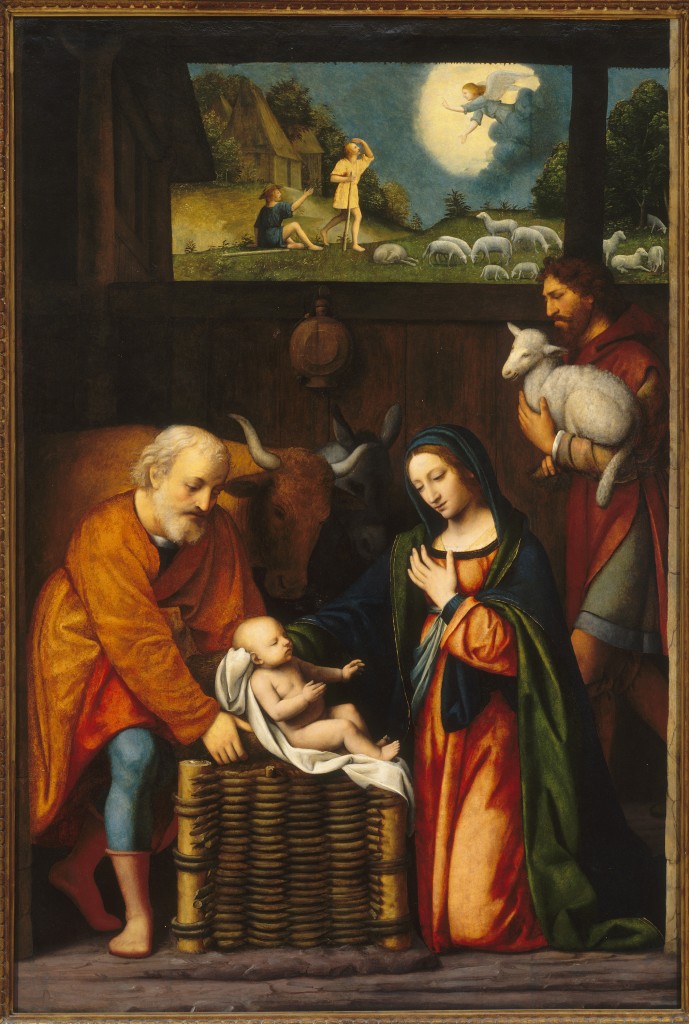
A century later, the Florentine Quattrocento workshops — Ghirlandaio, Lippi, Botticelli, di Credi, Mainardi, Sellaio — treat the vignette as a stock assembly. You can see the same angel-cloud-shepherd cell repeated across paintings that have nothing else in common with one another, dropped into Nativities as a kind of narrative widget. Fra Angelico systematises the larger "opened heavens" in his Annunciations; Sano di Pietro paints the angel literally made of cloud, emerging from the vapour at the head. The Sforza Hours (c. 1500) reduces it to a manuscript-miniature cloudlet full of cherubim over a tiny Nativity.
5. Cinquecento: from vignette to engulfing heaven
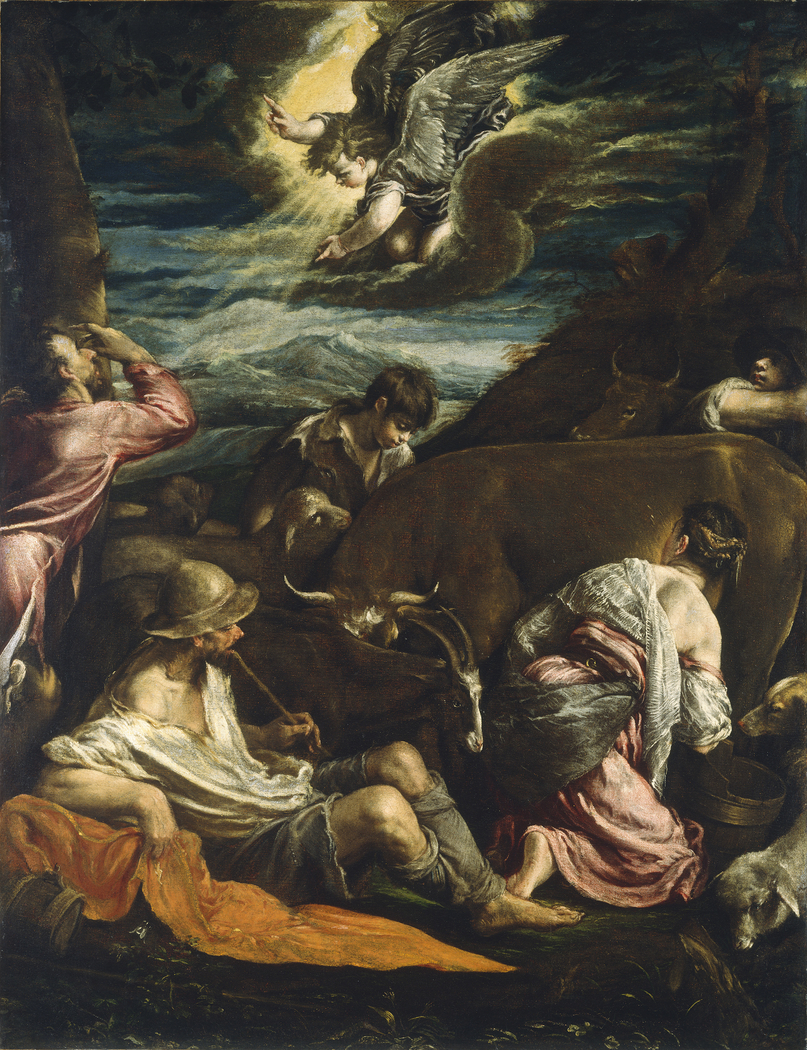
In the Cinquecento the cloud expands in scale. Raphael's Sistine Madonna (1512) stands on a mass of cherub-heads you can only read as cloud. Correggio, in the dome of Parma Cathedral (1526–30), fills the entire architectural space with a whirl of cloud-borne figures around Christ ascending. Jacopo Bassano in his Venetian Annunciation-to-the-Shepherds (c. 1560) makes the cloud a theatrical burst of gold and dark blue, the angel plunging out of it. Every painter is working off the same grammar: the cloud is the carrier of the sacred.
6. Baroque: the "soft cushions of vapour" Bussagli describes
By the Counter-Reformation the cloud has become scenery in its own right. Bernini's Ecstasy of Saint Teresa (1647–52) is a scooped-out marble cloud carrying both saint and angel. Andrea Pozzo's ceiling for Sant'Ignazio in Rome (1685–94) makes an entire sky a roiling cloud populated by saints, angels and the Trinity. Tiepolo, working into the 18th century, treats cloud and angel as interchangeable — an angel arrives by being a cloud with features.
Aert de Gelder's Baptism of Christ (c. 1710), routinely cited today as a UFO painting, sits squarely in this tradition. A dark cloud-rim frames a luminous opening, rays of grace descend, and the Holy Spirit dove is at the centre of the rim. Rembrandt's pupil is using the same vocabulary Pozzo is ballooning across his ceilings — just compressed, Northern, and moody.
7. Why the motif reads as a "UFO"
The cloud-angel depends on two things the modern reader has usually lost: (a) the Dionysian theology that makes cloud a dignified symbol of divinity, and (b) the visual training a medieval or Renaissance viewer received by absorbing hundreds of examples from childhood. Strip those two and you are left with a bright, sharply-outlined, often lens-shaped form, with beams of light, sometimes suspended in a landscape — which is exactly the post-1947 shape-vocabulary for a "flying saucer".
Two further accidents help the mis-reading along. First, on this particular painting the gold leaf that covered the cloud has flaked away, leaving a bare brown-grey paint layer that looks metallic. The "UFO" in the Palazzo Vecchio Madonna with Saint Giovannino is the case in point — fragments of oro zecchino are still visible around its rim. Second, the detail-crops that circulate online strip the shepherd, the dog, and the angel from the vignette, leaving only the cloud isolated and unmoored. Both of these are accidents of reception. Neither changes what the painter drew.
8. The test
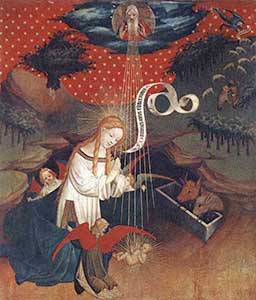
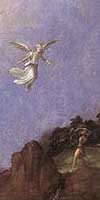
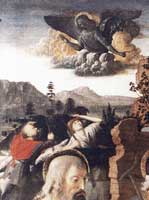
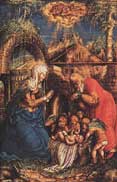
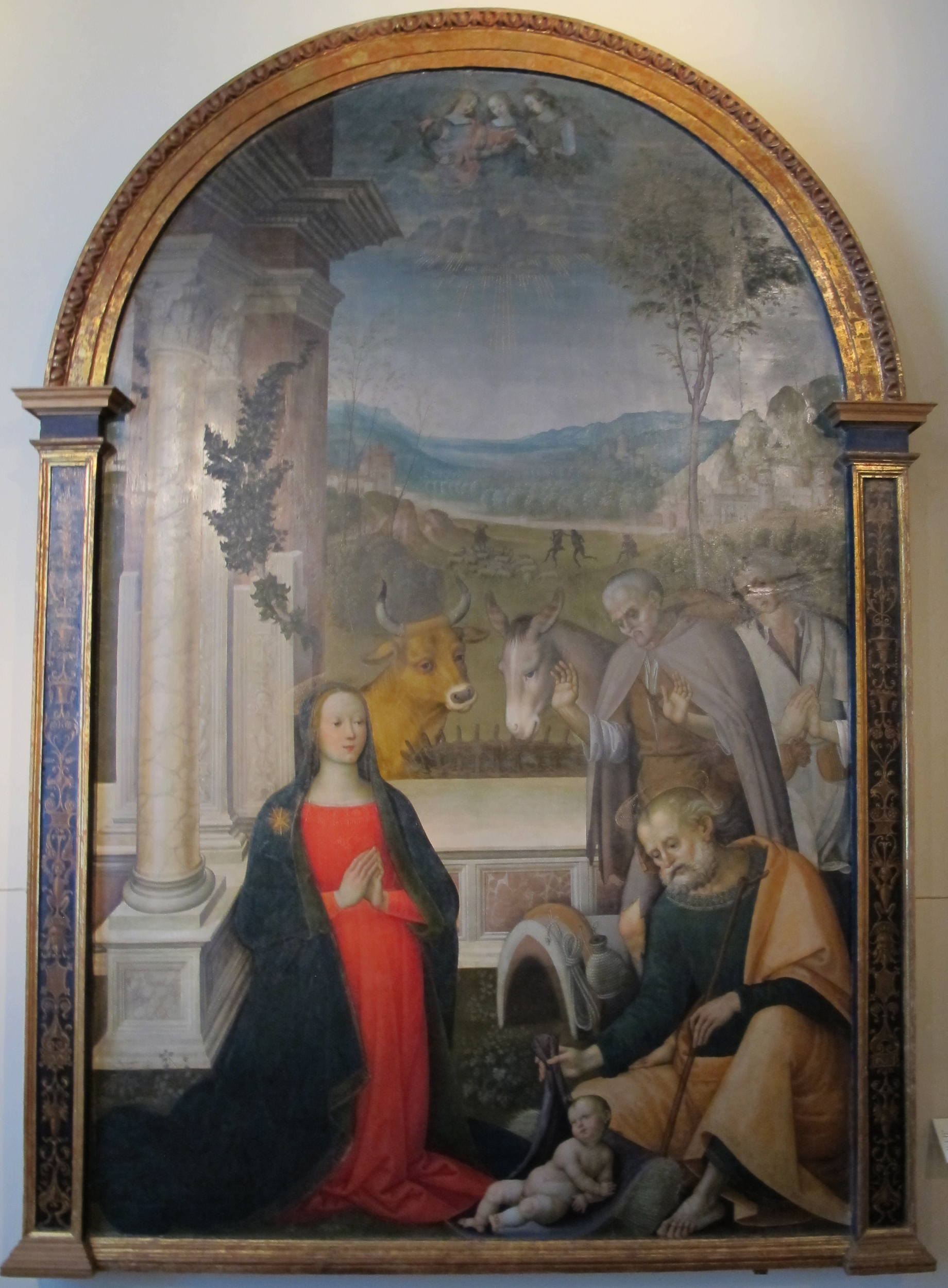
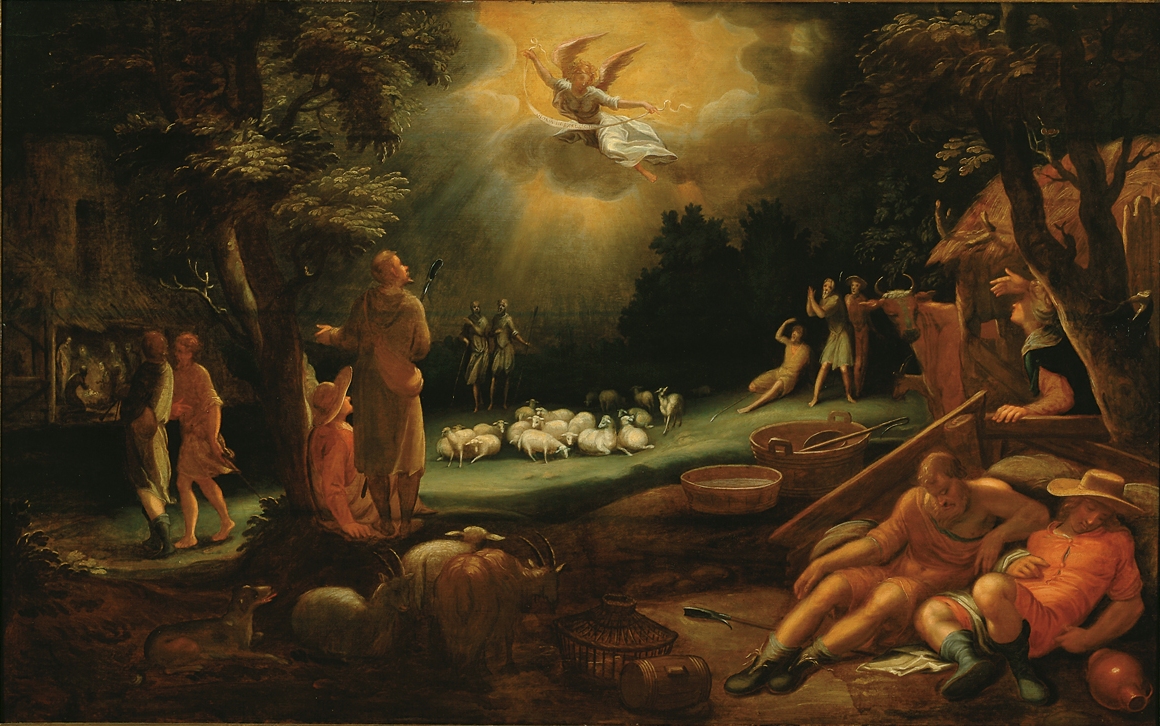
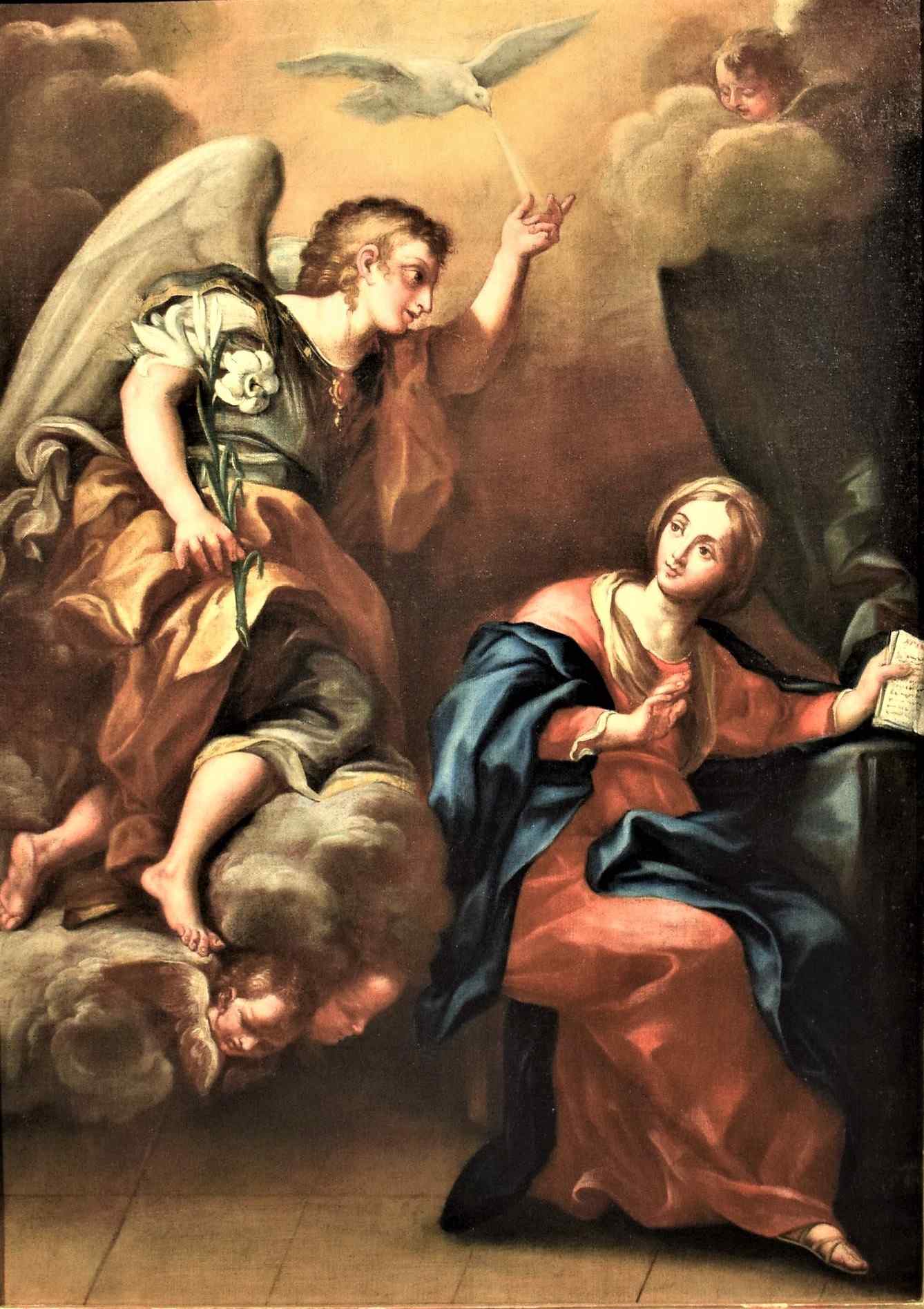
If the cloud-equals-angel rule is real, you should be able to predict where angels appear in Western sacred painting just by finding luminous outlined clouds in the sky above a sacred scene. In practice this is exactly what you can do. A grid of parallels is worth a thousand words. Below are workshop-detail crops and miniatures pulled from works spread across three centuries and half a dozen regional schools. In every case, the shape the UFO literature would call a craft is functioning as the pictorial container for an angel.
Further reading
- Pseudo-Dionysius the Areopagite, The Celestial Hierarchy — the theological core of the cloud-angel type.
- Marco Bussagli, Storia degli Angeli (Rusconi, 1991), and the exhibition catalogue Le Ali di Dio. Messaggeri e guerrieri alati tra Oriente e Occidente (2009) — the modern monographic treatment of angel iconography, including the Cloud Angels type.
- Protevangelium of James — the apocryphal Nativity whose "luminous cloud over the cave" supplies the formula for the shepherd shielding his eyes.
- Mandorla — the almond-shaped cloud-of-light body halo that is the Byzantine-Medieval codification of the same idea.
- Annunciation to the Shepherds — Wikipedia — the specific Gospel scene that carries the motif through Western painting from the Trecento onward.
- Diego Cuoghi, "Art and UFOs? No thanks, only art — Part 5" (2002) — the original argument on the Palazzo Vecchio Madonna, with the Protoevangelium citation and the Bussagli quote.
- James Hall, Dictionary of Subjects and Symbols in Art, rev. ed. — the standard working reference; see entries on "Cloud", "Angel", "Annunciation", "Annunciation to the Shepherds".